Cultural Glimpse

Enjoying diversity

The Power of Diversity at Beaumont

I traveled quite a bit before I got married and had children, visiting various countries in North Africa, the Middle East, Europe, and Latin America. I loved what I learned from watching peoples’ different way of life, and I always returned home having borrowed something to incorporate into my daily life.

What I learned after I stopped travelling abroad is that what my Native American teacher often said is true – “If you stand on the corner of New Year long enough, you will see the whole world.”

For years, my community has been fulfilling my desire to see the world by bringing it home. Yesterday morning, for instance, Beaumont Hospital held its 8th year Diversity Conference. The event was amazing!

Through slam poetry and hip-hop performances, Mike Ellison spoke words of love and acceptance that touched our hearts so deeply, we laughed and we cried. Then with DJ Invisible, the rhythm and beat of love got attendees on their feet, in their professional attires, grooving to Mike’s powerful lyrical message at the early hour of 8am. Anyone watching would have thought we had a little more than coffee and bagels for breakfast.

“Hip hop is a culture with roots in Africa,” said Ellison, who was born in Ethiopia, raised in Virginia and who fully realized himself as an actor, recording and performance artist in Detroit. “It’s progressive. It’s about respect and family. It’s not what you see today in commercial rap.”

Mike recently wrote, produced and performed in Broken Mirrors: Bullies & Bystanders. He uses his talents to reach out to students, to get their attention despite the millions of distractions around them. He wants people to see how we mirror each other.

“If we see ourselves in each other, then we are using the universal language of inclusion,” he said.

The next speaker was Chris Bashinelli, and no one imagined that a man who has not yet turned 28 would move us to the extent that he did. Chris was born and raised in Brooklyn, New York. After a decade long acting career including an appearance on the hit HBO TV Show – The Sopranos, he decided to follow his real passion, using media to bridge intercultural gaps worldwide. He now traverses the globe from Tanzania to Abu Dhabi as Host of Bridge the Gap, a new series featured on National PBS Television, where he discovers what it’s like to walk in someone else’s shoes for one day.

Christ talked about what it means to be a global citizen.

“It means being a productive member of our world,” he said. “It’s using our talents to serve others.”

We serve others by three simple steps: listening, being non-judgmental, and being willing to step outside of our comfort zone which is the only way to grow. But why should we bother to become a global citizen?

“Because the lives of people in economically poor countries are 100 percent directly related to our lives in the United States,” said Bashinelli. “Global citizenship does not mean changing geographic location. It means changing your heart. Changing your focus from me, me, me, to look at another person.”

Chris showed us videos of the people he met in other countries, people whose huge, courageous and enduring hearts were a magnificent example for us. One man that particularly inspired me was a man from Tanzania. He wanted to be a filmmaker and show the beautiful side of his country. He had very little resources, in comparison to us at least, but the power within him gave him the strength to work as a filmmaker in his own community because what he kept telling Chris is, “No matter what, I’m going to be a filmmaker. No matter what!”

The next speaker was Steve Luxenberg, a Washington Post associate editor who has worked for more than 35 years as a newspaper reporter and editor. Steve is the reason I went to Beaumont’s Diversity Conference to begin with. I had gone the night before to the Troy Community Center to listen to him talk about his award winning book, Annie’s Ghosts: A Journey into a Family Secret. Impressed by his talk, I visited his website to order his book. This led me to discover an event he was speaking at the next day – the diversity conference.

Steve’s story is part a detective story, part history, and part memoir and it revolves around his mother’s decision to hide the existence of a sister, Annie, who was institutionalized for 31 years in an asylum near Detroit. Through his book, he helps us see the potential damage of secrecy within families and the shame and stigma associated with certain issues that keep , for example, families from obtaining a patients’ medical records long after the patient has died.

He quoted something that Governor Calley, who has a daughter with autism, said recently. “We should stop trying to fix people with a disability. Autism is not a disability issue. It’s a diversity issue.”

“Today in jail, we place people with mental issues in segregated areas,” said Luxenberg. “It was like this in the 1840s. People in the future will wonder why we allowed this today. The way to make progress is to look into the past and learn from it so that we don’t make the same mistake in the future.”

The event had one more speaker, Cheryl Loveday, Executive Director of Angels’ Place, which provides community-based and residential services to nearly 200 individuals with developmental disabilities. I did not have the privilege of listening to her speak as I had to return home. But when I walked out of the event, I was grateful that my family and I and the majority of my relatives belong to Beaumont Hospital’s Healthy System, which has been serving us for decades, and which evidently from the quality of this conference, cares a great deal about having a healthy and conscientious relationship between its employees and its patients.
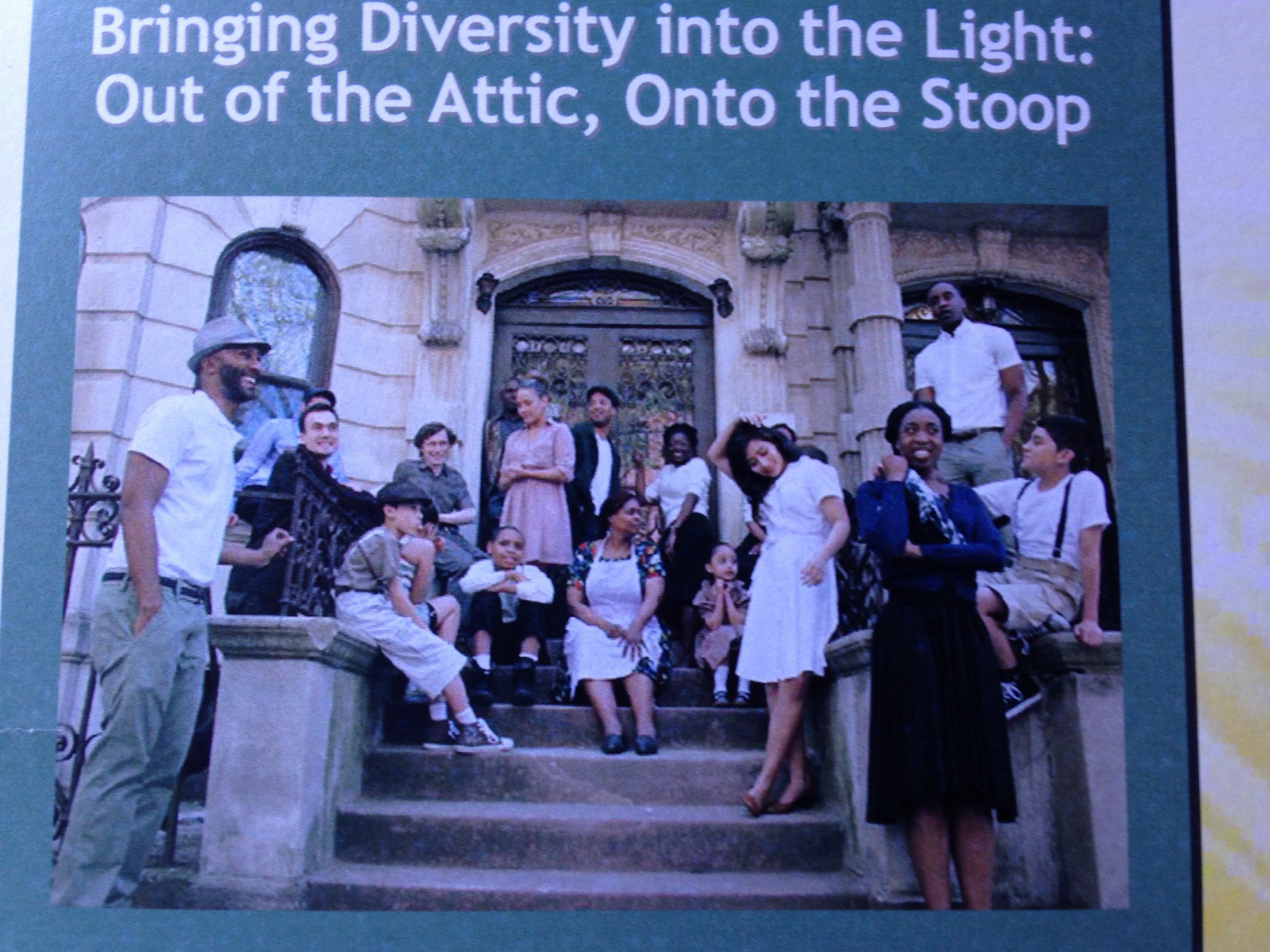
Beaumont Event Program Booklet

Beaumont Event Program Booklet
The Blessings of a Henna Party

My husband’s niece had her henna party last weekend and it was fun and meaningful. For me, henna parties have become much more exciting to attend than weddings. Aside from the fact that they are filled with so much tradition, in our Chaldean community henna parties are much more intimate (with about 200 guests) whereas the weddings are, in my opinion, a bit overcrowded (at 500 guests and up).

Despite the small number of guests (at 200), one of the most important pre-weddings ceremonies in Arab and Hindu weddings is the Henna Party. A Henna Party represents the bond of matrimony and signifies the love and affection between the couple and their families. It is believed that henna gives blessings, luck, and joy.

The ceremony is a colorful, musical and lively event. The women dress in extravagant, heavily embroidered gallabiyas and the men wear a dishdasha and a 3-piece head cover. Large trays of fruits and nuts, sweets, and chocolate are carried by the women as they lead the future groom to his future bride.

The bride and other females get decorative henna designs on their hands. According to tradition, the darkness of the henna color on the bride’s hands represents the deep love between would-be-couples. Another tradition says that the bride is not allowed to work in her marital house until the time her henna fades away. Then it is work nonstop (no tradition says that, but any wife or mother understands what I’m talking about). Any wife or mother also knows that it’s all worth it, and the henna and other pre-wedding celebrations are beautiful steps that walk us into our new world with enough blessings to last us, and our children, a lifetime.

Sally's Henna

Serving Our House through Journalism

Photo By: Vickie Thomas

Left to write: Marlon Walker of the Detroit Free Press, Weam Namou, and Charlie LeDuff of Fox News, and moderator Kathy Chaney, Producer/Reporter at WBEZ 91.5FM              (Photo by Vickie Thomas)

While in my birth country ISIS continues to wage war against journalists, here in the United States journalism continues to flourish, opening doors to new voices – as is the tradition of the United States.

It’s true that a lot of minority groups in America do not receive the air and press time they deserve. But it is also true that in America, there is an opportunity for people to break the mold without risking their life. Here, an association of black journalists says “welcome” to an Iraqi-American journalist like myself, because what they see and appreciate in each other is the heart of journalism, which is an appetite for truth and education, an appetite which journalists in many other countries cannot dare quench.

On October 11th, at the 2014 NABJ Conference in Detroit, sitting on the panel next to award winning reporter Charlie LeDuff of Fox News and reporter Marlon Walker of the Detroit Free Press, listening to the easy and lively manner in which they spoke about how they dealt with “Conflict in the Community”, the topic of our discussion, I realized that a large part of the problem many Middle Easterners and Arabs have is inner conflict. Born and raised under authoritarian regimes, they have difficulty expressing their truths in constructive ways. Rather than influence public opinion and government policy, they try to influence each other – which often builds tension within their own communities rather than create progress.

Investigative Journalism is such a phenomenon in the Arab World that Arab Reporters for Investigative Journalism (ARIJ) based in Amman, Jordan describes it on its website as “still an alien practice.” Many journalists from that region who growing up, were told to “Hush!” and “Mind your own business” have wounds to heal before they can grow wings like the American journalists who were told to “Speak up!” and “Dig for the truth”, who like Charlie LeDuff can confidently say, “This is my house too! We’re all living in the United States, sharing it.”

It is when people from the Arab world, who over the last decade have become one of the fastest growing ethnic groups in the United States, fully comprehend, appreciate and believe in the words “This is my house too!” that we will best serve this house through journalism.

To Our Countries

“To Our Countries” is a project produced by a group of youths who live in Sweden and are originally from Syria, Iraq, Lebanon and Palestine.

The song expresses different parts of the Middle East. Here’s an excerpt about Baghdad:

 In Iraq there has been a liberation for more than 10 years.  A liberation from injustice, oppression and tyranny that came with a greater tyranny, injustice and oppression, where the people of the country were all expelled.

A liberation that divided what was already divided and what broke what’s already broken. A liberation where civilizations cease to exist. A liberation which all Iraqi citizens were marginalized regardless of their ethnic or religious background.

A liberation that enslaved people and demolished homes. One that killed the human and the motherland.”

I have the right to peace of mind

I have a right to peace of mind

Give Americans Some Slack, Not Jail Time

Chained Slave

On Monday, an L.A. Judge announced that a 74-year-old grandmother would be released from prison after serving 32 years for a murder she did not commit. In 1981, Jones’ abusive boyfriend kidnapped two drug dealers and then forced Jones at gunpoint to drive them into an alley, where the boyfriend shot one of the men. Jones ran from the scene, expecting to be killed too. Instead, the teacher’s aide and churchgoer with no criminal record was charged with and convicted for two counts of murder and other crimes.

Also on Monday, the Real Housewives of New Jersey Teresa Guidice, a mother of 4 children, was sentenced for 15 months of jail time for fraud charges. Her husband was sentenced to 4 years.

The majority of Americans are hardworking people who try to give back to the community. They want to do the right thing, they try to help, they pretty much follow the rules, which is not so easy given the number of rules they have to follow. They are good people, and yet they get slapped pretty hard for being human and making mistakes or in Jones’ case, being caught in the wrong situation.

“Over-incarceration in America destabilizes families and communities,” writes Piper Kerman, in Orange is the New Black. “We have a racially biased justice system that over punishes, fails to rehabilitate and does not make us safer.”

Read Amanda Scherker’s article in the Huffington Post and you will see how easily a person can be locked up as a “criminal” for a non-violent offense, which not only ruins his or her life but that of his family, and in return affects us greatly as a community while making corporations quite rich. http://www.huffingtonpost.com/2014/06/16/us-prison-size_n_5398998.html

It’s pretty scary! According to the article, the total prison population has grown by 500 percent over the last 30 years. Currently, one-third of the world’s entire imprisoned female population is awaiting trial or serving sentences in the U.S., mostly for nonviolent crimes. Many are mothers. And we lock up more juveniles than any other developed country.

Americans do not deserve this type of harsh treatment – especially not while the real criminals are out there, happily sauntering around, living rich off of others’ destruction.

In Honor of International Peace Day

International Peace Day

“We invest in chaos because chaos is more profitable than peace,” said Greek composer Vangelis.

Hmmm, everything is making sense now. Luckily, there are many people around the world who opt for peace over profit. Today at church, for instance, the Pastor talked about The Book of Ruth, and how in several chapters of the book, everyone is looking for the best interest of everyone else.

“This is remarkable, and it’s very rare,” said Pastor Aaron. “What would happen if we all lived like Naomi, Ruth, and Boaz? What if as a family we all look for the best interest of each other, beyond the pain? What if as a church we look out for other churches and their pastors and their congregations? When people walk around thinking only of themselves, it becomes a toxic environment for other people.”

He added, “When I go into a season of discouragement, I get out and start thinking of someone outside of me. This is when I begin to get healthier.”

Are you up for a healthier spirit?

Happy Belated Grandparents Day!

Mom (4)

I’m one of the many who did not celebrate Grandparents Day on September 7th. But in my defense, my grandparents have long ago passed away, and my mother, who is geographically the only grandparent available to my children, is a strong part of our life. We celebrate her presence regularly.

What I noticed was that no major store advertised for Grandparents Day. No local activities were set up in its honor, and if they were I totally missed it. No noise was made about it, as it happens for Halloween, Mother’s Day, Father’s Day, and Valentine’s Day, to name a few.

This says a lot about how our society views our elderly. We overly focus on one type of people, like youth, which in turn creates an unbalanced society. The wisdom an elderly has to offer is invaluable. If we tapped into their rich minds, hearts and spirits, we would come out a richer civilization.

Utilizing the Constitution to Stop ISIS

OLYMPUS DIGITAL CAMERAWhen I picked up my kindergartner from school the other day, he was wearing a white, red, and blue paper hat he made in class. I asked him what it was for, and he said, smiling, “It’s constitushi day.”

“What?” I asked.

“It’s constitushi day,” he said with an even bigger smile.

“Mom, it’s Constitution Day,” my daughter explained.

I was glad that the teachers had the children pay special attention to this important day, so kids can learn the value of the constitution at an early age. As drafted, the Constitution’s purpose was to create a government that had enough power to act on a national level, but without so much power that individual’s fundamental rights would be at risk.

But many adults need to revisit the values of the Constitution, and act upon this privilege that in many countries is obsolete. Having been raised under Saddam’s totalitarian regime, I can tell you that people in the United States do not fully utilize the political freedoms bestowed upon them.  Oftentimes this freedom is taken for granted. If that continues, I’m afraid that one day we will see ISIS strolling around in our neighborhoods.

“ISIS is here, they’re capable of striking,” CNN national security analyst and former CIA operative Bob Baer

Have we Turned 9/11 into a tradition rather than a lesson?

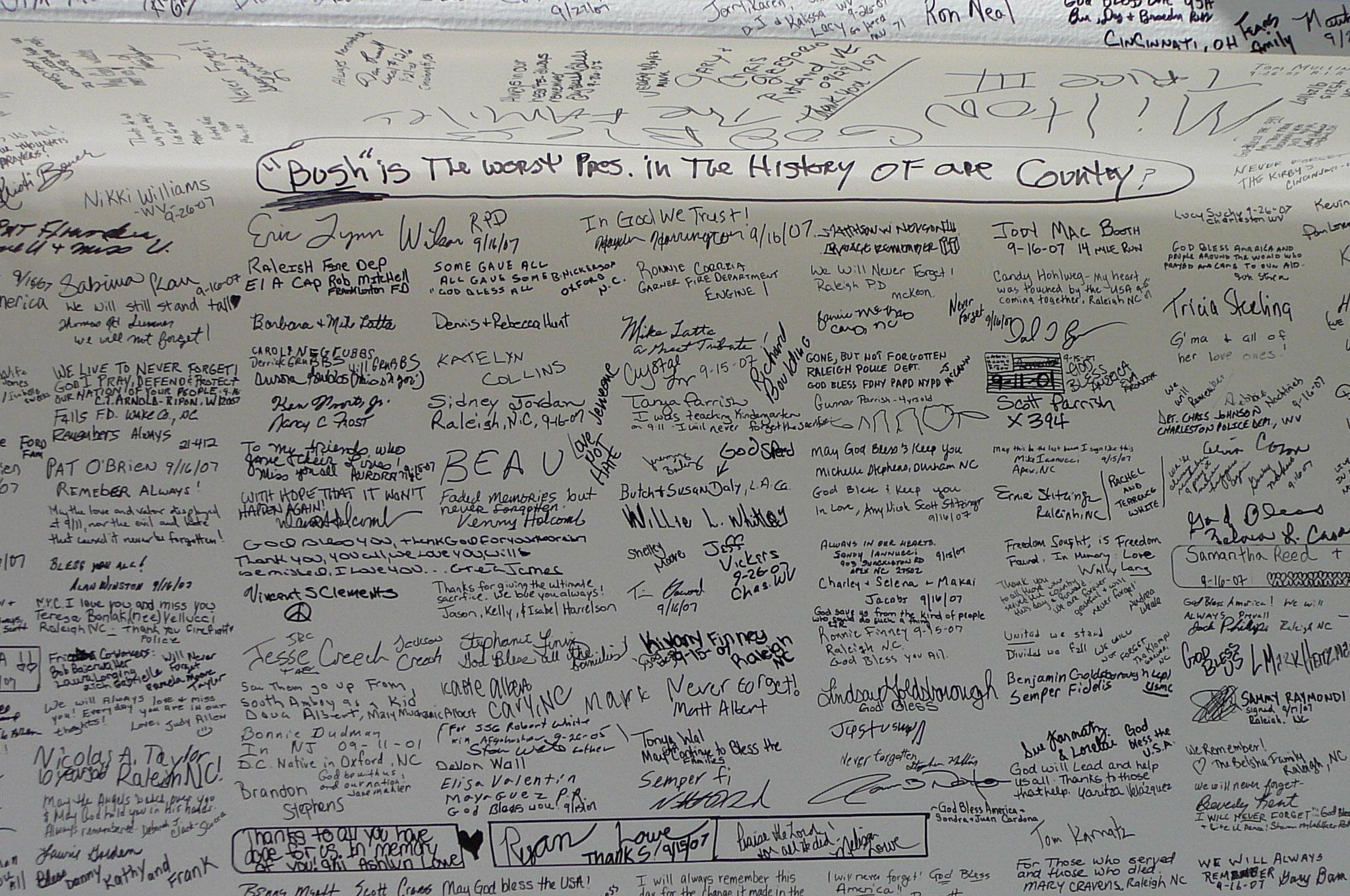
911 (signed names)

I watched the ceremonies performed yesterday in honor of those who died in the 9/11 terrorist attacks. Across the country, the names of victims were called and people stood in silence to remember the dreadful events of that day. Broadcasters  talked about how the “threat of terrorism” still lingers on 13 years later, and I wondered, what lesson have we learned from this attack, if we learned any lesson at all?

The 9/11 Commission left many questions unanswered because of the initial destruction and removal of evidence and the budget being limited to $15 million, whereas $30 million was given to dig up the dirt in the Bill Clinton Monica Lewinsky scandal. In order to really honor the victims, we should make a greater effort learning a lesson from the events that led to their loss – not just perform ceremonies.

Where’s the Doritos?

“I feel so bad for the squirrels,” my sister said. “The trees were not very fruitful this year so they don’t have enough to eat.”

“Oh, that explains why they’ve been gathering at my patio,” I said, and told her how today, for instance, a squirrel came by and fought to open my can of Pam near the barbecue grill. He rolled with it until it fell onto the grass and he jumped after it. Ten minutes later, I found its red lid on top of the swing set.

I also told her how a few days ago my children forgot a bag of Doritos outside overnight. In the morning, a squirrel appeared, sniffing around until he reached the Doritos bag. He ate from it, and then his friends came and ate from it. The next several days, different colored squirrels stopped by looking for food. In the past, I have given them bread, cookies, cereal. But at one point, they started to get too close for comfort, coming right up to my slide door.

“If the trees are not fruitful,” I said to my sister, “how come this year I have seen more squirrels than ever before in this area?”

She pondered on that, but had no answer. I think in America, everyone is fed well, even the squirrels.

IMG_2087