Cultural Glimpse

Enjoying diversity

Category: Culture

Real Talent Lives in My Neighborhood

Sabah Wazi 2Today I went to Wazi’s Rug Shop to pick up a gift that talented artists Sabah Selou Wazi made for me. Sabah is one of sixteen artists I interviewed for my upcoming book, Iraqi Americans: The Lives of the Artists. Because the shop is only a few blocks from my house, I mostly interviewed Sabah at his shop.

Each time I go into the shop, I feel I’m entering a small museum. Sabah has a studio in the back of the and his artwork is displayed in various corners in the front. Being surrounded by Babylonian and Sumerian artwork makes you want to wander around, and basically, not leave. When visitors admire his work, Sabah takes the opportunity to introduce and educate them to the rich history and culture of Mesopotamia. Doing so has become dearer to him since the horrific attempts to destroy Iraq’s heritage.

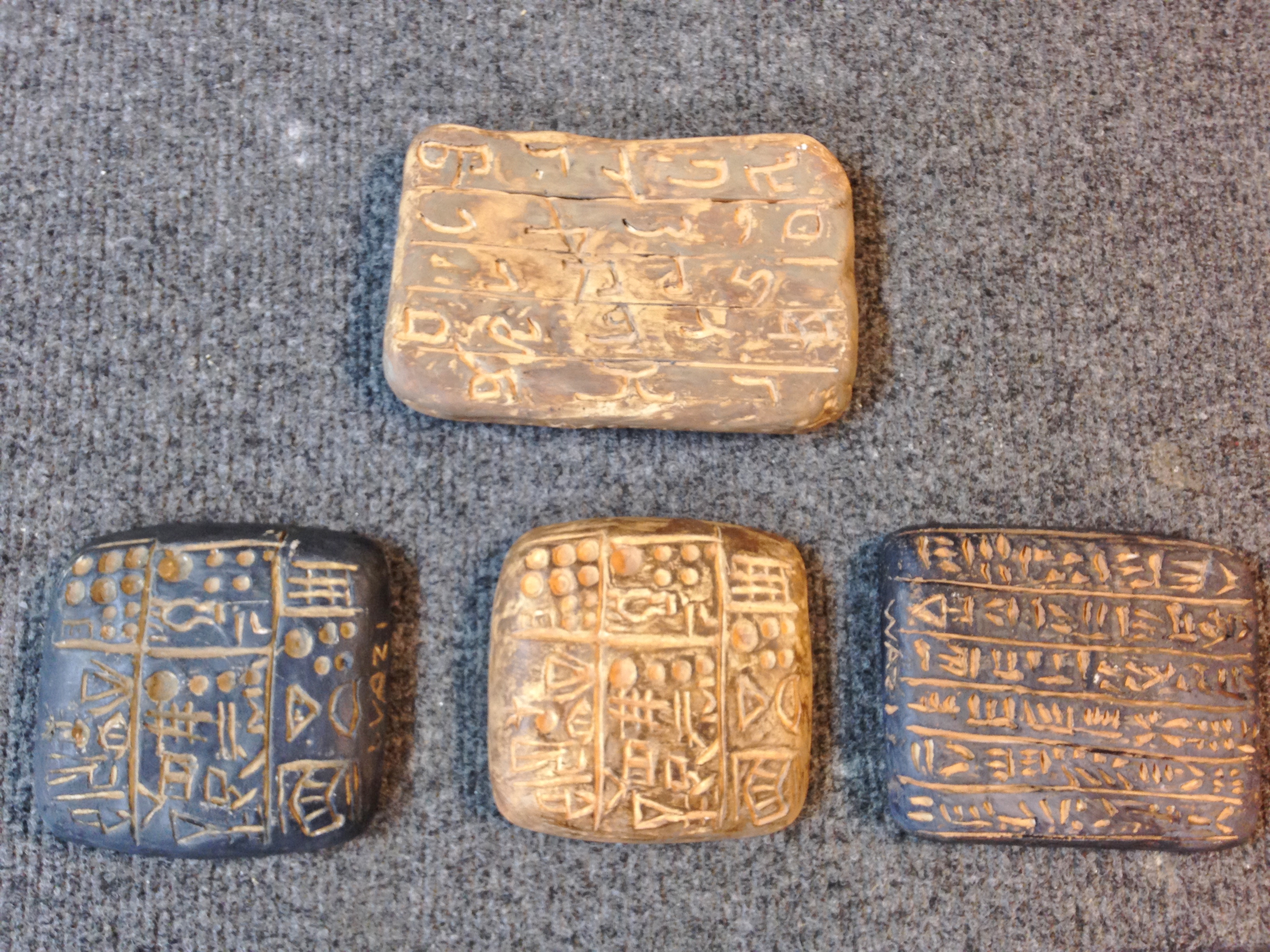
About a month ago, Sabah told me that he made clay tablets with cuneiform writing, replicas of those made during ancient Babylonian and Sumerian times. He passed them out for free during the opening of the Keys Grace Academy in Madison Heights. Grace Academy is the first Chaldean charter school in the United States. He told me he would make some tablets for me and my family. Today I picked up these four tablets.

Aside from being impressed by the detail of his work, so many feelings went through me as I held the stones that resemble those made thousands of years ago by my ancestors, who invented the first writing system.  There was a mixture of awe and wonder, a real closeness to my birth country, but also a little sadness to what has happened to that land. By the time I returned home, the sadness was gone and all that was left was joy – joy at having a number of real talented artists live in my neighborhood and doing their part in keeping the memory of the Cradle of Civilization alive.

Sabah Wazi

Read the rest of this entry »

Transforming Your Fears

Lynn-with-feathers-Mardi
Today I received this letter from Lynn Andrews. In the last four years, Lynn and her school has helped me transform my life through her teachings so I wanted to share information about a two-week online course she has from September 25- October 8.
My Dear Apprentices,
My teachers tell me that modern societies are living in greater chaos and confusion now than at any other time in history. They say that humans were never intended to live in this kind of pressure. Yet here we are, and it is a chaos and confusion that we, ourselves have created, for we are the ones who have poisoned the air that we breathe, the soils in which we grow our food, and the waters that are the very source of life itself. We are the ones who have created and bought in the paradigm of perpetual warfare instead of harmony, creating weapons of mass destruction so powerful they are capable of wiping out entire cities in the blink of an eye. Will we use those weapons? That is a choice we will have to make. And yet, we find ourselves moving into fear, not making choices, not creating abundance. Why is that?
Fear is a trap that we fall into, and when we are caught in the grips of fear, we are unable to move forward. We are stuck in a place of negativity, and we have moments when love and power seem to be unattainable. When we are standing in fear, abundance cannot move into our life. As I look out across the landscape of life, I see so much opportunity just waiting for us to tap into it. We live in a time when the creative brilliance of the human spirit, combined with the technology we have, puts all of possibility at our fingertips. Think about this for a moment. Just look at the incredible opportunities that are there for us today. Life is filled with abundance, and it’s all there for you to accept. So what is keeping you from it?
 
What is next for you? It is time for each of us to transform our fears, to take another step forward into the life we have been dreaming of, whatever that may be. Of course, even then there will be new difficulties to face, new fears to look at and transform, and hopefully each time you do it will be easier for you as you fill with light and gratitude. I am here to help you with all of that by giving you the tools you can use each time you are faced with fear.
It is my dearest wish for each of you that as you move forward in your lives, that you will seek the truth that is within you, learning how to discern the right path. Our next online course begins this week, and I have created it to help you do exactly that. “Transforming Your Fears with the Four Sacred Laws of the Painted Feather” is filled with the steps you can take to explore your fears, and then transform them, opening your heart and spirit to love and abundance. I want you to begin to find the inner peace and joy that comes from living by the Four Sacred Laws of the Painted Feather; to glow, beautifully attracting a life that is abundant with goodness for you to share, and that you will live fully each day, freed of the limits that fear imposes.
You are each so very dear to me, and to the Sisterhood of the Shields. I hope you will join me on this next step towards living the life you deserve to enjoy and love.
Namaste,
Lynn Andrews

Qais Al-Sindy’s “Return to the Garden of Eden”

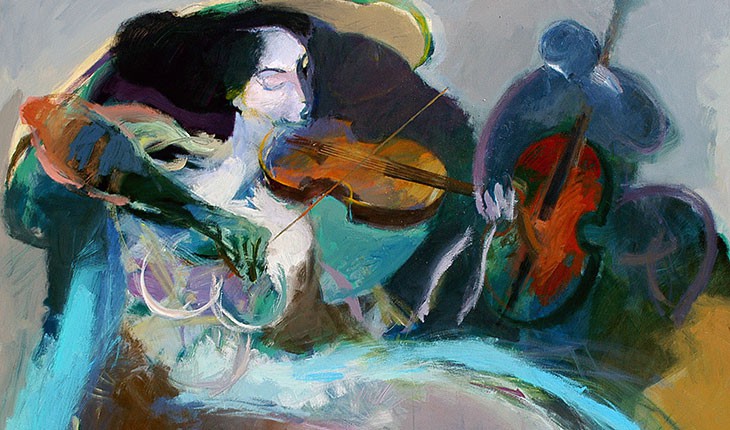
The Revivification of Music by Qais Al-Sindy

The Revivification of Music by Qais Al-Sindy

I’m currently working on the third book of the Iraqi Americans book series, which will be about the lives of artists. This project has been a luxury since it has introduced me to breathtaking artwork and inspiring artists, one of who is renowned Iraqi American artist Qais Al-Sindy.

I spent this morning enwrapped in Qais’ exquisite art and meaningful literature. Qais lives in San Diego, and shortly after I started this project, nearly every artist I talked to mentioned Qais’ accomplishments. They said I had to meet this artist, and last month, I had the pleasure of interviewing him over the phone. Then I received six of his books in the mail.

This morning, flipping through the pages of his books as I drank my coffee and listened to Zen music, I felt lifted in spirit by the imaginative, rhythmic, and emotional canvases that display much more than the appearance of the subject. They convey the subject’s inner mysticism. Through these paintings, one enters the dream of a “Return to the Garden of Eden” – the title of one of Qais’ books.

In the last page, he quotes the Epic of Gilgamesh, as translated by Maureen Gallery Kovacs:

“Gilgamesh goes off in search of the answer of everlasting life. When he arrives on the other side of the long darkness, he encounters “the Garden of the Gods.” But the description then turns to the precious metals and stones. “And the gold of that land is good; bdellium and onyx are there… There was a Garden of the Gods: all round him stood bushes bearing gems… fruit of hung thick with fruit, sweet to see… rare stones, agate, and pearls from the sea.”

In another book,The Struggles for Survival, Al-Sindy writes this passage called “Foothold.”

Soon after birth your search begins for a foothold on this globe. You search for your being, for a piece of land to secure your feet in. You search for a place upon which to stand on and declare “Here I am.”

The world has become overcrowded with its human inhabitants. There is traffic wherever you go. Everyone is competing for a chair to sit on. An unstoppable race to win the first positions, rather to win any position. When you don’t find that space, you hover above awaiting someone to be removed, or rather you remove somebody.

Who doesn’t want to say, “I am here!?” Who isn’t tempted by that moment of existence? Who doesn’t wish to announce his existence or prove that he exists?

In this conceptual work I invite the viewer to find his own foothold… despite the footprints overcrowding the space, the excitement of the search is not void of passion and adventure, even if that adventure is found in daydreaming to achieve harmony with the reality.

To learn more about Qais Al-Sindy, visit his website: http://qaissindy.com/

New York Author John Gorman Interviews Me on Paper Cut

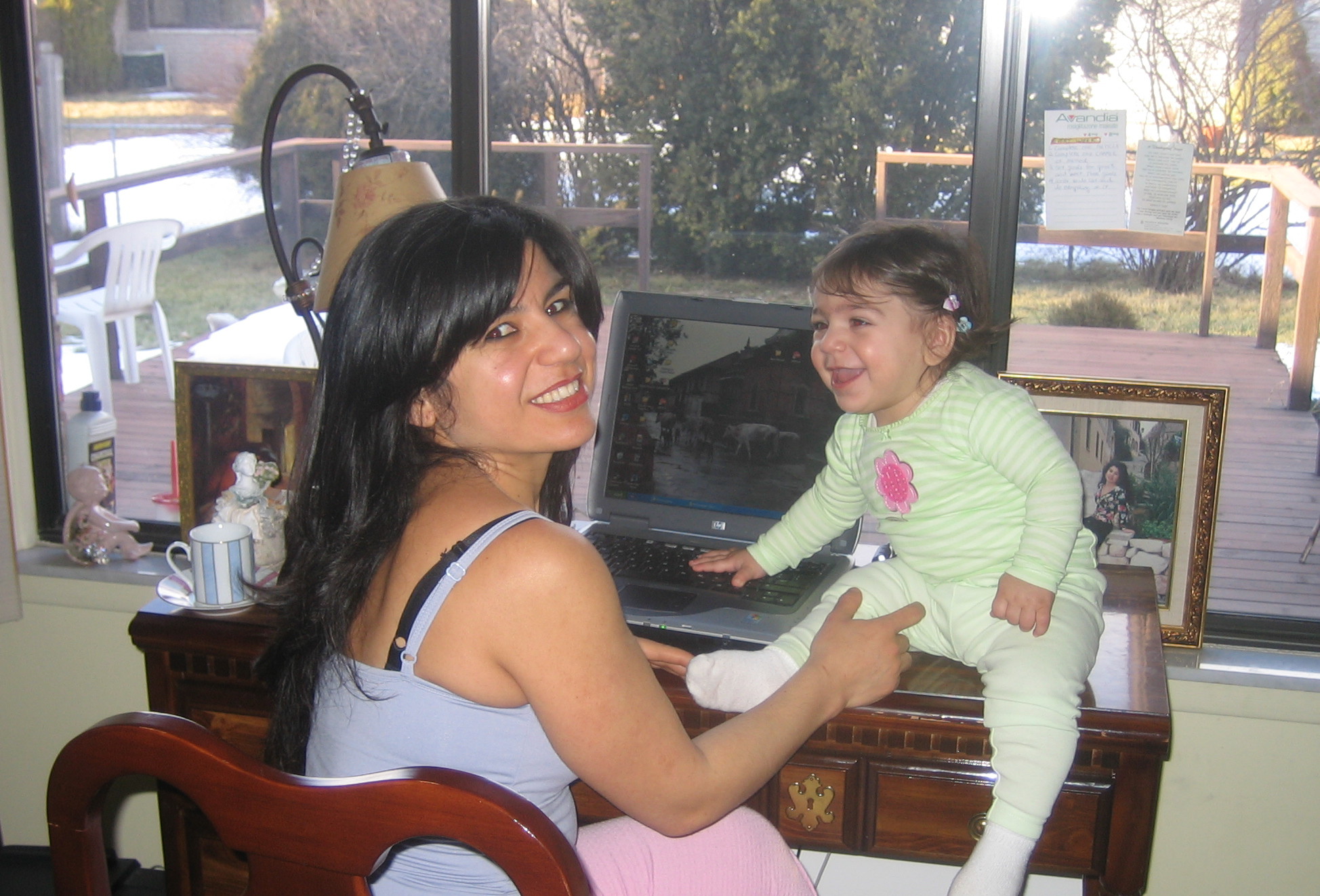
Picture with my daughter eight years ago

Picture with my daughter eight years ago

This interview was originally published on PaperCut  http://jgpapercut.blogspot.com/2015/08/interview-with-weam-namou.html

JG: Today I’m sitting with my friend and fellow author Weam Namou. She is the author of the booksThe Mismatched Braid, The Feminine Art, The Flavor of Cultures, and, a poetry collection entitled I Am a Mute Iraqi With A Voice. Because of the great success of that collection, she started the Iraqi Americans book series. So far she has two books published of this series: 1) The War Generation; 2) Witnessing a Genocide. Welcome to Papercut. Thanks for taking some time to chat with me and my readers. Tell us a little about yourself.

WN: Thanks for inviting me.

JG: Your first book is The Feminine Art. Would you mind sharing your experience both the writing and the publishing aspects?

WN: It took me two years to complete The Feminine Art, and then in 1996, I attended a local writer’s conference at Oakland University where Frances Kuffel, then a literary agent at the Jean Naggar Agency, critiqued the first chapter of the novel. She loved it, asked me to send her the finished manuscript, and soon we signed a contract. Frances was my literary agent for a number of years. Her belief in my work allowed me to start and finish a second novel, The Flavor of Cultures.

Frances went on to become the vice president of the Maria Carvainis Agency in New York. She was still my agent, but then in early 2003, she published her first memoir, Passing for Thin, and left the agency. No longer having representation, I was advised by a number of friends, professors and authors, to independently publish my book. The 2003 US-led invasion had just begun and they felt that my book had a timely appeal. They were right. Within six months of publication, I did over a hundred nationwide radio interviews. I also received a number of newspaper and magazine jobs, requests for poetry submissions, speaking and reading invitations, and even my own column for a local paper.

JG: How long have you been writing? What is your earliest recollection of writing?

WN: My first attempt at writing a book started about twenty-four years ago, at age nineteen. My earliest recollection of writing a story was in fifth grade, shortly after I arrived to America. I had to write a personal story and I wrote about having to leave, in secrecy, my friends and school in Iraq and moving to a foreign land. My English teacher asked me to share my story in front of an audience of parents at a school event. This was my first “published” piece.

JG: You’ve been engaging in multiple mediums for some time now. Tell us about the articles you write.

WN: I live in the city of Sterling Heights, nicknamed “Little Baghdad,” so I’m surrounded by material which is easily translated into different types of literature. Writing articles about high profiled Iraqi Americans, mostly Chaldeans, as well as covering events about the community has introduced me to people and subjects that I would not have discovered on my own. These encounters led me to come up with the idea of the Iraqi Americans book series. Each series will include a different subject matter about the Iraqi American community.

JG: What’s it like to write a screenplay?

WN: Green Card Wedding was a short film I made for my thesis at the Motion Picture Institute of Michigan. After graduation, I spent two years turning it into a feature script. The process was entertaining because a number of people were involved. My younger brother and my nephews, who were in their early twenties, came over every week to critique the material I had written. Because the script was a light comedy, we had fun playing around with the scenarios. The creative energy in my living room was great, and it led us all (including my husband and one year old daughter) to go to L.A. in 2007, to find actors for the film. Lance Kawas, an accomplished filmmaker who was one of my instructors in film school, really believed in Green Card Wedding and worked with me to attain funding.

Then in 2010, a family approached me to write a story about their daughter, Dawn Hanna. Dawn was in federal prison at that time, accused of conspiring to broker telecom equipment to Iraq during the sanctions. Unbeknownst to her and the jury which tried her, her coconspirator was actually a CIA operative. The project was sponsored by the United States to listen in on Saddam and his men. I put the film on hold and for the next four and a half years, worked on the Dawn Hanna story, which I named The Great American Family. I completed the book last year and currently, I’m searching for a home for it.

JG: How do you organize your day?

WN: During the school year, I write once I send the kids to school. I will take breaks in the late afternoon, during which time I cook and do light housework. The evenings are for research, interviews and marketing. In the summer, my writing hours in the daytime are shorter because I like to spend time with the kids and enjoy the warm weather that does not last too long in Michigan.

JG: Have you been to writing festivals? Do you have an opinion regarding them?

WN: No, I haven’t. I feel that interacting in any literary community is healthy and inspiring for writers. However, some writers spend more time in writer’s groups and conferences than they do writing, or honing the craft of writing, and that’s not going to move the book forward.

JG: What are you reading now?

WN: Maria Theresa Asmar’s Memoirs of a Babylonian Princess
Maya Angelou’s I Know Why the Caged Bird Sings (audio)
The Paris Review Interviews Women Writers at Work

JG: What is your job as a writer? Who is your audience?

WN: I freelance, mostly for the Chaldean News and right now I’m concentrating on the Iraqi Americans book series. The next book will be about the lives of artists, and it will be released in autumn 2015. My audience is intellectuals who like to read history, politics, biography and literary fiction.

JG: You are Chaldean. Can you explain what exactly that means? How does being Chaldean inform your writing?

WN: Chaldeans are Christian Iraqis who trace their roots to Prophet Abraham since he was from Ur, the biblical land of the Chaldees. When I began to learn about my heritage, I felt empowered by the richness of my ancestral land, where writing was invented. But I was also bothered by how little the world knew of these people’s achievements. Enheduanna, the first recorded writer in history, was a woman from ancient Iraq. I came across her name by accident and I could not understand why our Chaldean churches and the general educational institutions did not highlight her achievements.
Then while covering a story in 2012, I learned that almost two hundred years ago, a woman from Telkaif (my parents’, grandparents and great-great parents’ once Christian village in northern Iraq) had written a 720 page memoir. Maria Theresa Asmar was a Chaldean woman born in 1804 when the Ottoman occupied Iraq. She ended up traveling to Europe by herself, met the Queen of England (even dedicated the book to her), and described in the book her travels through Turkey, Syria, Lebanon and Israel. She died in France. An English version of her book was published in 1844 and was well received in England. Yet very few people in our Chaldean community know about her work.

JG: You are a wonderful writer. I’m a huge fan, as you might’ve guessed. I think that you are the Chaldean equivalent of Jhumpa Lahiri. Would you agree or disagree?

WN: I’m honored. Thank you. I read Lahiri’s “Interpreter of Maladies” when it first came out, and she and other ethnic writers such as Amy Tan showed me the possibility of telling my ethnic stories through the English language. Although, as I write this, I remember my former agent, Frances, and an Iraqi American book critic, after reading The Feminine Art, had compared my writing to that of Jane Austen because of my attention to small details that are the thread of family relationships.

JG: Do you have a schedule for writing, a preferred time or place?

WN: From early morning until late afternoon, every day, unless I’m out of town.
I used to love writing at coffee shops, libraries and bookstores. When you have kids, however, it’s not easy to just get up and go. You have to depend on the schedule of those who will watch your kids, and that dependence takes away your freedom to write how much you want to write.

I live in the same house my husband and I bought ten years ago when we got married. From the start, we made the family room my office. While I loved it spaciousness, it took years for me to get used to working in an atmosphere that was either very quiet (when the kids are asleep) or very noisy (when they were up). But over the years, I renovated it to create the right writing atmosphere for myself. I began to enjoy the window view I have while writing – the squirrels, birds, cats and rabbits that visit our backyard and nibble on food that is left behind from the previous night’s dinner we had on the patio.

For some years now, this has become my favorite and preferred place to write.

JG: What does Weam do when she is not writing?

WN: When not writing, Weam is mostly taking care of the house and kids and doing various family activities. I’m also currently helping care for my mother, who lives with me. I come from a big family (six sisters and four brothers, nearly 35 nieces and nephews, etc. – not to count my husband’s side) so much time goes into extended family as well as my own family.
When I have free time, I love to spend it in physical activities such as yoga, walking, and swimming. Once in a great while, I’ll have time to go to the movies.

JG: What do you want to be when you grow up?

WN: My great-grandmother Maria was a well-known healer. My father, who headed the accounting department at Baghdad’s railway station, was also a bonesetter for family and friends and whoever needed that free service.
Since it’s in my genes, for many years I have been studying spiritual work through different teachers. I’m currently a fourth year apprentice of Lynn Andrew’s school. Lynn Andrews is the bestselling author of the Medicine Woman series. Over twenty-five years ago, she founded Lynn Andrew’s Center for Sacred Arts and Training, a four year spiritual and healing school.
I want to continue to use my storytelling abilities to do work similar to that of my great-grandmother, my father and other family members.

JG: If you were throwing a dinner party who would you invite (Living or dead)?

WN: Dead: Margaret Mitchell, Maya Angelou, Henry James, Nora Ephron, Saddam Hussein (I have a lot of questions to ask him), Layla Al Attar (a famous Iraqi artist), Maria Theresa Amar

Alive: Woody Allen, Al Pacino, Robert Di Nero, Meryl Streep, Michael Moore, Stephen King, Kahtim al Sahir (famous Iraqi singer), President Bush Sr. & President Bush Jr. (I have a lot of questions to ask them too).

JG What projects are you working on now?

WN: I’m in postproduction of The Great American Family, based on the book with the same title.www.thegreatamericanfamilydocumentary.com

JG: What’s the hardest lesson you’ve learned as a writer?

WN: You are responsible for your own success.

JG: Any advice?

WN: A friend of mine once said to me that if she wanted to, she could write a book in a week. This woman had a master’s degree in business and was successful in her field, but she is a very impatient person and the one thing you need to have to write a good book, especially if you’re starting out, is patience – while writing the book, while finding an agent/publisher, and after the book is published, then when writing the next book, and so on.

Along this journey, it’s important that you keep your priorities straight and have a balance rather than obsess over your writing. What’s the use of having a great book if you have a lousy life? These days, especially, having a great life can easily translate into a great book.

JG: Opinions about MFAs?

WN: It’s a matter of preference and opportunity. If one can go, why not? If one can’t, that should not stop them from being a writer. Many famous writers never went to college. Maya Angelou never even took a writing class. William Faulkner, Mark Twain, Jack London, and H.G. Wells dropped out of high school nearly from the time they enrolled.

JG: How did you land your agent?

WN: As I mentioned earlier, I met my first agent, Frances Kuffel, at a writer’s conference at Oakland University in Michigan. I met my second agent, Cicily Janus, in 2012 at a writer’s retreat in Colorado. At that time, she worked at Folio Literary Management.

My Kurdish Shia Friend

Artwork by:  Luis Rosenfeld

Artwork by: Luis Rosenfeld

Yesterday, two of my poems were published by Section8Magazine http://www.section8magazine.com/my-kurdish-shia-friend/

  1. My Kurdish Shia Friend
  2. Redder and Redder

My Kurdish Shia Friend

I had no inkling that she was Muslim,
that she was not Christian like me.
I had no knowledge of her Kurdish heritage,
and that Kurds were a branch of the Iranian tree.
I knew not that she was a Shiite,
nor did I understand what that word meant.
What I did perceive, and still do,
was that her name, Niran, meant fire.
In Baghdad, she lived across from me
in a house with a blue door.
Her mother was a beautiful woman
who treated me like a daughter.
We both wore our hairs in ribbons and braids
and were the best of friends
until our lives dramatically altered
because we had to abandon our homes
due to other peoples’ addictive interpretations
of politics, ideals and religions.

Redder and Redder 
I turn redder and redder
each time they slaughter a human being
in a manner that resembles the slaughter
of a sheep for a fancy feast honoring a big celebration.

I turn redder and redder
each time they command a woman to remain a prisoner
in her body and home, giving her a punishment and a sentencing order merely because God chose her to be a certain gender.

I turn redder and redder
each time they train impressionable children how to execute acts in the name of Allah, acts that are insane with void and aggression, acts that are frowned upon even by the animal kingdom.

I turn redder and reader
each time they spread their wings, possess more land,
swim into the hearts of the innocent and conquer peace
rather than overcome their own terrifying addictions.

The Woman That Keeps on Giving

WomanThatKeepsOnGiving2

When I returned home from a weekend family trip, I checked my mailbox and found an envelope from Nidhal Garmo, a pharmacist known for her incredible humanitarian work in Iraq and neighboring countries. I opened the envelope and found a three-hundred dollar check. I asked Nidhal what this check was for, and she said, “You have been supportive of my work for many years. I wanted to do the same for you.”

I didn’t know what to say. Nidhal’s generosity took me by surprise, even though she is well known as “a giver.” In one of my books, The War Generation, I titled the chapter about her “The Woman That Keeps on Giving.” Yet the last time someone from the Iraqi American community was that generous was over ten years ago. At my book launch party, a Muslim man I had never met donated two-hundred dollars, because he said he was proud of my achievement.

While the Iraqi American community is established economically and generous in general, when it comes to supporting the arts – well, let’s just say that compared to the rest of the world, they have some catching up to do. But I guess that’s not the case with Nidhal. She has given me a gift as a token of appreciation for my consistent desire to dispel stereotypes by telling true life stories. She knows the enormous time, money and energy I’ve invested into these projects, and her gracious gift says to me, “Keep going.”

Thank you Nidhal!

The Dog Called Hitler – A Kresge Fellowship Winner!

Walerian Domanski

Since the spring of this year, when my friend and poetry editor Elisabeth Khan returned from India and we began to meet more frequently, we have been talking about Walerian Domanski, who is a member of our Rochester writers group.

In her beautiful Flemish accent, Elisabeth told me that she’d been editing Walerian’s second short story book collection, called The Calf. His first book, The Dog Called Hitler, was originally published in Poland. The Dog Called Hitler is about life and problems of common people, mostly very poor people in Communism Poland. But the book is universal, showing the heroism and weakness of people.

Elisabeth found his stories delightful, full of good writing, humor and satire. I told her that last year, for the first time I had listened to him read a poem, a poem that was very beautiful and touching.

Our discussions about his work was inspiring, leading me to write a poem based on his short story title: Kiss My Ass. Then one day, Elisabeth said to me, excitedly, “Our friend Walerian has won the Kresge Fellowship!”

“I suddenly became famous,” Walerian said to us as Elisabeth and I took a stroll with him by Lake St. Clair. “Even my wife, who did not used to read my work, suddenly started reading it.”

We asked him what he was going to do with the fellowship money and he said, “Buy good liquor.” We laughed.

Walerian continued to make us laugh with his sense of humor last Friday evening at Dr. John Telford’s home in St. Claire Shores. The beautiful house is on Lake St. Clair, and Dr. John Telford is the author of A Life on the Run, a memoir about his life and times as a Detroit educator and activist. He hosted, as he has done for some years now, the summer potluck writer’s group meeting.

Later on, we gathered in the backyard and various writers read their works. Walerian read one of his short stories, which was short, sweet, and funny. We have so much talent in our community!

Born in Russia, Walerian went to Poland with his parents in 1946. In Poland, he finished elementary school and high school, received a master’s degree in civil engineering and worked for state owned construction companies. Having joined an anti-communist movement, he was jailed by communists in December 1981. In 1987, he came to the United States as a political refugee.

From the beginning he loved the United States. He found a job in a geotechnical company and in 1994 he received a master’s degree in geotechnical engineering from Wayne State University. In 2008, he retired from the City of Detroit and started cartooning again, and soon switched to writing. He’s truly a man with many talents. Check out his book by visiting this link: http://www.amazon.com/The-Called-Hitler-Walerian-Domanski-ebook/dp/B00TWJ029O

On the Way to School

On the way to school

While organizing my office, I watched a French documentary on Netflix called On the Way to School. I expected this film to occupy me a little while I multitasked. I did not expect it to capture my attention more closely than a suspense movie.

On the Way to School is the story of how children in different parts of the world, who live in remote villages, get to school. Jackson and his young sister live in Kenya and walk ten miles a day each way to get to their school.  They have to beware of the wild animals in their path. Carlito and his younger sister ride their horse more than eleven miles each way across the plains of Argentina. Zahira and her friends live in the Moroccan Atlas Mountains and their journey, partially on foot and partially hitchhiking, takes four hours to get to their boarding school. In India, two brothers have to push their brother Samuel, who’s in a wheelchair, 2.5 miles each way to get to school.

These children not only go to school, but they also help around the house. They did not complain, analyze or compare their situation to anyone else’s. They did what they had to do and learned a great deal in the process. They had an attitude of gratitude and a type of understanding that parents hinder their children from having when they baby them too much.

When I finished watching this documentary, I told my children they had to help me clean the house. I handed out a list of tasks and I stopped feeling bad about telling them to make their own sandwiches, grab their own drinks and potato chip bags. Since I watched the movie, each time an inner complain wiggles itself inside my head, I think of them. I think of their dedication and perseverance and I switch my complaints to an attitude of gratitude.

That’s what good movies are all about. They make you visit other peoples’ lives, learn something new, gain a different perspective, and maybe, hopefully, make a change.

Another Arabian Wedding in America

I love weddings, but as my responsibilities at home and work increase – as do the weddings invitations that arrive to our doorsteps – I have found myself often complaining about the beautification process required to attend these events. Then I get to the banquet hall and I am grateful to be a part of such beautiful celebration.

Yesterday, my husband’s nephew got married and I enjoyed the wedding so very much that I wanted to share one moment of it with the rest of the world.  So enjoy!IMG_4067 - Copy

Memoirs of a Babylonian Princess

Memoirs of a Babylon Princess

I have finally started reading Memoirs of a Babylonian Princess, a book written 200 years ago by a woman from Telkaif in northern Iraq, my ancestors’ once Christian town which was overtaken by the Islamic State in the summer of 2014. The fact that this little gem of a book, and its author Maria Theresa Asmar, were practically buried into oblivion among its own people is quite disturbing to me, to say the least.

I first learned about Memoirs of a Babylonian Princess when I had to cover a story in the summer of 2012. Emily Porter PhD, an Iraqi-British artist, author and activist, had traveled from her hometown in Great Britain to do work at the Metropolitan Museum of Arts in New York regarding Asmar’s memoirs. She gave a lecture at Shenandoah Country Club about this memoir, and like Porter, I was amazed that few, if any, people in our Chaldean community had heard about this 720 page book.

Porter had stumbled upon this book when she was searching through a friend’s library.

“I found a book about Telkaif that briefly mentions Memoirs of a Babylonian Princess, followed by the criticism that Maria Asmar exaggerates in her work,” said Porter. “I thought, over 700 pages of a memoir, written by a woman from Telkaif in the early 19th century, and all this person has to say about it is that the author exaggerates in her writing?”

Maria was no ordinary woman, either. She traveled alone to Europe, the Middle East and other parts of the world. She met with Queen Victoria and even dedicated her book to the queen. She set up a school for women in Baghdad and welcomed western Christian missionaries, who then bribed the Turkish government to give them the licence for the school and forbid Maria to carry on with her project. Left frustrated and angry to have been treated this way by fellow Christians, she sought sanctuary with the Muslim Bedouins. She set about recording their daily lives, everything from the weddings and celebrations to their assaults on other tribes.

As I read her memoirs, I am in awe of the rich material it contains and of the beauty in Maria’s literary voice. I also find it interesting that while her work was neglected by her own community, in Great Britain and even in the United States, it has received a much wider and respectable recognition.