Cultural Glimpse

Enjoying diversity

Walking For Fun, Health and Therapy

I was enjoying a pleasant walk, breathing in the lovely weather, smiling at the chubby little squirrels that swerved every which way when I saw a woman walking towards me. She was far away but I recognized her walk. It was my sister.

“What a nice coincidence,” we said to each other as we met in the middle of the road and started to walk together, stopping here and there to take pictures because, unfortunately, this was an unusual encounter.

For almost a decade, my sisters and I would get up every morning and walk for five miles, even in the freezing cold. Four of us were serious walkers, but sometimes the fifth sister accompanied us. Sometimes, my cousin came along. When it was snowing or raining, people would watch us from their windows and probably think we were crazy.

Our schedules caused us to stop this morning tradition. Now each sister walks as her schedule permits, but we all still walk outdoors. Although I sometimes do miss those group walks. For the most part, they were healthy – except when we would get into such heated disagreements that the whole neighborhood again thought we were crazy.

Despite that, a recent study conducted by researchers at the University of Michigan found that taking group nature walks is associated with a great deal of mental health benefits, including decreased depression, improved well-being and mental health, and lower perceived stress.

Sean Gobin is a veteran who founded Warrior Hike, a nonprofit outdoor therapy program that helps combat veterans’ transition by hiking the country’s national scenic trails. Gobin recently won an award for this program which has helped many veterans who suffered from post-traumatic stress disorder.

Walking outdoors is one of the many free and beneficial gifts available to us. When we use these gifts, we have a more powerful relationship with this earth, with ourselves and each other, and we’re less dependent on medications for healing.

Trumbo’s Communism was the Islamism of the Time

My father, a lover of words and numbers, was the head of the accounting department for Baghdad Railway Station. On the side, he did translation, from Arabic to English and vice versa. His free services included being a bonesetter and representing people who could not afford an attorney in court. People trusted him because he was a just man and he knew how to play with words as if they were marbles.

Words can be used with good or bad intentions. My father used words to help heal and free people. Some people, like government officials and media personalities, play with words to instill fear and oppress people. They will take a word like communism and flavor it with all the necessary negativity to cause an unwarranted fear and create an Us vs. Them attitude.  Anyone slightly associated with that word is the “Bad Guy” and anyone against that word is the “Good Guy.”

Let me demonstrate a specific way the government played with words to help its war campaign against Iraq. The communists of Iraq are rarely mentioned because, for the sake of showing what a brutal man Saddam was, these communists were renamed anti-Saddamists. Look at the infamous black and white televised image of Saddam at the podium. He announces that “There are traitors among us (i.e. communists).” Then he calls off a list of names (given to him by US gov.). He wipes tears from his eyes because some of these men, although communists, were his friends. But he was willing to do anything to align with his western allies and gain power.

The US helped the rise of the Baathist Party because they did not want another communist country. From the beginning, they offered a list of 800 Iraqi communists to the Baathist insurgents, and all were killed. Many communists fled Saddam’s regime. The televised image of Saddam calling out the names of these communists (later called anti-Saddamists) was circulated to convince people that the world would be safer and more peaceful without Saddam.

Ironically, removing these 800 communists, then removing Saddam, has not made the world safer or more peaceful. We’ve actually achieved the opposite effect. Yet, when I watched Trumbo the other day, I realized that we’ll be doing more of the same thing and expecting a different result (the definition of insanity). We’ll continue to be tricked into a fear-based atmosphere which will distract us from what’s really going on and rob us of our true freedom.

I write not to point fingers. I write from experience. Having grown up in a totalitarian regime, I can smell oppression thousands of miles away.  For that reason, I strongly encourage people to not only watch Trumbo, but to learn from it.

Healing Wisdom for a Wounded World

Healing Wisdom for a Wounded World3

This is the first of a four-book memoir series – Release date February 2016

When Irina Tweedie, a British woman, met with her Sufi Master in India, he told her to keep a diary.

“One day it will become a book,” her Teacher said. “But you must write it in such a way that it should help others. People say, such things did happen thousands of years ago – we read in books about it. This book will be a proof that such things do happen today as they happened yesterday and will happen tomorrow – to the right people, in the right time, and in the right place.”

Tweedie’s diary spans five years and, published as Daughter of Fire, it records her spiritual transformation. Several times I read her book with a burning desire to have a similar teacher as hers help me toward my spiritual journey.

My concern was, do I have to go to India or other parts of the world for that? The answer was no. Throughout my life, I had different spiritual teachers (from India and Native Americans) who came to my door and helped me walk out of the fog and into my bliss. They taught me a great deal, but after we departed, I felt something was unfinished.

Then I met Lynn Andrews – through a book. As a woman from Beverly Hills, who was the bestselling author of some 20 books, I figured she’d give me a bit of literary advice. I did not expect her to change my life through her shamanic school. At that time, I had never even heard of Lynn Andrews or the word shaman.

Several factors drew me to the school, most notably its ancient teachings that also reside in my heritage, ancient Mesopotamia, now called Iraq. Although it’s not easy to image this now, once upon a time ancient Iraq was the Cradle of Civilization and its land flourished with goddesses like Inanna. Two important women are from that region: the first recorded writer in history, Enheduanna, a princess and priestess, and Kubaba, the first recorded woman ruler in history.

The Feminine Power that lived there was eventually attacked and oppressed by strict patriarchal beliefs. Little by little, due to totalitarian regimes and too many wars that were, and still are, led by unfathomable greed and ignorance, the Cradle of Civilization has turned into a frightening nightmare.

It is a blessing that my parents had the wisdom to move us to America right before the Iraq/Iran war. Here in America, with the love and support of powerful western women who have walked this path long before me, I had the opportunity to heal my wounds and to do what I could never do in Iraq – openly share my spiritual journey in a book.

Healing Wisdom for a Wounded World, the first of a four book memoir series, will be released in February 2016. The memoir is about how Lynn’s school changed my life, one year at a time. Harry Potter’s Hogwarts School of Witchcraft and Wizardry could not have done a better job teaching its students the creative depth and breadths, the charms, art, divination, ancient studies, the history of magic and potions needed to transform ourselves, people, relationships and circumstances.

I’m Most Grateful for Graduating this Year

IMG_5157

Morning of Graduation

When I graduated high school, I did not walk at commencements. I did not view my high school diploma as much of an accomplishment. When three years later, I received my bachelor’s degree from Wayne State University, I again did not walk at commencements. Although I enjoyed my college years and was happy to attain my degree, I felt there was something missing. I had a deep desire to learn more about myself and real life that seemed beyond what formal education could teach.

For the next two decades, I studied with various spiritual masters and took umpteen writing courses. All were wonderful experiences that helped me grow and flourish as a person and a writer, but most importantly, they led me to an extraordinary school, Lynn Andrews’ four-year shamanic school. I had initially signed up to the school to find my literary voice which had gotten lost by the pains of witnessing the Iraq war and by my enormous responsibilities as a wife and new mother.

I had no idea then that the school’s ancient teachings would not only heal old wounds that had muffled my literary voice, but that it would also improve my relationship with the Great Spirit, with myself, and with my family. The work was mystical but also very intense and challenging. I had to put my heart and soul into my family, home and career while doing the schoolwork because the purpose of these teachings is to incorporate what we learn into every aspect of our daily life.

Last month, I flew to Arizona to join other apprentices in a gathering where we graduated from Lynn’s school. This time, I walked at commencements in a most sacred ceremony.  I had taken a life-changing journey and was now surrounded by amazing women from all walks of life. For me, this was a real milestone that was worthy of celebration.

This Thanksgiving, I give special gratitude for graduating from a school that had, not long ago, only existed in my imagination.

For more information about Lynn and her school, you can visit her website: http://lynnandrews.com/

Iraqi Americans: The Lives of the Artists

Iraqi Americans the lives of the artists FRONT for Amazon

Artists have a story, a story that affects their pallets. In Iraqi Americans: The Lives of the Artists, I wanted to honor artists of Mesopotamian ancestry by giving them the opportunity to share their incredible stories themselves rather than risk having others to do it for them, as was the case with Layla Al Attar.

Layla Al Attar died in 1993, along with her husband, after her house was bombed by a US missile. Iraqi news announced that she was killed since she was responsible for creating the mosaic of George Bush Sr.’s face on the steps of Al Rashid Hotel, over which Iraqis and people from all over the world walked on upon entering. Unfortunately, she is remembered more so by how she died rather than by her incredible talent and the way in which she lived her life. Worse than that, many misinterpret the play 9 Parts of Desire by Heather Raffo to be based on her life.

Like Al Attar, the 16 artists in this book are not victims, but victors over their lives, following their passions and finding ways to showcase it despite any and all challenges.

This book is available in print and as an eBook

Counterpoint: Religious Intolerance Serves No One

Religious Tolerance

This opinion piece was originally published by The Chaldean News a few days ago http://www.chaldeannews.com/counterpoint-religious-intolerance-serves-no-one/

Many of our people, like Californian artist Paul Batou and Chicago attorney Wisam Naoum, have compared the genocide of the Christian Iraqis to that of the Native Americans, who recount how an estimated 80-100 million of their people were wiped out by disease, famine or warfare imported by white men carrying crosses who came here to find gold and to own new land. Those who survived were forced to convert to Christianity and to abandon their traditions and their native language.

Yet, we don’t see Native Americans protesting against our churches in the prejudiced manner we’ve protested against mosques. They keep their ancestral memory and lessons alive through storytelling and ceremonies, not hate speech.

Native Americans mainly blame politics and greed, not religion, for what happened to them. They’re not the only ones with this viewpoint. Ariel Sabar is a Kurdish Jewish author whose father was from Zakho. Currently a professor of Hebrew at UCLA, Sabar is a native speaker of Aramaic and has published more than 90 research articles about Jewish Neo-Aramaic and the folklore of the Kurdish Jews. In his book, My Father’s Paradise, he describes the old community in Zakho:

“Muslims, Jews, and Christians, Judaism, Sufi mysticism, Bahaism, and Yezidism flourished alongside one another and extremism was rare…. Muslim, Jew, and Christian suffered alike through the region’s cruel cycles of flood, famine, and Kurdish tribal bloodshed. They prospered alike when the soil yielded bumper crops of wheat, gall nuts, and fragrant tobacco. In important ways, they were Kurds first and Muslims, Christians, or Jews second.”

Sabar also blames politics and greed, not religion, on the mass exodus of 120,000 Jews from Iraq in the 1950s. Some of Sabar’s accounts are similar to what occurred last year with ISIS’ Christian genocide. If we were to research history, we would see that political greed is at the root of most invasions, massacres and occupations.

If we choose to have a one-sided memory, we will never be able to have a dialogue with other cultures, ethnicities and religions, and yet that’s what democracy is about. It’s the reason this country has such great potential and why people risk their lives to come here.

We remember the 1933 Simele Massacre but we forget the 1991 Gulf War, the unjust UN-imposed sanctions that were enforced on Iraq for more than 12 years, and the 2003 U.S.-led invasion, all which caused the deaths of millions of innocent Iraqi civilians and a refugee crisis for which the world is today paying the price. The Arab world looked upon these wars and sanctions as Christians’ war against Muslims. During that time, many in Iraq began labeling Christians “Bush’s people” and terrorists were easily able to recruit extremists.

Despite all this, Saddam did not permit Muslims to use hate speech against Christians. Batras Mansour, a refugee I once interviewed, said, “I haven’t seen a day of peace since the war. During Saddam’s regime in Iraq, we experienced much better days. Back then, no one could say a wrong word to us Christians.”

Mansour told the story of how an imam spoke against the Christians over the microphone. After he was reported to authorities, the mosque was circled by four cars. The imam was taken away and no one saw him since.

So was Saddam more intolerant of religious hate speech than we are?

Over the years, I have interviewed dozens of people from the Catholic religious order. They never blamed Islam for Iraq’s current situation. In my recent book about the lives of Iraqi American artists, most of the artists expressed nostalgia for the Iraq that was once unified.

Randa Razoky said, “I once painted a painting of mosque, churches, and Mandaean men baptizing women by the river, where the Tigris and Euphrates Rivers flow. This painting represents an Iraq of diverse religions which no longer exists. We lost that Iraq.”

Maybe We can get that Iraq back if we open our hearts and re-learn to co-exist. Otherwise, true peace will never find a home within us.

Bridging Worlds: The Art of Qais Al-Sindyor

Al Sindy Photo

This article was originally published by the Chaldean News a few days ago. It’s about Qais Al-Sindy, one of the artists in my upcoming book, The Lives of the Artists.  http://www.chaldeannews.com/bridging-worlds-the-art-of-qais-al-sindy/

Chaldean Qais Al-Sindy studied engineering at the University of Baghdad and though he excelled in his classes, he soon discovered that the field was not for him. After graduating, he applied to the Academy of Fine Arts, telling the administration, “If you force me to be a Baathist, I will study outside this country and you will lose me.”

It worked. They made an exception to Al-Sindy’s non-Baathist affiliation and enrolled him. In 2004, he graduated with an MFA from the Academy of Fine Arts. His thesis was on Christian paintings from all over Iraq. This led him to take a big tour of Iraq to visit all the monasteries and different cities from Zakho (in the Kurdisan region) to al-Faw (a marshy region in the extreme southeast of Iraq).

“It was dangerous to travel, especially since I did not have a sponsor,” he said. “I paid from my own pockets and drove my own car. Because I speak English very well, I managed well at American checkpoints. I received harassment from the insurgents and extremists, but at that time, it wasn’t very severe. I managed, but I did leave the country shortly after graduating.”

Al-Sindy, who began painting at age 14, has held art exhibits all over the world. His work has drawn so much attention that six books have been published about it by various venues, including the Kuwait Cultural Center and the Iraqi Cultural Center in Washington, D.C.

“I don’t do anything else in this world except for art,” said Al-Sindy, who resides in California. “If you are able to do the art that you like and find a way to sell it, this means that you believe in yourself.”

Al-Sindy, whose work includes painting, videos and installations of objects designed to make a point, is known to engage audiences in his art. An example of this is the “Mamdooh” series.

“After I left Iraq, I lived in Jordan, where I taught art in the architectural department,” he said. “One day I heard that one of my dearest friends in Iraq, a talented portrait artist named Mamdooh, suffered injuries as a result of a car explosion that injured and killed many people. He was transferred to the hospital where he struggled against death for one week, then died.”

This led Al-Sindy to do a series of four paintings. The first one is a portrait of Mamdooh in an expressionist style that focuses on his appearance. The second is a ghostly figure with transparency like his character, full of hue colors. It is the moment that Mamdooh suffers and dies. In the third painting, he brought some ashes and charcoal from the ruins of the car that exploded and drew Mamdooh using those ashes. That means Mamdooh is gone. The fourth painting is a pure blank canvas.

“Everyone is well aware that it’s prohibited to touch the artwork in galleries and museums,” Al-Sindy said. “But in this, I came up with something new to complete the fourth painting. I asked the viewers to wipe their hands on painting number three. Of course, now their hands are stained with charcoal and ashes. They want to clean their hands, but I ask the crowd to wipe their hands on the blank canvas, on painting number four. The fingerprints on the canvas mean that you’re a participant of this crime in Iraq.”

Al-Sindy said this was his way of getting his audience to participate in the message he wanted to deliver: It is up to us to make this world the best place to live in.

He showed the series in more than 10 countries and the fourth piece, the blank canvas, is now covered with more than a thousand people’s fingerprints.

“Everyone wants to show that they are responsible for us not having peace in this world,” he said. “The frames are cracked and damaged because they toured many, many countries. I kept it as it is.”

Al-Sindy has also produced an 11-minute documentary about the burning of the Iraqi library called “Letters Don’t Burn.”

His latest project, called “The Bridge,” showcased the work of 47 premier and emerging Arab, Persian and Jewish visual artists around the theme of what “bridges” us to each other. The show opened in Paris in February and has been seen in England, Egypt and other countries.

The idea was to collect stones and bricks and, instead of using them to hit each other, to build a bridge out of them that would start a cultural dialogue between different countries.
“This would help create love,” he said, “because if I love you I will not fight you. If I love you, then I will put my hands with your hands and we will build something together. All the problems in this universe are the result of us not loving each other. People’s desires for opportunism, greed, for looking out for themselves and not each other, are the reasons we don’t have universal peace.”

View more of the artist’s work at QaisSindy.com.

My Lovely New Garden… Inspired by Frankenmuth

My New Garden

My family went to Frankenmuth for Labor Day weekend and the very first day that we returned home I bought a rocking bench to put on our front porch, and the next day, I told my husband that we had to change our landscape. The jungle we had in the front of our house was getting out of control, and it was ugly. And it looked even uglier after I had the opportunity to sit amongst the lovely landscape and floral displays in Frankenmuth.

He said, “Sure, I’ll do it next spring.”

That statement was not promising so I started looking for a landscape gardener.  Within less than a month, my landscape was transformed. I replaced gigantic bushes with lots of colorful flowers, an apple tree and a pear tree.  After ten years of living in this house, I’m finally able to enjoy my front yard.

I always say you don’t need to travel far to find inspiration, and this is a perfect example. A town that’s only one hour away from my home truly inspired me, not only with regards to the landscaping but with its other splendors.

Frankenmuth, nicknamed “Little Bavaria”, has a population of roughly 5,000 people. It’s a beautiful city that has more than three million visitors each year. It is famous for Zender’s Restaurant, which serves homemade Bavarian chicken, and for Bronner’s Christmas Wonderland, the world’s largest Christmas store.

The night we were there, we rode a horse carriage where we saw a house where the same family has lived for over a hundred years. We learned from the horse carriage driver that the owner of Zender’s Restaurant is 94 years old and that she still works every day in the kitchen, except for Monday. Mondays she teaches her grandchildren how to bake. This bit of information made me feel quite young.  Another brownie point for Frankenmuth!

Real Talent Lives in My Neighborhood

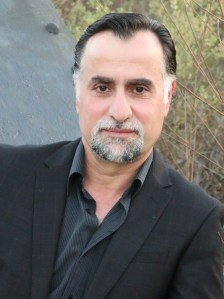
Sabah Wazi 2Today I went to Wazi’s Rug Shop to pick up a gift that talented artists Sabah Selou Wazi made for me. Sabah is one of sixteen artists I interviewed for my upcoming book, Iraqi Americans: The Lives of the Artists. Because the shop is only a few blocks from my house, I mostly interviewed Sabah at his shop.

Each time I go into the shop, I feel I’m entering a small museum. Sabah has a studio in the back of the and his artwork is displayed in various corners in the front. Being surrounded by Babylonian and Sumerian artwork makes you want to wander around, and basically, not leave. When visitors admire his work, Sabah takes the opportunity to introduce and educate them to the rich history and culture of Mesopotamia. Doing so has become dearer to him since the horrific attempts to destroy Iraq’s heritage.

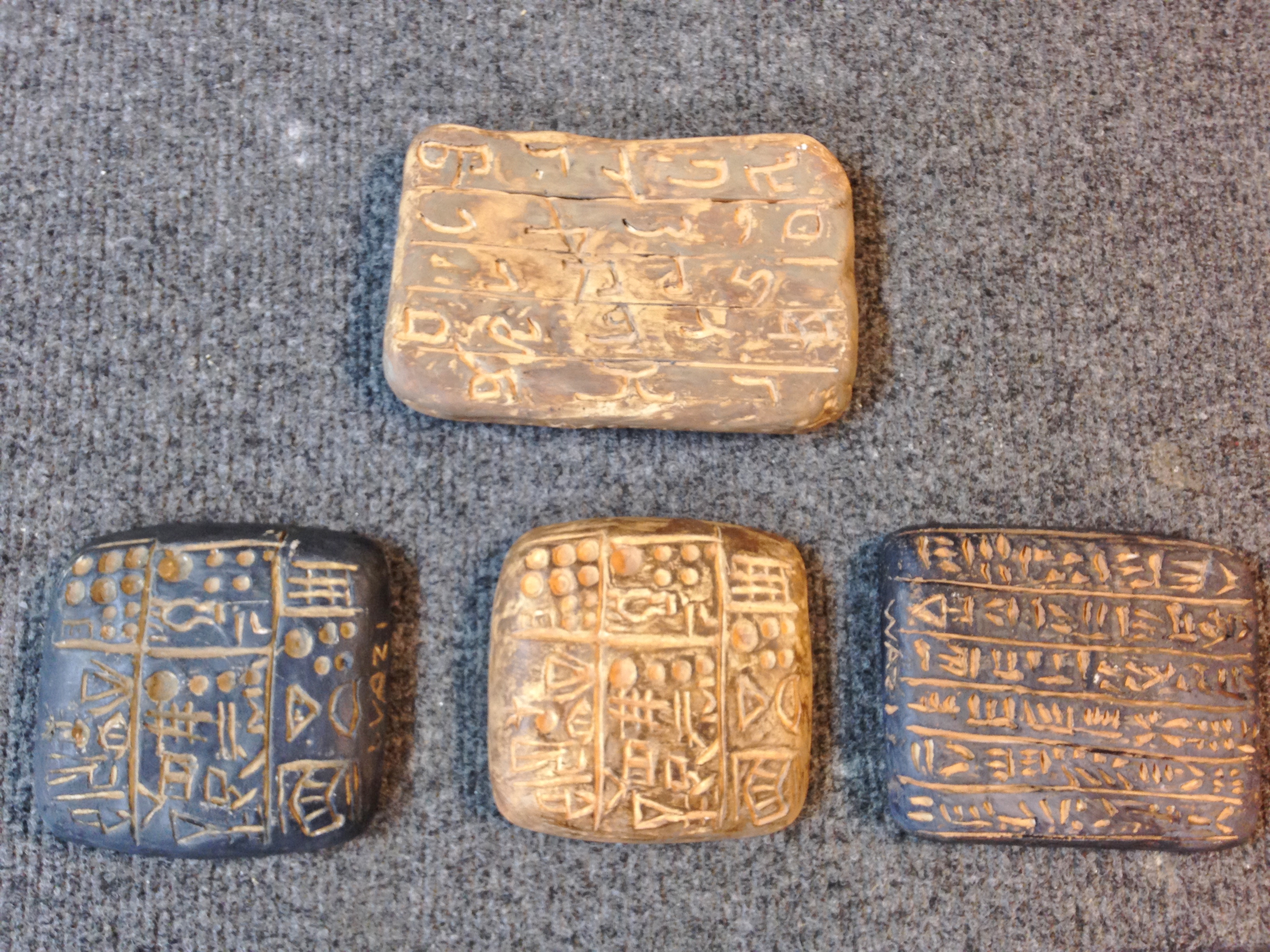
About a month ago, Sabah told me that he made clay tablets with cuneiform writing, replicas of those made during ancient Babylonian and Sumerian times. He passed them out for free during the opening of the Keys Grace Academy in Madison Heights. Grace Academy is the first Chaldean charter school in the United States. He told me he would make some tablets for me and my family. Today I picked up these four tablets.

Aside from being impressed by the detail of his work, so many feelings went through me as I held the stones that resemble those made thousands of years ago by my ancestors, who invented the first writing system.  There was a mixture of awe and wonder, a real closeness to my birth country, but also a little sadness to what has happened to that land. By the time I returned home, the sadness was gone and all that was left was joy – joy at having a number of real talented artists live in my neighborhood and doing their part in keeping the memory of the Cradle of Civilization alive.

Sabah Wazi

Read the rest of this entry »

Transforming Your Fears

Lynn-with-feathers-Mardi
Today I received this letter from Lynn Andrews. In the last four years, Lynn and her school has helped me transform my life through her teachings so I wanted to share information about a two-week online course she has from September 25- October 8.
My Dear Apprentices,
My teachers tell me that modern societies are living in greater chaos and confusion now than at any other time in history. They say that humans were never intended to live in this kind of pressure. Yet here we are, and it is a chaos and confusion that we, ourselves have created, for we are the ones who have poisoned the air that we breathe, the soils in which we grow our food, and the waters that are the very source of life itself. We are the ones who have created and bought in the paradigm of perpetual warfare instead of harmony, creating weapons of mass destruction so powerful they are capable of wiping out entire cities in the blink of an eye. Will we use those weapons? That is a choice we will have to make. And yet, we find ourselves moving into fear, not making choices, not creating abundance. Why is that?
Fear is a trap that we fall into, and when we are caught in the grips of fear, we are unable to move forward. We are stuck in a place of negativity, and we have moments when love and power seem to be unattainable. When we are standing in fear, abundance cannot move into our life. As I look out across the landscape of life, I see so much opportunity just waiting for us to tap into it. We live in a time when the creative brilliance of the human spirit, combined with the technology we have, puts all of possibility at our fingertips. Think about this for a moment. Just look at the incredible opportunities that are there for us today. Life is filled with abundance, and it’s all there for you to accept. So what is keeping you from it?
 
What is next for you? It is time for each of us to transform our fears, to take another step forward into the life we have been dreaming of, whatever that may be. Of course, even then there will be new difficulties to face, new fears to look at and transform, and hopefully each time you do it will be easier for you as you fill with light and gratitude. I am here to help you with all of that by giving you the tools you can use each time you are faced with fear.
It is my dearest wish for each of you that as you move forward in your lives, that you will seek the truth that is within you, learning how to discern the right path. Our next online course begins this week, and I have created it to help you do exactly that. “Transforming Your Fears with the Four Sacred Laws of the Painted Feather” is filled with the steps you can take to explore your fears, and then transform them, opening your heart and spirit to love and abundance. I want you to begin to find the inner peace and joy that comes from living by the Four Sacred Laws of the Painted Feather; to glow, beautifully attracting a life that is abundant with goodness for you to share, and that you will live fully each day, freed of the limits that fear imposes.
You are each so very dear to me, and to the Sisterhood of the Shields. I hope you will join me on this next step towards living the life you deserve to enjoy and love.
Namaste,
Lynn Andrews