Cultural Glimpse

Enjoying diversity

Category: Spirituality

Healing Wisdom for a Wounded World

Healing Wisdom for a Wounded World3

This is the first of a four-book memoir series – Release date February 2016

When Irina Tweedie, a British woman, met with her Sufi Master in India, he told her to keep a diary.

“One day it will become a book,” her Teacher said. “But you must write it in such a way that it should help others. People say, such things did happen thousands of years ago – we read in books about it. This book will be a proof that such things do happen today as they happened yesterday and will happen tomorrow – to the right people, in the right time, and in the right place.”

Tweedie’s diary spans five years and, published as Daughter of Fire, it records her spiritual transformation. Several times I read her book with a burning desire to have a similar teacher as hers help me toward my spiritual journey.

My concern was, do I have to go to India or other parts of the world for that? The answer was no. Throughout my life, I had different spiritual teachers (from India and Native Americans) who came to my door and helped me walk out of the fog and into my bliss. They taught me a great deal, but after we departed, I felt something was unfinished.

Then I met Lynn Andrews – through a book. As a woman from Beverly Hills, who was the bestselling author of some 20 books, I figured she’d give me a bit of literary advice. I did not expect her to change my life through her shamanic school. At that time, I had never even heard of Lynn Andrews or the word shaman.

Several factors drew me to the school, most notably its ancient teachings that also reside in my heritage, ancient Mesopotamia, now called Iraq. Although it’s not easy to image this now, once upon a time ancient Iraq was the Cradle of Civilization and its land flourished with goddesses like Inanna. Two important women are from that region: the first recorded writer in history, Enheduanna, a princess and priestess, and Kubaba, the first recorded woman ruler in history.

The Feminine Power that lived there was eventually attacked and oppressed by strict patriarchal beliefs. Little by little, due to totalitarian regimes and too many wars that were, and still are, led by unfathomable greed and ignorance, the Cradle of Civilization has turned into a frightening nightmare.

It is a blessing that my parents had the wisdom to move us to America right before the Iraq/Iran war. Here in America, with the love and support of powerful western women who have walked this path long before me, I had the opportunity to heal my wounds and to do what I could never do in Iraq – openly share my spiritual journey in a book.

Healing Wisdom for a Wounded World, the first of a four book memoir series, will be released in February 2016. The memoir is about how Lynn’s school changed my life, one year at a time. Harry Potter’s Hogwarts School of Witchcraft and Wizardry could not have done a better job teaching its students the creative depth and breadths, the charms, art, divination, ancient studies, the history of magic and potions needed to transform ourselves, people, relationships and circumstances.

I’m Most Grateful for Graduating this Year

IMG_5157

Morning of Graduation

When I graduated high school, I did not walk at commencements. I did not view my high school diploma as much of an accomplishment. When three years later, I received my bachelor’s degree from Wayne State University, I again did not walk at commencements. Although I enjoyed my college years and was happy to attain my degree, I felt there was something missing. I had a deep desire to learn more about myself and real life that seemed beyond what formal education could teach.

For the next two decades, I studied with various spiritual masters and took umpteen writing courses. All were wonderful experiences that helped me grow and flourish as a person and a writer, but most importantly, they led me to an extraordinary school, Lynn Andrews’ four-year shamanic school. I had initially signed up to the school to find my literary voice which had gotten lost by the pains of witnessing the Iraq war and by my enormous responsibilities as a wife and new mother.

I had no idea then that the school’s ancient teachings would not only heal old wounds that had muffled my literary voice, but that it would also improve my relationship with the Great Spirit, with myself, and with my family. The work was mystical but also very intense and challenging. I had to put my heart and soul into my family, home and career while doing the schoolwork because the purpose of these teachings is to incorporate what we learn into every aspect of our daily life.

Last month, I flew to Arizona to join other apprentices in a gathering where we graduated from Lynn’s school. This time, I walked at commencements in a most sacred ceremony.  I had taken a life-changing journey and was now surrounded by amazing women from all walks of life. For me, this was a real milestone that was worthy of celebration.

This Thanksgiving, I give special gratitude for graduating from a school that had, not long ago, only existed in my imagination.

For more information about Lynn and her school, you can visit her website: http://lynnandrews.com/

Bridging Worlds: The Art of Qais Al-Sindyor

Al Sindy Photo

This article was originally published by the Chaldean News a few days ago. It’s about Qais Al-Sindy, one of the artists in my upcoming book, The Lives of the Artists.  http://www.chaldeannews.com/bridging-worlds-the-art-of-qais-al-sindy/

Chaldean Qais Al-Sindy studied engineering at the University of Baghdad and though he excelled in his classes, he soon discovered that the field was not for him. After graduating, he applied to the Academy of Fine Arts, telling the administration, “If you force me to be a Baathist, I will study outside this country and you will lose me.”

It worked. They made an exception to Al-Sindy’s non-Baathist affiliation and enrolled him. In 2004, he graduated with an MFA from the Academy of Fine Arts. His thesis was on Christian paintings from all over Iraq. This led him to take a big tour of Iraq to visit all the monasteries and different cities from Zakho (in the Kurdisan region) to al-Faw (a marshy region in the extreme southeast of Iraq).

“It was dangerous to travel, especially since I did not have a sponsor,” he said. “I paid from my own pockets and drove my own car. Because I speak English very well, I managed well at American checkpoints. I received harassment from the insurgents and extremists, but at that time, it wasn’t very severe. I managed, but I did leave the country shortly after graduating.”

Al-Sindy, who began painting at age 14, has held art exhibits all over the world. His work has drawn so much attention that six books have been published about it by various venues, including the Kuwait Cultural Center and the Iraqi Cultural Center in Washington, D.C.

“I don’t do anything else in this world except for art,” said Al-Sindy, who resides in California. “If you are able to do the art that you like and find a way to sell it, this means that you believe in yourself.”

Al-Sindy, whose work includes painting, videos and installations of objects designed to make a point, is known to engage audiences in his art. An example of this is the “Mamdooh” series.

“After I left Iraq, I lived in Jordan, where I taught art in the architectural department,” he said. “One day I heard that one of my dearest friends in Iraq, a talented portrait artist named Mamdooh, suffered injuries as a result of a car explosion that injured and killed many people. He was transferred to the hospital where he struggled against death for one week, then died.”

This led Al-Sindy to do a series of four paintings. The first one is a portrait of Mamdooh in an expressionist style that focuses on his appearance. The second is a ghostly figure with transparency like his character, full of hue colors. It is the moment that Mamdooh suffers and dies. In the third painting, he brought some ashes and charcoal from the ruins of the car that exploded and drew Mamdooh using those ashes. That means Mamdooh is gone. The fourth painting is a pure blank canvas.

“Everyone is well aware that it’s prohibited to touch the artwork in galleries and museums,” Al-Sindy said. “But in this, I came up with something new to complete the fourth painting. I asked the viewers to wipe their hands on painting number three. Of course, now their hands are stained with charcoal and ashes. They want to clean their hands, but I ask the crowd to wipe their hands on the blank canvas, on painting number four. The fingerprints on the canvas mean that you’re a participant of this crime in Iraq.”

Al-Sindy said this was his way of getting his audience to participate in the message he wanted to deliver: It is up to us to make this world the best place to live in.

He showed the series in more than 10 countries and the fourth piece, the blank canvas, is now covered with more than a thousand people’s fingerprints.

“Everyone wants to show that they are responsible for us not having peace in this world,” he said. “The frames are cracked and damaged because they toured many, many countries. I kept it as it is.”

Al-Sindy has also produced an 11-minute documentary about the burning of the Iraqi library called “Letters Don’t Burn.”

His latest project, called “The Bridge,” showcased the work of 47 premier and emerging Arab, Persian and Jewish visual artists around the theme of what “bridges” us to each other. The show opened in Paris in February and has been seen in England, Egypt and other countries.

The idea was to collect stones and bricks and, instead of using them to hit each other, to build a bridge out of them that would start a cultural dialogue between different countries.
“This would help create love,” he said, “because if I love you I will not fight you. If I love you, then I will put my hands with your hands and we will build something together. All the problems in this universe are the result of us not loving each other. People’s desires for opportunism, greed, for looking out for themselves and not each other, are the reasons we don’t have universal peace.”

View more of the artist’s work at QaisSindy.com.

My Lovely New Garden… Inspired by Frankenmuth

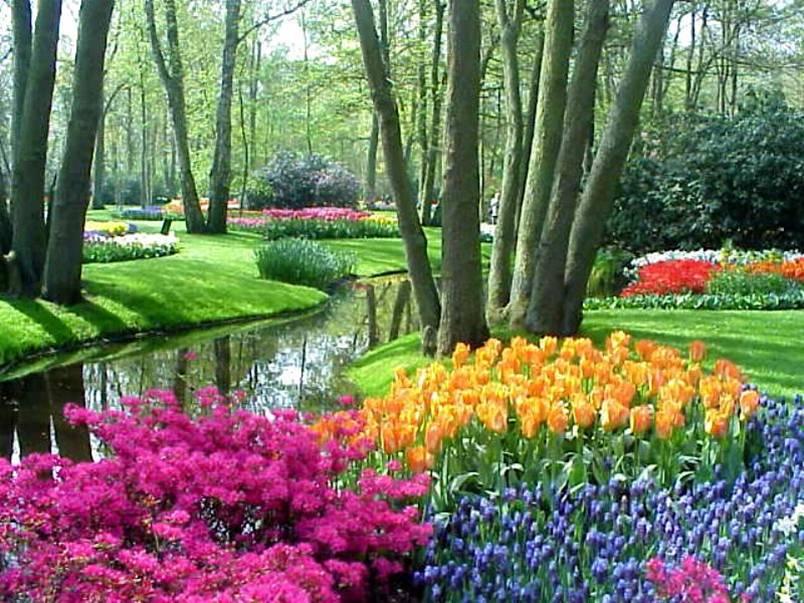
My New Garden

My family went to Frankenmuth for Labor Day weekend and the very first day that we returned home I bought a rocking bench to put on our front porch, and the next day, I told my husband that we had to change our landscape. The jungle we had in the front of our house was getting out of control, and it was ugly. And it looked even uglier after I had the opportunity to sit amongst the lovely landscape and floral displays in Frankenmuth.

He said, “Sure, I’ll do it next spring.”

That statement was not promising so I started looking for a landscape gardener.  Within less than a month, my landscape was transformed. I replaced gigantic bushes with lots of colorful flowers, an apple tree and a pear tree.  After ten years of living in this house, I’m finally able to enjoy my front yard.

I always say you don’t need to travel far to find inspiration, and this is a perfect example. A town that’s only one hour away from my home truly inspired me, not only with regards to the landscaping but with its other splendors.

Frankenmuth, nicknamed “Little Bavaria”, has a population of roughly 5,000 people. It’s a beautiful city that has more than three million visitors each year. It is famous for Zender’s Restaurant, which serves homemade Bavarian chicken, and for Bronner’s Christmas Wonderland, the world’s largest Christmas store.

The night we were there, we rode a horse carriage where we saw a house where the same family has lived for over a hundred years. We learned from the horse carriage driver that the owner of Zender’s Restaurant is 94 years old and that she still works every day in the kitchen, except for Monday. Mondays she teaches her grandchildren how to bake. This bit of information made me feel quite young.  Another brownie point for Frankenmuth!

Transforming Your Fears

Lynn-with-feathers-Mardi
Today I received this letter from Lynn Andrews. In the last four years, Lynn and her school has helped me transform my life through her teachings so I wanted to share information about a two-week online course she has from September 25- October 8.
My Dear Apprentices,
My teachers tell me that modern societies are living in greater chaos and confusion now than at any other time in history. They say that humans were never intended to live in this kind of pressure. Yet here we are, and it is a chaos and confusion that we, ourselves have created, for we are the ones who have poisoned the air that we breathe, the soils in which we grow our food, and the waters that are the very source of life itself. We are the ones who have created and bought in the paradigm of perpetual warfare instead of harmony, creating weapons of mass destruction so powerful they are capable of wiping out entire cities in the blink of an eye. Will we use those weapons? That is a choice we will have to make. And yet, we find ourselves moving into fear, not making choices, not creating abundance. Why is that?
Fear is a trap that we fall into, and when we are caught in the grips of fear, we are unable to move forward. We are stuck in a place of negativity, and we have moments when love and power seem to be unattainable. When we are standing in fear, abundance cannot move into our life. As I look out across the landscape of life, I see so much opportunity just waiting for us to tap into it. We live in a time when the creative brilliance of the human spirit, combined with the technology we have, puts all of possibility at our fingertips. Think about this for a moment. Just look at the incredible opportunities that are there for us today. Life is filled with abundance, and it’s all there for you to accept. So what is keeping you from it?
 
What is next for you? It is time for each of us to transform our fears, to take another step forward into the life we have been dreaming of, whatever that may be. Of course, even then there will be new difficulties to face, new fears to look at and transform, and hopefully each time you do it will be easier for you as you fill with light and gratitude. I am here to help you with all of that by giving you the tools you can use each time you are faced with fear.
It is my dearest wish for each of you that as you move forward in your lives, that you will seek the truth that is within you, learning how to discern the right path. Our next online course begins this week, and I have created it to help you do exactly that. “Transforming Your Fears with the Four Sacred Laws of the Painted Feather” is filled with the steps you can take to explore your fears, and then transform them, opening your heart and spirit to love and abundance. I want you to begin to find the inner peace and joy that comes from living by the Four Sacred Laws of the Painted Feather; to glow, beautifully attracting a life that is abundant with goodness for you to share, and that you will live fully each day, freed of the limits that fear imposes.
You are each so very dear to me, and to the Sisterhood of the Shields. I hope you will join me on this next step towards living the life you deserve to enjoy and love.
Namaste,
Lynn Andrews

Qais Al-Sindy’s “Return to the Garden of Eden”

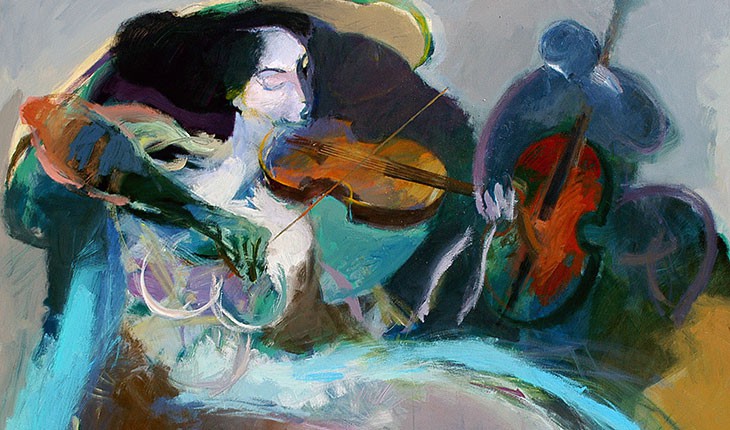
The Revivification of Music by Qais Al-Sindy

The Revivification of Music by Qais Al-Sindy

I’m currently working on the third book of the Iraqi Americans book series, which will be about the lives of artists. This project has been a luxury since it has introduced me to breathtaking artwork and inspiring artists, one of who is renowned Iraqi American artist Qais Al-Sindy.

I spent this morning enwrapped in Qais’ exquisite art and meaningful literature. Qais lives in San Diego, and shortly after I started this project, nearly every artist I talked to mentioned Qais’ accomplishments. They said I had to meet this artist, and last month, I had the pleasure of interviewing him over the phone. Then I received six of his books in the mail.

This morning, flipping through the pages of his books as I drank my coffee and listened to Zen music, I felt lifted in spirit by the imaginative, rhythmic, and emotional canvases that display much more than the appearance of the subject. They convey the subject’s inner mysticism. Through these paintings, one enters the dream of a “Return to the Garden of Eden” – the title of one of Qais’ books.

In the last page, he quotes the Epic of Gilgamesh, as translated by Maureen Gallery Kovacs:

“Gilgamesh goes off in search of the answer of everlasting life. When he arrives on the other side of the long darkness, he encounters “the Garden of the Gods.” But the description then turns to the precious metals and stones. “And the gold of that land is good; bdellium and onyx are there… There was a Garden of the Gods: all round him stood bushes bearing gems… fruit of hung thick with fruit, sweet to see… rare stones, agate, and pearls from the sea.”

In another book,The Struggles for Survival, Al-Sindy writes this passage called “Foothold.”

Soon after birth your search begins for a foothold on this globe. You search for your being, for a piece of land to secure your feet in. You search for a place upon which to stand on and declare “Here I am.”

The world has become overcrowded with its human inhabitants. There is traffic wherever you go. Everyone is competing for a chair to sit on. An unstoppable race to win the first positions, rather to win any position. When you don’t find that space, you hover above awaiting someone to be removed, or rather you remove somebody.

Who doesn’t want to say, “I am here!?” Who isn’t tempted by that moment of existence? Who doesn’t wish to announce his existence or prove that he exists?

In this conceptual work I invite the viewer to find his own foothold… despite the footprints overcrowding the space, the excitement of the search is not void of passion and adventure, even if that adventure is found in daydreaming to achieve harmony with the reality.

To learn more about Qais Al-Sindy, visit his website: http://qaissindy.com/

Creating Alternative Ways to Serve Our Country

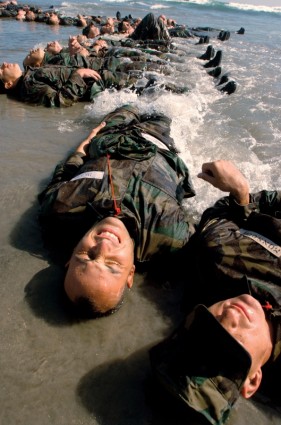
Army

This afternoon, I actually had free time on my hands, alone. Wanting to take full advantage of this rarity, especially now that it is summer and my children are home from school, I drove to the bookstore. I treated myself to a white chocolate mocha and browsed through the book shelves. I picked up a small book that called out to me, titled The Thing You Think You Cannot Do. I opened to a page that talked about the author’s experience in Iraq.

I walked with the book to the café and sat at a table next to the window. I returned to that page, and read something that I thought was quite appropriate to share for the Fourth of July Holiday. Here are excerpts of what the author, Gordon Livingston, M.D., wrote in Chapter 10, Beware of ideas on which we all agree:

“No shared feelings are more firmly embedded in the American culture than the admiration and gratitude that we have toward the young men and women who have served in our most recent wars. Their sacrifices are celebrated at every opportunity, and stories about our “wounded warriors” and their families are a stable of the nightly news. Our great national spectacles – sporting events, holidays – become occasions for patriotic celebration and remembrance, rife with clichés (such as “Freedom isn’t Free”) designed to reassure us that, while we personally have not chosen to sacrifice anything during wartime, we at least appreciate those who have made the choice to do so. They stand in their camouflage uniforms often looking a little mystified at the applause.

The reflexive impulse to treat our troops as heroes serves an important part aside from relieving our guilt at having done nothing ourselves. The war in Iraq, no less than other wars, involved the morally ambiguous process of killing large numbers of people who posed no threat to us. Because the instruments of destruction were our sons and daughters, we find it hard to take responsibility for asking this of them without regret and self-examination. Ignoring our misjudgments and redoubling our admiration for the young people who risked everything on our behalf are far easier….

The “Support our troops” bumper magnets that blossomed as the invasion of Iraq commenced could have just as well read “My country, right or wrong!”

And so we venerate those who put themselves in fear-inducing situations on our behalf and did whatever they could to survive. Most of them are neither heroes nor killers, just patriotic people volunteering to hazard themselves for reasons that to them seemed good at the time. Can we deal with our fears in some way that does not involve the use of bullets or high explosives? Can we celebrate those willing to take risks while creating alternative ways for young people to serve their country that are less costly to them and to others in distant places who love their children in the same way that we love ours?” 

I hope that we value our troops enough to listen and reflect upon the questions Mr. Livingston posed before us, and invest the time, wisdom and love necessary to find answers for these powerful questions.

Love and Power and War

Love&Power

This morning I read a passage about war in Lynn Andrew’s book, Love and Power (pg.76), which I felt is important to share.

War comes from the idea and the belief that I am here and you are there, and we are separate. There is a great weakness in this concept. In blindly accepting the concept of duality, you will always lose, because you become lost in a deadly game of social power. The game of social power is very different from the game of personal power. In personal power, you honor a worthy opponent, which I’ll explain later. In the game of social power, you are trying to win over someone else. That immediately puts you in a one-down position, which is an aggressive, confrontational position of separation. If you are trying to live in true power, this one-down position will defeat you at every turn. You are caught before a vast chasm of duality where you are forever distanced from others whom you wish to dominate.

The first step toward bridging the chasm of duality is accepting life as it is.


Combining Yoga and Journaling

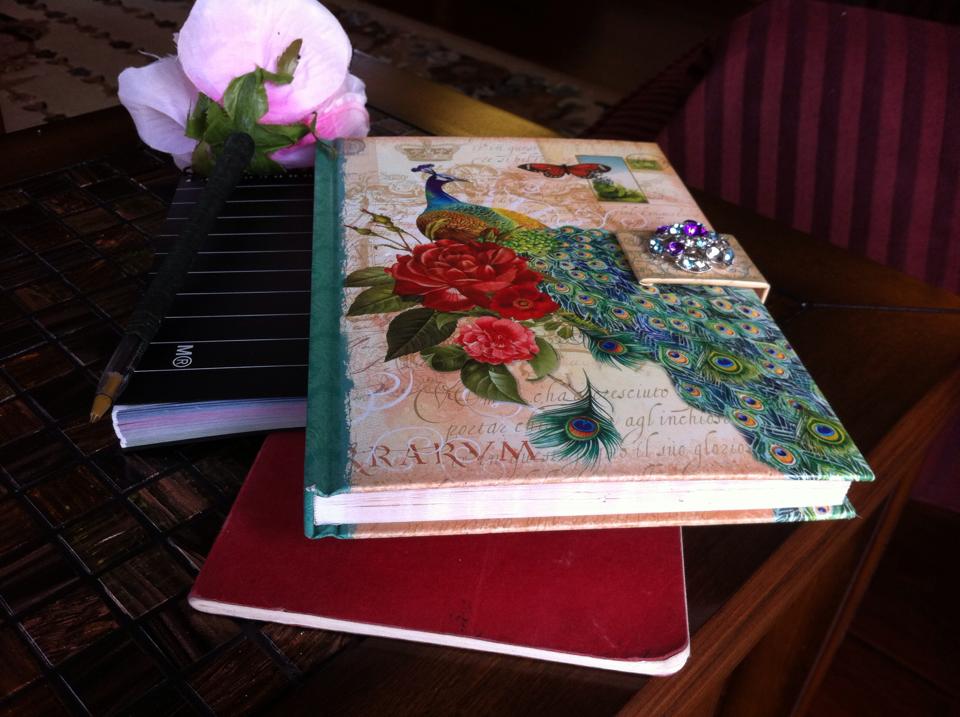
Journaling

I love journaling and I love yoga. So when my niece Sandy, a yoga instructor, asked me to participate in a trial yoga and journaling class for her upcoming studio workshop, I was delighted to do so. I have been doing yoga for over ten years and many instructors have incorporated creative ideas along with this practice but journaling was never one of them – although it makes perfect sense to combine the two.

Many times in my yoga class the instructor would say a profound statement or I myself received an inner message, a revelation which I wanted to jot down. I would remind myself to take note of these things at home, only to get too preoccupied. I’d leave the yoga studio, pick up my children from the daycare center, and arrive home to a list of unfinished household chores. By nighttime, whatever I wanted to write left my mind and like a bird flew into the sky.

When Sandy led this yoga and journaling class Tuesday afternoon, I enjoyed the moments in between the meditations and yoga movements where we had the opportunity to look within and write about certain experiences.  It was a lovely, meaningful and deep way to start the day, with its positive energy spilling over into the evening and night.

As I write this, I recall an interview with Billy Hayes, who wrote a book about his life in a Turkish prison, Midnight Express. The story was later made into an award winning film by Oliver Stone.  Hayes says that yoga saved his life in jail.

“Stress kills,” Hayes said in the interview. “Yoga keeps me healthy, helps me chill. Emotionally, it keeps me balanced. It saved me in jail. In prison, you have no control over anything except you; you still have yourself, your own body, so yoga gives you back that control that the prison takes away.”

Today Hayes works with James Fox on the Prison Yoga Project.

Writing has had a similar healing, growing and thriving effect on people.

“When you write down your ideas you automatically focus your full attention on them. Few if any of us can write one thought and think another at the same time. Thus a pencil and paper make excellent concentration tools.” Michael Leboeuf

Imagine the power of combining these two activities into our regular routine.

For more information about this workshop, visit www.sandynaimou.com

pure intention 2-26-15

Create a Paradise

Paradise

From Walk in Balance by Lynn Andrews – a book of daily meditations

You see, in a way I have created my own paradise. What we create in the world, we must first create within ourselves. A long time ago, I realized that we can either live in hell on this earth or we can live in a land of peace and joy, what one might call a paradise. There are really only two ways to live. If one is to find heaven, one has to open one’s heart to love. That is the moon gate that one has to walk through to find eternal peace.”

Shakkai  Shakkai, Woman of the Sacred Garden