Cultural Glimpse

Enjoying diversity

Category: History

Ziplining through the Yucatan Peninsula Jungle

Today’s freezing cold reminded me of the beautiful warm weather in Cancun, particularly the day we ziplined in the Yucatan jungle. The video here is the second zipline adventure we did, and it was mild in comparison to the first one, where the zipline was so high, they paired us with our children.

I was proud to have participated in something excitingly frightening – until on the flight home, I watched Everest and felt that this zipline really paled in comparison to most adventures. Anyway, I still take credit for doing something outside my comfort zone. When you’re in that area, surrounded by nature, it becomes natural to do physical activity.

The Yucatan Peninsula consists largely of the ancient Maya Lowlands, with many Maya archaeological sites such as the Chichen Itza, Tulum, and Uxmal. In modern history, it was largely a cattle ranching, logging, chicle and henequen production area. Since the 1970s, and the fall of the world henequen and chicle market due to the advent of synthetic subtitles, the Yucatan Peninsula’s economy has leaned more on tourism.

Due to this, we were able to enjoy a stroll in a Mayan town, having lunch at a family-owned Mayan restaurant, and experiencing several ceremonies with Mayan shamans, which for me was the most delightful adventure!

DSC_6151


Riding the Mayan Limousine to the Coba Ruins

“Mayan people did not leave the Earth, with aliens, to another planet,” said our tour guide. “They are still here, making handmade items. Each family-owned store supports almost fifty people.”

Our bus arrived to the Coba Ruins in Tulum.  The tour guide explained that Mayan was not an empire. It was a city of 70,000 people with smaller cities within the bigger city, but not where one person ruled over everyone. Their classical era was between 400 to 900 AC. During that time, men who had knowledge controlled people by keeping them ignorant and using this knowledge to make them people believe in them.

So, those who knew about solstice and equinox, which occurs twice a year, would make predictions based on this information and would credit this prediction to his close relationship to God, which he communicated with by going to the top of the temple. They claimed that the God of Rain, or whatever god, delivered information to this or that special person. (Hmm… I think people in power are still using this system to control people).

He talked about the Mayan sacred book, which mentions the World Tree. That’s a magical tree that creates the four sacred directions moving out of the center. It’s a structure for humans that shapes and accesses the spiritual worlds. According to their belief, the World Tree was the first creation and then everything emanated, and continues to emanate, from it.

“Now we are going to go see the Coba archeological site and, if you want, you can go up the 120 steps.”

The tour guide then explained that we had three options to get to the ruins: one, walk there; two, rent a bicycle; three, rent a Mayan limo, a chauffeured tricycle where you just sit and take in the sights. We opted for the limo, which my children (even myself) found more adventurous than climbing the Coba ruins’ 120 steps, which we did, huffing and puffing.

IMG_5733 (2)

The Loss of Chivalry

Chivalry

An American man who worked as a warden at the U.S. Embassy in Bahrain once told me how when he got to the airport in Bahrain, he learned that contrary to what he had grown up thinking, women in the Arab world do have rights, not as many rights as they need to have, but they do have rights.

He was standing in line at customs when a woman just zoomed in front of all the men in line. He called out on her inappropriateness with a “Hey, hey, back of the line!”

All of the sudden, he was surrounded by police and angry civilian men. He knew he’d done something wrong, but given the language barriers, he couldn’t figure out what it was. Seeing what’d happened, a British man intervened, explaining to the police that this American did not know the customs of this country, which was that women are allowed to cut in line whenever or however they pleased and no one could say a word about it.

“You don’t do that here with women,” said the British to the American.

For the remainder of his stay in Bahrain, the American man didn’t dare open his mouth when he begrudgingly watched women cut in line at supermarkets, even when he and other men would have one or two items and the women had ten.

This right may seem like no big deal, but it is a big deal given how far we’ve distanced ourselves from chivalry and respect toward women. Yesterday, a Muslim woman was kicked out of Donald Trump’s rally, with a crowd of men harassing her exit along the way. It was an inappropriate behavior for our great nation that’s supposed to set an example for the rest of the world. It’s also a behavior that puts our nation at risk. When these types of footage go viral, they attract the attention of those who already hate us and makes it easier for them to recruit more members.

As I often say, it’s not a woman’s dress that threatens our society, whether she dresses modestly or in a bikini, it’s the politics of leaders who place their best interest before that of their nation, as so happened at this rally.

The Truth About the Veil

The Veil

Last week, I did a radio interview with Stu Bryer of WICH in Norwich, Connecticut. We talked about several subjects, including the Syrian refugees and the veil. While I believe that veils that completely disguise people are problematic for safety purposes and unnecessary in a Western country where people choose to live, I also feel that we should explore the issue of veiling in a more historical and personal context.

During my trip to Baghdad in 2000, I visited my parents’ Christian village in Mosul and asked my cousins to find me an abayya in the souk. He found one I liked, disputed with the merchant over a few dinars, wanted to walk out, and at my plea, agreed on a price. I left with an abbaya that today still has some of the spices I’d carried in my luggage in a journey that lasted from Baghdad to Detroit three days.

What’s an abbaya? It’s a veil that reminds me of my mother and the neighborhood women who’d sometimes wear it when they went to the market. Since Saddam encouraged women to wear western clothing and he was against Islamic fundamentalists, the burka wasn’t allowed in Iraq. Usually older women wore the abbaya. They did so for religious purposes, as Islam requires women to dress modestly in order to keep the focus of beauty on spiritual and not superficial attributes. Wearing the veil was also a way to avoid harassment. But mostly, they wore it because it was part of a culture that predates Islam by many centuries.

In the Near East, Assyrian kings first introduced both the seclusion of women in royal harem and the veil. Prostitutes and slaves, however, were told not to veil, and were slashed if they disobeyed this law. This practice also appeared in classical Greece, in the Byzantine Christian world, in Persia and in India among upper caste women. It’s suggested that afterwards it spread among the Arabs.

Muslims in their first century were relaxed about female dress. As Islam reached other lands, regional practices, including the covering of women, were adopted. Yet it was only in the second Islamic century that the veil became common, first used among the powerful and rich as a status symbol. Muhammad’s wives originally dressed in veil in order for people to distinguish them from other women.

Throughout Islamic history only a part of the urban classes were veiled and secluded. Rural and nomadic women, the majority of the population, were not. The veil did not appear as a common rule to be followed until around the tenth century. In the Middle Ages numerous laws were developed which most often placed women at a greater disadvantage than in earlier times.

For 2,000 years, Catholic women have veiled themselves before entering a church or any time they are in the presence of the Blessed Sacrament (e.g., during sick calls). It was written into the 1917 Code of Canon Law, Canon 1262, that women must cover their heads – “especially when they approach the holy table”

For many centuries (until around 1175) Anglo-Saxon and then Anglo-Norman women, with the exception of young unmarried girls, wore veils that entirely covered their hair, and often their necks up to their chins. It was in the Tudor period (1485), when hoods became increasingly popular, that veils of this type became less common.

Sometimes a sheer was draped over and pinned to the bonnet or hat of a woman in mourning. They would also have been used as a simple method of hiding the identity of a woman who was travelling to meet a lover, or doing anything she didn’t want other people to find out about. Veils were also sometimes worn to protect the complexion from sun and wind damage (when un-tanned skin was fashionable), or to keep dust out of a woman’s face. Conversely, veils are often part of the stereotypical image of the courtesan and harem woman where the mysterious veil hints at sensuality and the unknown.

Among the Tuareg of West Africa, women do not traditionally wear the veil, while men do. It’s believed that the veil wards off evil spirits, but most probably relates to protection against the harsh desert sands as well. This veil is worn from 25 years of age and is never removed, even in front of family members.

What about the origin of a bride’s veil? Some say that the veil was introduced in ancient Rome to keep away the evil spirits. It’s also said that it was a symbol of purity, chastity, and modesty. Other say that the origin of the bridal veil was due to the circumstances of an arranged marriage. In days past, men bargained with an eligible young lady’s father for their hand in marriage. After the ceremony, the veil was lifted to reveal the bride’s features. This was to keep a groom from backing out of the deal if he didn’t like what he saw.

With my mother, the veil was used for convenience, when she didn’t want to change from her nightgown in order to go to the bakery and buy bread. Or when my cousin wanted to meet her lover without anyone noticing her. Or it was worn by those who found it attractive or simply liked having it flutter around their ankles.

When I was a little girl, I used my mother’s veil to play house. I couldn’t wait to grow up and have my own veil, not knowing then that one day wearing fabric in such a manner, or not wearing it, could cost women their lives.


Trumbo’s Communism was the Islamism of the Time

My father, a lover of words and numbers, was the head of the accounting department for Baghdad Railway Station. On the side, he did translation, from Arabic to English and vice versa. His free services included being a bonesetter and representing people who could not afford an attorney in court. People trusted him because he was a just man and he knew how to play with words as if they were marbles.

Words can be used with good or bad intentions. My father used words to help heal and free people. Some people, like government officials and media personalities, play with words to instill fear and oppress people. They will take a word like communism and flavor it with all the necessary negativity to cause an unwarranted fear and create an Us vs. Them attitude.  Anyone slightly associated with that word is the “Bad Guy” and anyone against that word is the “Good Guy.”

Let me demonstrate a specific way the government played with words to help its war campaign against Iraq. The communists of Iraq are rarely mentioned because, for the sake of showing what a brutal man Saddam was, these communists were renamed anti-Saddamists. Look at the infamous black and white televised image of Saddam at the podium. He announces that “There are traitors among us (i.e. communists).” Then he calls off a list of names (given to him by US gov.). He wipes tears from his eyes because some of these men, although communists, were his friends. But he was willing to do anything to align with his western allies and gain power.

The US helped the rise of the Baathist Party because they did not want another communist country. From the beginning, they offered a list of 800 Iraqi communists to the Baathist insurgents, and all were killed. Many communists fled Saddam’s regime. The televised image of Saddam calling out the names of these communists (later called anti-Saddamists) was circulated to convince people that the world would be safer and more peaceful without Saddam.

Ironically, removing these 800 communists, then removing Saddam, has not made the world safer or more peaceful. We’ve actually achieved the opposite effect. Yet, when I watched Trumbo the other day, I realized that we’ll be doing more of the same thing and expecting a different result (the definition of insanity). We’ll continue to be tricked into a fear-based atmosphere which will distract us from what’s really going on and rob us of our true freedom.

I write not to point fingers. I write from experience. Having grown up in a totalitarian regime, I can smell oppression thousands of miles away.  For that reason, I strongly encourage people to not only watch Trumbo, but to learn from it.

Healing Wisdom for a Wounded World

Healing Wisdom for a Wounded World3

This is the first of a four-book memoir series – Release date February 2016

When Irina Tweedie, a British woman, met with her Sufi Master in India, he told her to keep a diary.

“One day it will become a book,” her Teacher said. “But you must write it in such a way that it should help others. People say, such things did happen thousands of years ago – we read in books about it. This book will be a proof that such things do happen today as they happened yesterday and will happen tomorrow – to the right people, in the right time, and in the right place.”

Tweedie’s diary spans five years and, published as Daughter of Fire, it records her spiritual transformation. Several times I read her book with a burning desire to have a similar teacher as hers help me toward my spiritual journey.

My concern was, do I have to go to India or other parts of the world for that? The answer was no. Throughout my life, I had different spiritual teachers (from India and Native Americans) who came to my door and helped me walk out of the fog and into my bliss. They taught me a great deal, but after we departed, I felt something was unfinished.

Then I met Lynn Andrews – through a book. As a woman from Beverly Hills, who was the bestselling author of some 20 books, I figured she’d give me a bit of literary advice. I did not expect her to change my life through her shamanic school. At that time, I had never even heard of Lynn Andrews or the word shaman.

Several factors drew me to the school, most notably its ancient teachings that also reside in my heritage, ancient Mesopotamia, now called Iraq. Although it’s not easy to image this now, once upon a time ancient Iraq was the Cradle of Civilization and its land flourished with goddesses like Inanna. Two important women are from that region: the first recorded writer in history, Enheduanna, a princess and priestess, and Kubaba, the first recorded woman ruler in history.

The Feminine Power that lived there was eventually attacked and oppressed by strict patriarchal beliefs. Little by little, due to totalitarian regimes and too many wars that were, and still are, led by unfathomable greed and ignorance, the Cradle of Civilization has turned into a frightening nightmare.

It is a blessing that my parents had the wisdom to move us to America right before the Iraq/Iran war. Here in America, with the love and support of powerful western women who have walked this path long before me, I had the opportunity to heal my wounds and to do what I could never do in Iraq – openly share my spiritual journey in a book.

Healing Wisdom for a Wounded World, the first of a four book memoir series, will be released in February 2016. The memoir is about how Lynn’s school changed my life, one year at a time. Harry Potter’s Hogwarts School of Witchcraft and Wizardry could not have done a better job teaching its students the creative depth and breadths, the charms, art, divination, ancient studies, the history of magic and potions needed to transform ourselves, people, relationships and circumstances.

I’m Most Grateful for Graduating this Year

IMG_5157

Morning of Graduation

When I graduated high school, I did not walk at commencements. I did not view my high school diploma as much of an accomplishment. When three years later, I received my bachelor’s degree from Wayne State University, I again did not walk at commencements. Although I enjoyed my college years and was happy to attain my degree, I felt there was something missing. I had a deep desire to learn more about myself and real life that seemed beyond what formal education could teach.

For the next two decades, I studied with various spiritual masters and took umpteen writing courses. All were wonderful experiences that helped me grow and flourish as a person and a writer, but most importantly, they led me to an extraordinary school, Lynn Andrews’ four-year shamanic school. I had initially signed up to the school to find my literary voice which had gotten lost by the pains of witnessing the Iraq war and by my enormous responsibilities as a wife and new mother.

I had no idea then that the school’s ancient teachings would not only heal old wounds that had muffled my literary voice, but that it would also improve my relationship with the Great Spirit, with myself, and with my family. The work was mystical but also very intense and challenging. I had to put my heart and soul into my family, home and career while doing the schoolwork because the purpose of these teachings is to incorporate what we learn into every aspect of our daily life.

Last month, I flew to Arizona to join other apprentices in a gathering where we graduated from Lynn’s school. This time, I walked at commencements in a most sacred ceremony.  I had taken a life-changing journey and was now surrounded by amazing women from all walks of life. For me, this was a real milestone that was worthy of celebration.

This Thanksgiving, I give special gratitude for graduating from a school that had, not long ago, only existed in my imagination.

For more information about Lynn and her school, you can visit her website: http://lynnandrews.com/

Memoirs of a Babylonian Princess

Memoirs of a Babylon Princess

I have finally started reading Memoirs of a Babylonian Princess, a book written 200 years ago by a woman from Telkaif in northern Iraq, my ancestors’ once Christian town which was overtaken by the Islamic State in the summer of 2014. The fact that this little gem of a book, and its author Maria Theresa Asmar, were practically buried into oblivion among its own people is quite disturbing to me, to say the least.

I first learned about Memoirs of a Babylonian Princess when I had to cover a story in the summer of 2012. Emily Porter PhD, an Iraqi-British artist, author and activist, had traveled from her hometown in Great Britain to do work at the Metropolitan Museum of Arts in New York regarding Asmar’s memoirs. She gave a lecture at Shenandoah Country Club about this memoir, and like Porter, I was amazed that few, if any, people in our Chaldean community had heard about this 720 page book.

Porter had stumbled upon this book when she was searching through a friend’s library.

“I found a book about Telkaif that briefly mentions Memoirs of a Babylonian Princess, followed by the criticism that Maria Asmar exaggerates in her work,” said Porter. “I thought, over 700 pages of a memoir, written by a woman from Telkaif in the early 19th century, and all this person has to say about it is that the author exaggerates in her writing?”

Maria was no ordinary woman, either. She traveled alone to Europe, the Middle East and other parts of the world. She met with Queen Victoria and even dedicated her book to the queen. She set up a school for women in Baghdad and welcomed western Christian missionaries, who then bribed the Turkish government to give them the licence for the school and forbid Maria to carry on with her project. Left frustrated and angry to have been treated this way by fellow Christians, she sought sanctuary with the Muslim Bedouins. She set about recording their daily lives, everything from the weddings and celebrations to their assaults on other tribes.

As I read her memoirs, I am in awe of the rich material it contains and of the beauty in Maria’s literary voice. I also find it interesting that while her work was neglected by her own community, in Great Britain and even in the United States, it has received a much wider and respectable recognition.

Sleeping Bear Dunes

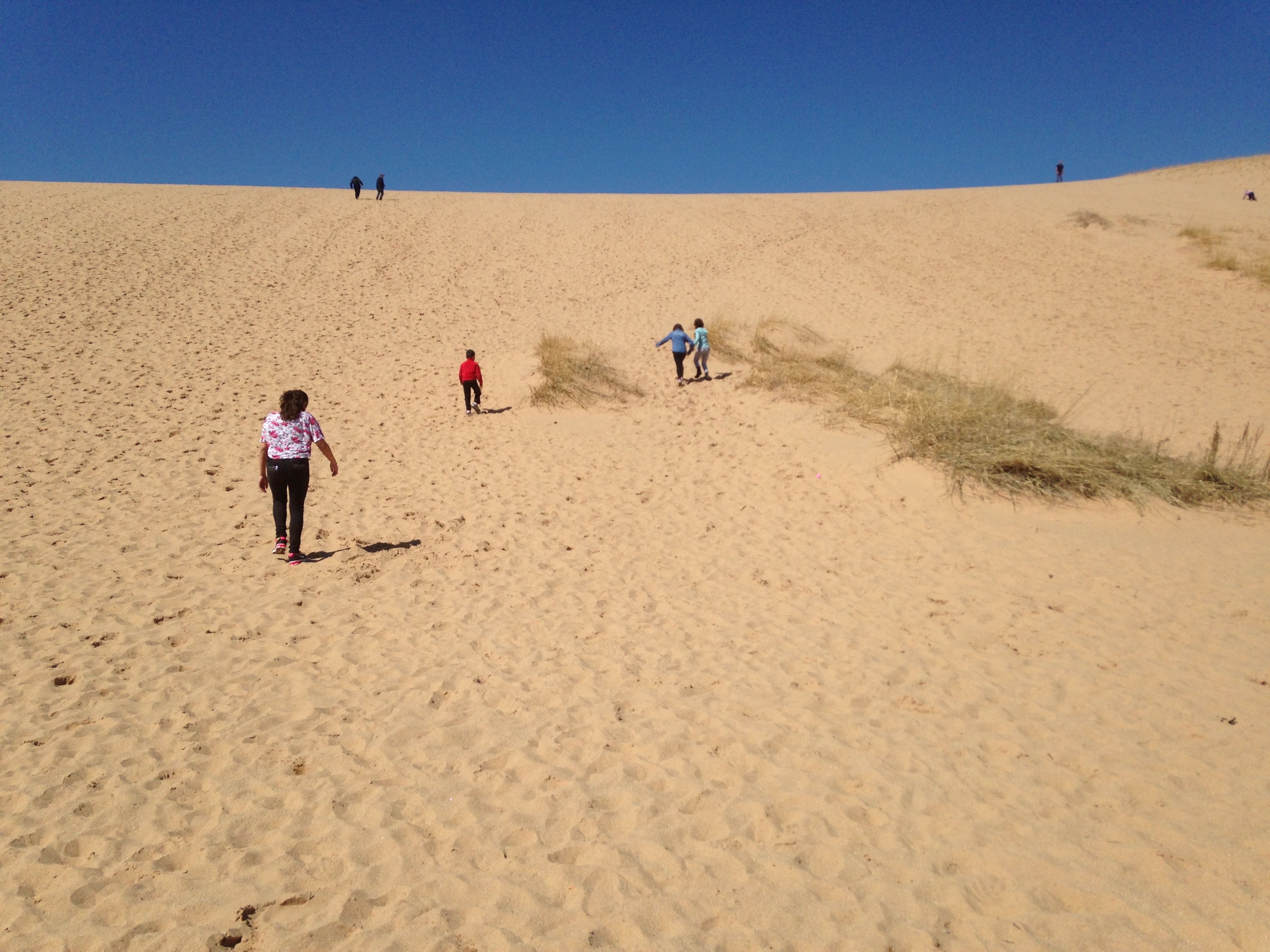
We visited Sleeping Bear Dunes last month. This park covers a 35-mile-long stretch of Lake Michigan’s eastern coastline as well as North and South Manitou islands. It was an adventure climbing up and rolling down the sandy mounds that reminded us of Baghdad’s deserts, walking barefoot alongside Lake Michigan, collecting rocks and getting lost while we were at it.

I later learned through online research that the park is named after a Chippewa legend of the sleeping bear. According to legend, an enormous forest fire drove a mother bear and her two cubs into the lake for shelter, to reach the opposite shore. After many miles of swimming, the two cubs wadded behind and eventually drowned. The mother bear arrived to shore and waited for her cups to appear.

“That’s a touching and nice story,” my Native American friend said when I told it to him. “A lot of tourist places have a mythical story which is the attraction.”

The Great Spirit, I continued, created two islands (North and South Manitou islands) to commemorate the cubs, and the winds buried the sleeping bear under the sands of the dunes where she waits to this day.

“That doesn’t sound like a gift from the Great Spirit,” he said. “It sounds like a mother that couldn’t take care of her cubs.”

He said that the Manitou in Canada originally came from the Michigan region, the Manitou Island, which translates as “the Creator’s Island.” When the English and the Americans were fighting during the Revolution and other wars, most Indians didn’t want to join either side so they went to Manitou Island in Ontario, just to get away from the fighting. When the fighting was over, and they wanted to return, the Americans would not allow them to return because they had alliance with King George at that point. So they had to stay in Canada.

“People in the clan system are still here,” my Native American friend said. “They haven’t gone anywhere. It’s the Sleeping Bear. It’s sleeping because you’re not using it. There are very powerful things there, but no one is using them. They can say there were little bears frolicking around there, whatever, but the Sleeping Bear is always here. It never left. It’s still waiting for good things. And these people that make war they don’t want to wake up the Sleeping Bear, because then the truth will come out.”

IMG_3641

Never Forget Those Who Spent Their Lives Protecting, Empowering and Informing Us

IMG_3793

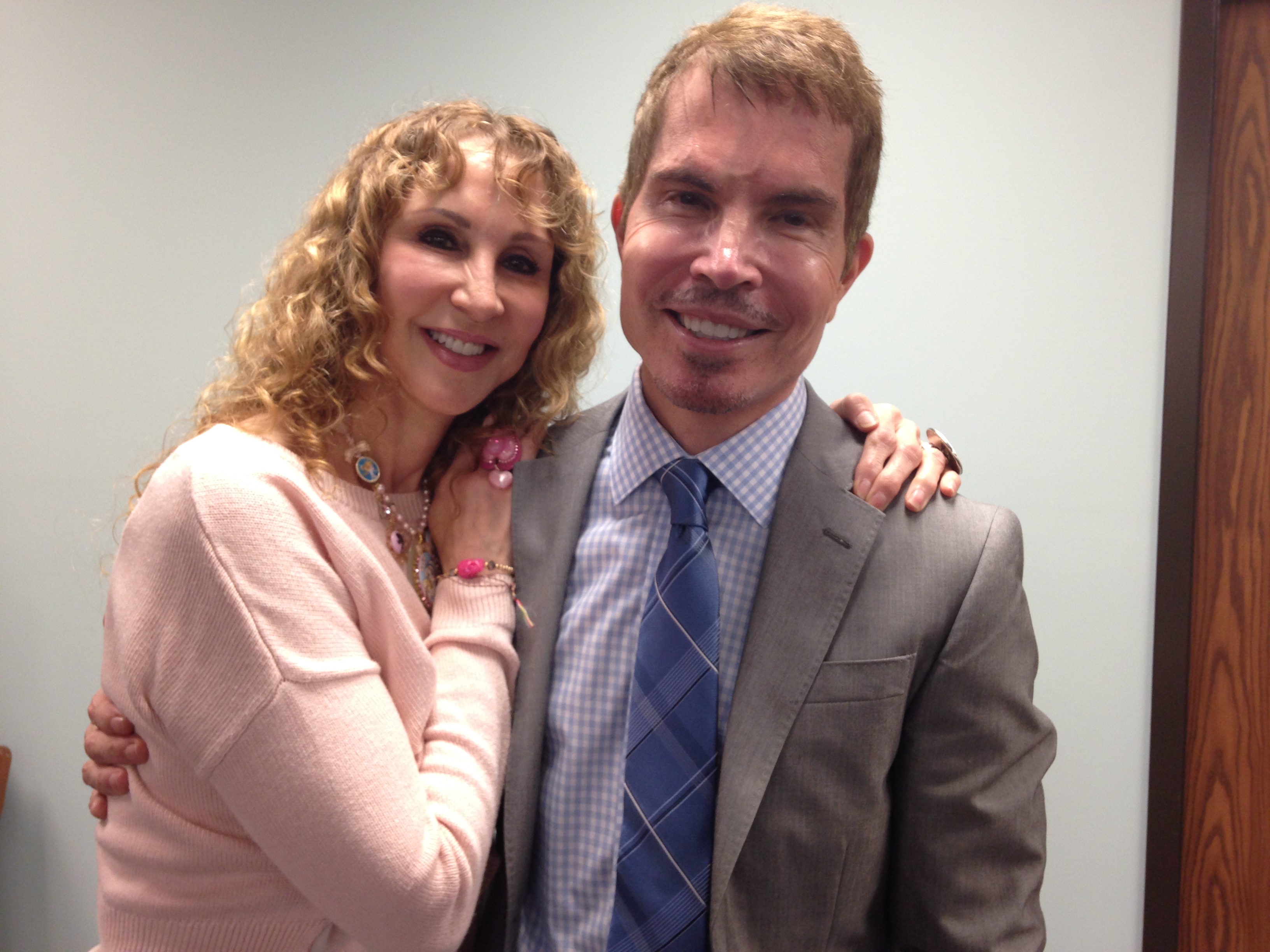
Last week investigative journalist and author of twelve books Gerald Posner visited the Troy Public Library. I arrived early to the event and sat in the front row. A beautiful woman with exquisite jewelry sat nearby. The man behind me was asking her questions and I soon discovered her name is Trisha, and she was the author’s wife.

With a British accent, she talked about how she and her husband met thirty five years ago. She’s from England, he’s from San Francisco, and they met on a blind date in New York. He started out as an attorney, she was in fashion, he’s Catholic, she’s Jewish, but they work as a team. She helps do research for her husband’s books.

Posner’s work has received much controversy, and at one point, even death threats.

“Once someone sent us a dead fish and another time, a rat’s tail in the mail,” said Trisha. “I was very surprised. I never realized that at this day and age, this type of mentality exists.”

She adds that this has never, and never will, stop them from writing what intrigues them.

Posner’s first book, co-written with British journalist John Ware and published in 1986, was the biography of Mengele: The Complete Story. Mengele was a German Schutzstaffel (SS) officer and physician in Auschwitz concentration camp during World War II. From May 1943 through January 1945, Mengele selected who would be gassed immediately, who would be worked to death, and who would serve as involuntary guinea pigs for his spurious and ghastly human experiments (twins were Mengele’s particular obsession). After the war, he fled to South America, where he evaded capture for the rest of his life. Posner and Ware obtained exclusive access to 5,000 pages of Joseph Mengele’s diaries and personal papers for their book.

Another one of Posner’s books is Hitler’s Children: Sons and Daughters of Leaders of the Third Reich Talk about Themselves and Their Fathers, which includes in-depth interviews with a dozen children of top Nazi officials.

Why America Slept exposes the frequent mistakes made by law enforcement and government agencies, and demonstrates how the failures to prevent 9/11 were tragically not an exception but typical.

In Secrets of the Kingdom: The Inside Story of the Secret Saudi-U.S. Connection, Posner provides an account of the “close” business and personal relationship between the House of Saud and the U.S. government, including discussions of “dirty bomb” technology and the financial and political maneuvering surrounding 9/11. Posner also asserts that the Saudis have built an elaborate doomsday scenario around their oil fields. The Saudis have denied this, and according to Posner, he and his wife, Trisha, have been banned from entering Saudi Arabia as a result of this book.

Posner’s most recent book is God’s Bankers: A History of Money and Power at the Vatican is a 200 year history of Vatican finances and the Vatican Bank.

“For 1800 years, these were Pope Kings who had their own empire and lived a lavish lifestyle,” said Posner. “They lost it in the late 1800s and they got it back by Mussolini, the fascist dictator of Italy, who gave them sovereignty in 1929. This changed everything.”

By World War II, the church created the Vatican Bank that operated “in the dark, in total secrecy.”

Posner explained how during this time, the Nazis collected a tax for the Vatican that amounted to 100 million dollars a year.

“Part of the silence from the Pope in World War II was financial,” he said.

In a review written in the Washington Post by Beth Kingsley, she states:

“Church leaders’ priorities were often questionable. Reluctant to publicly address the Holocaust, they did not hesitate to protest reports of nudism being practiced by the Germans. Prostitution worried them more than did death camps.”

This reminded me of the same-sex marriage laws that the world is focusing and refocusing on right now as hundreds of thousands of peoples are destroyed by the war in the Middle East that we have the power to put an end to.

Some people have called God’s Bankers anti-Catholic, but Posner says, “Now wait a minute, I’m Catholic. If you’re a devout Catholic it should not mean you cannot look at all sides of that topic. You can’t leave out the bad news with the good news. I can’t write about Germany and leave the Holocaust out. I can’t write about Henry VIII without writing about him having chopped his wife’s head off.”

It seems that anyone who is smart enough to want to question and research a topic, which we’re all encouraged to do since a very young age, is automatically called “anti this” and “anti that”.

“This book is not about God and it’s not about religion,” he said. “You can learn from it so it can be avoided in the future.”

That’s exactly what truth is all about, and why men and women risk their lives to defend the United States or immigrate to this country. The practice of free speech is a gift from God, and in realizing its importance, this country made it a First Amendment. Incredible amount of information is easily and readily available to us, yet most people will not bother investing their time in such matters, even though that’s one of the greatest ways to pay tribute to our veterans.