Cultural Glimpse

Enjoying diversity

Category: Culture

Never Forget Those Who Spent Their Lives Protecting, Empowering and Informing Us
IMG_3793

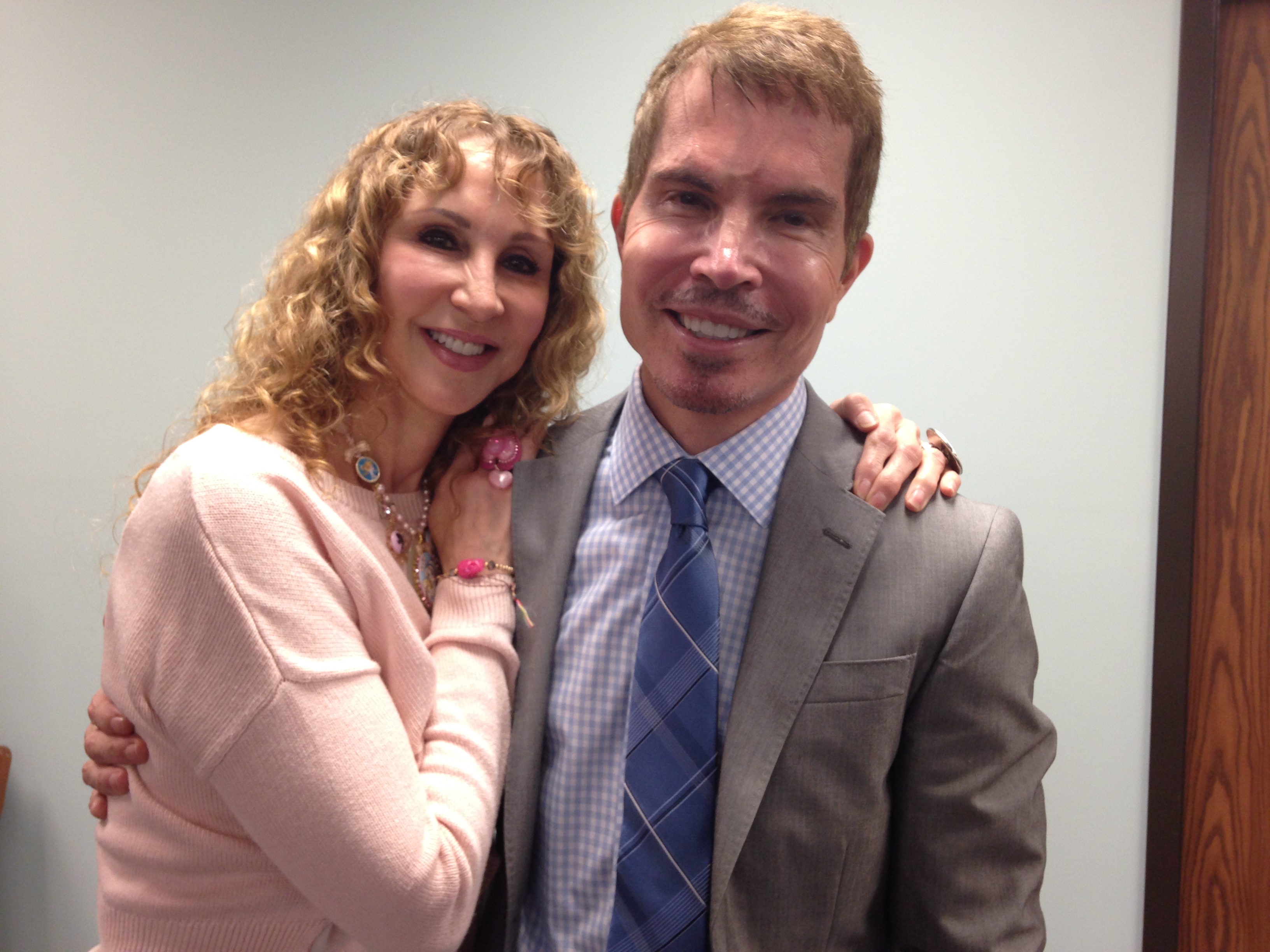
Last week investigative journalist and author of twelve books Gerald Posner visited the Troy Public Library. I arrived early to the event and sat in the front row. A beautiful woman with exquisite jewelry sat nearby. The man behind me was asking her questions and I soon discovered her name is Trisha, and she was the author’s wife.

With a British accent, she talked about how she and her husband met thirty five years ago. She’s from England, he’s from San Francisco, and they met on a blind date in New York. He started out as an attorney, she was in fashion, he’s Catholic, she’s Jewish, but they work as a team. She helps do research for her husband’s books.

Posner’s work has received much controversy, and at one point, even death threats.

“Once someone sent us a dead fish and another time, a rat’s tail in the mail,” said Trisha. “I was very surprised. I never realized that at this day and age, this type of mentality exists.”

She adds that this has never, and never will, stop them from writing what intrigues them.

Posner’s first book, co-written with British journalist John Ware and published in 1986, was the biography of Mengele: The Complete Story. Mengele was a German Schutzstaffel (SS) officer and physician in Auschwitz concentration camp during World War II. From May 1943 through January 1945, Mengele selected who would be gassed immediately, who would be worked to death, and who would serve as involuntary guinea pigs for his spurious and ghastly human experiments (twins were Mengele’s particular obsession). After the war, he fled to South America, where he evaded capture for the rest of his life. Posner and Ware obtained exclusive access to 5,000 pages of Joseph Mengele’s diaries and personal papers for their book.

Another one of Posner’s books is Hitler’s Children: Sons and Daughters of Leaders of the Third Reich Talk about Themselves and Their Fathers, which includes in-depth interviews with a dozen children of top Nazi officials.

Why America Slept exposes the frequent mistakes made by law enforcement and government agencies, and demonstrates how the failures to prevent 9/11 were tragically not an exception but typical.

In Secrets of the Kingdom: The Inside Story of the Secret Saudi-U.S. Connection, Posner provides an account of the “close” business and personal relationship between the House of Saud and the U.S. government, including discussions of “dirty bomb” technology and the financial and political maneuvering surrounding 9/11. Posner also asserts that the Saudis have built an elaborate doomsday scenario around their oil fields. The Saudis have denied this, and according to Posner, he and his wife, Trisha, have been banned from entering Saudi Arabia as a result of this book.

Posner’s most recent book is God’s Bankers: A History of Money and Power at the Vatican is a 200 year history of Vatican finances and the Vatican Bank.

“For 1800 years, these were Pope Kings who had their own empire and lived a lavish lifestyle,” said Posner. “They lost it in the late 1800s and they got it back by Mussolini, the fascist dictator of Italy, who gave them sovereignty in 1929. This changed everything.”

By World War II, the church created the Vatican Bank that operated “in the dark, in total secrecy.”

Posner explained how during this time, the Nazis collected a tax for the Vatican that amounted to 100 million dollars a year.

“Part of the silence from the Pope in World War II was financial,” he said.

In a review written in the Washington Post by Beth Kingsley, she states:

“Church leaders’ priorities were often questionable. Reluctant to publicly address the Holocaust, they did not hesitate to protest reports of nudism being practiced by the Germans. Prostitution worried them more than did death camps.”

This reminded me of the same-sex marriage laws that the world is focusing and refocusing on right now as hundreds of thousands of peoples are destroyed by the war in the Middle East that we have the power to put an end to.

Some people have called God’s Bankers anti-Catholic, but Posner says, “Now wait a minute, I’m Catholic. If you’re a devout Catholic it should not mean you cannot look at all sides of that topic. You can’t leave out the bad news with the good news. I can’t write about Germany and leave the Holocaust out. I can’t write about Henry VIII without writing about him having chopped his wife’s head off.”

It seems that anyone who is smart enough to want to question and research a topic, which we’re all encouraged to do since a very young age, is automatically called “anti this” and “anti that”.

“This book is not about God and it’s not about religion,” he said. “You can learn from it so it can be avoided in the future.”

That’s exactly what truth is all about, and why men and women risk their lives to defend the United States or immigrate to this country. The practice of free speech is a gift from God, and in realizing its importance, this country made it a First Amendment. Incredible amount of information is easily and readily available to us, yet most people will not bother investing their time in such matters, even though that’s one of the greatest ways to pay tribute to our veterans.

I Authenticate Myself

IMG_3638

The moment we arrived to the Schoolhouse Cottage in Suttons Bay, I told everyone I was going for a walk. I wanted to see the little town that Melissa, the house owner, described over the phone. She talked about the little café’s and art galleries, the wine tasting tours, the hikes and the nearby beaches. We had driven for five hours and I was ready to explore. My niece said she would accompany me. We got to the main street, which resembled a picturesque street that belonged to a small European town with no fast food restaurants or chain stores.

One particular corner caught my eyes. The outside had several metal welded art pieces on its walls and the center of its courtyard:  a bike, butterfly and the body of a women sleeping on her side. I took pictures of the area before I entered a store called Casey-Daniels. It had colorful handmade handbags and matching hats as well as handmade jewelry.

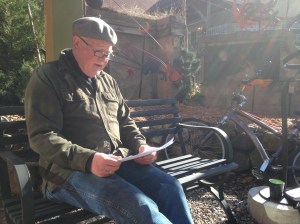
A man greeted us and when I told him we had just arrived for a weekend vacation, he immediately we dove into a long conversation about the town of Suttons Bay. His name was Will and he had been living in this area for 50 years. He made his own jewelry and pointed to a table where he sat all day to do the work. He told us about his neighborhood, the dozens of artists and writers who lived and worked there and the diners that served good food. I asked if I could write about him in my blog and he said, “You can do whatever you want. You’re a writer?”

“Yes.”

“What do you write?”

I told him about my books, including the poetry book coming out in May. He went to a corner and returned with two magazines, handed me one and my niece the other. It was called Exposures 2014, a Leelanau County Student Journal and it had been around for 26 years. He said he was the publisher. I flipped through it and saw poems written by school students along with pictures, paintings and other art work.

“There are no ads in here,” I said. “How are you able to publish this?”

“It’s funded by the schools.”

I frowned and closely observed it. “How did you manage that?”

He opened his eye glasses from the center of the frame and removed them. “We submitted a proposal to the school and they accepted.”

I was impressed. Before we left, he emphasized that we return to his store if we needed anything. The next morning I woke up before everyone else. I made myself a cup of coffee and walked to Will’s store. He and I sat on a bench outside his store, under the sun.

He told me about traveling with his friend every year to countries like Egypt and Ecuador, regions where their wives were not interested to go. He asked me about my work, and after I explained that I write about the Iraqi American experience, he said, “There’s an attitude in this country about the Middle East that is very stereotyped and we refuse to acknowledge that region’s historical literature. We want to group it in simplistic mindset in what constitutes the Middle East.”

He pointed to a green building across from us. “This building is green, right? But I tell you it’s blue. That’s the audience you’re confronting it.”

We continued to talk about the business of unconventional writing, and in the end, he said, “It’s important to get your foot through the door. Is it relevant which door you get your foot into it? I make weird things. I’m not going to stick myself in art shows. You know why? Because I’m not looking for the approval of others. No, I’m going to authenticate me.  You’re going to authenticate yourself. If I want to put them at a gallery, then I’m placing what I do at the throne of someone else. They stand and say, ‘Oh, that’s this and that.’ And I lose myself.”

With that, I returned home with a whole new perspective.  

IMG_3640

The Free Artist

An artist is truly free and creative when he or she is able to perform anywhere, at any time, with or without an audience, with or without monetary gain, utilizing the gifts God has given him, if only for God’s pleasure, the air, the trees, the birds around him. The sharing of his soul is his gift to the world. This describes the man we came across on Mother’s Day, as we walked towards our favorite restaurant in Greek Town.

On Giving

Khalil Gibran

You give but little when you give of your possessions.
It is when you give of yourself that you truly give.
For what are your possessions but things you keep and guard for fear you may need them tomorrow?
And tomorrow, what shall tomorrow bring to the overprudent dog burying bones in the trackless sand as he follows the pilgrims to the holy city?
And what is fear of need but need itself?
Is not dread of thirst when your well is full, the thirst that is unquenchable?

There are those who give little of the much which they have–and they give it for recognition and their hidden desire makes their gifts unwholesome.
And there are those who have little and give it all.
These are the believers in life and the bounty of life, and their coffer is never empty.
There are those who give with joy, and that joy is their reward.
And there are those who give with pain, and that pain is their baptism.
And there are those who give and know not pain in giving, nor do they seek joy, nor give with mindfulness of virtue;
They give as in yonder valley the myrtle breathes its fragrance into space.
Through the hands of such as these God speaks, and from behind their eyes He smiles upon the earth.

It is well to give when asked, but it is better to give unasked, through understanding;
And to the open-handed the search for one who shall receive is joy greater than giving.
And is there aught you would withhold?
All you have shall some day be given;
Therefore give now, that the season of giving may be yours and not your inheritors’.

You often say, “I would give, but only to the deserving.”
The trees in your orchard say not so, nor the flocks in your pasture.
They give that they may live, for to withhold is to perish.
Surely he who is worthy to receive his days and his nights, is worthy of all else from you.
And he who has deserved to drink from the ocean of life deserves to fill his cup from your little stream.
And what desert greater shall there be, than that which lies in the courage and the confidence, nay the charity, of receiving?
And who are you that men should rend their bosom and unveil their pride, that you may see their worth naked and their pride unabashed?
See first that you yourself deserve to be a giver, and an instrument of giving.
For in truth it is life that gives unto life while you, who deem yourself a giver, are but a witness.

And you receivers… and you are all receivers… assume no weight of gratitude, lest you lay a yoke upon yourself and upon him who gives.
Rather rise together with the giver on his gifts as on wings;
For to be overmindful of your debt, is to doubt his generosity who has the freehearted earth for mother, and God for father.

IMG_3766

Love and Power and War

Love&Power

This morning I read a passage about war in Lynn Andrew’s book, Love and Power (pg.76), which I felt is important to share.

War comes from the idea and the belief that I am here and you are there, and we are separate. There is a great weakness in this concept. In blindly accepting the concept of duality, you will always lose, because you become lost in a deadly game of social power. The game of social power is very different from the game of personal power. In personal power, you honor a worthy opponent, which I’ll explain later. In the game of social power, you are trying to win over someone else. That immediately puts you in a one-down position, which is an aggressive, confrontational position of separation. If you are trying to live in true power, this one-down position will defeat you at every turn. You are caught before a vast chasm of duality where you are forever distanced from others whom you wish to dominate.

The first step toward bridging the chasm of duality is accepting life as it is.


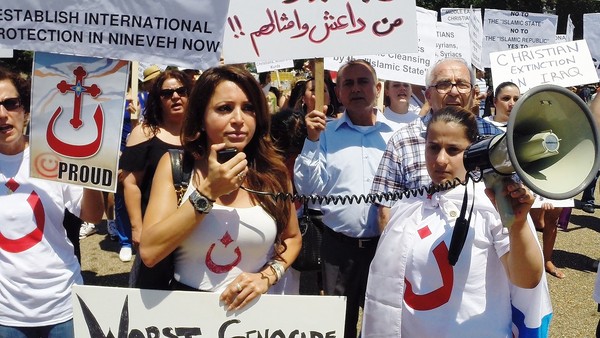
ISIS Continues Targeting Christians

Assyrians

My friend Nahren sent me the following report:

It is being reported by my journalist friends in Khabour that ISIS has started using the Assyrian Christian hostages as human shields including the children against the Syrian Military. It is confirmed that the amount of hostages right now are 217 and the difference from the original amount were hiding in red zone areas until they made their way back to their families and were identified. However, ISIS is requesting a ransom of $100,000 per Assyrian Christian hostage. The Sheikhs are trying to demand for their release through consistent communication and the sheiks claim that the 217 are still alive. Many Americans and non-Assyrians have attempted to drive into the Northern Part of Khabour which is under the Kurdish occupation. They were turned away even with permits from the KRG.

It is also reported by numerous sources that as some of the civilians made their ways back to their homes, they found that the Kurds completely have taken over their homes and properties. They were told that their homes did not belong to them anymore. Journalists and media are not permitted in the area anymore and witnesses have confirmed that they were allowing only Kurdish civilians to enter through the border. Furthermore, it is reported that the Kurds are already attempting to convert the Assyrian Christian village names into Kurdish names (it’s confirmed that 2 to 3 villages have already been changed).

I asked Nahren, who with other activists demands international protection, why the Iraqi minorities have not yet been helped. She explained part of the problem.

“Our own people are so divided in organizations, political parties, churches and so forth,” she said. “The day our people (Assyrians, Chaldeans and Syriacs) will unite like we used to be, I promise that Nineveh will rise with an amazing power that will be distinguishable in the world.”

Which reminded me of the famous Pogo quote, “We have met the enemy and it is us.”

Choosing Faithfulness

Pastor Aaron (2)

Pastor Aaron read from 1 Samuel 2:12

“Now it was the practice of the priests that, whenever any of the people offered a sacrifice, the priest’s servant would come with a three-pronged fork in his hand while the meat was being boiled and would plunge the fork into the pan or kettle or cauldron or pot.”

He stopped and said, as if to himself, “It’s always dangerous to talk about food, especially when it’s barbecue, especially during second service.”

The congregation laughed.

Being light-hearted and down-to-earth makes it so much easier to feel God’s message. This is what happens every Sunday at Freedom Christian, where the pastor incorporates the bible’s teachings into his everyday family life. He turns the act of helping a man shovel his snow into a thoughtful and humorous story. The man whom he helped thanked him and asked, “Where do you work?”

“I’m a pastor.”

“Oh, you’re a man of God.”

“A title does not make me a man of God,” said the pastor. “You should know me for a few years and decide whether or not I am a man of God.”

He added that some Christian colleges are worse than regular colleges. They have the same ungodliness but they are wrapped up with religious terms.

The sermon’s topic was not religious terms, but it was about Samuel proving that we can be faithful in an unfaithful environment.

“You choose faithfulness and you choose unfaithfulness and then faithfulness and unfaithfulness chooses you,” he said. “I will take a faithful person in my life more than someone who is talented or someone who is flashy. Faithfulness means being faithful again and again and again. It’s being faithful in your life from the east of your life to the west of your life, from the north of your life to the south of your life.”

The pastor’s last words during today’s sermon were “Examine one area in your life where you can be faithful and work all week to make it a strength.”


The Power of Western Women

Photo by: Pedro J Perez

Photo by: Pedro J Perez

Last night, I wrapped myself in a red blanket as I listened to my teacher Lynn Andrews talk during a conference call with her apprentices. She said something which I never heard her say before. She said, “I really believe that the world is going to be saved by the women of the west.”

Many societies have thrived as a result of powerful women. Enheduanna of ancient Iraq was the daughter of Sargon of Akkad. She is the world’s first recorded writer. She was a high priestess in Ur of the Chaldees until her father’s death, the new ruler of Ur removed her from power. Kubaba, a Sumerian Queen in ancient Iraq, is the world’s first recorded woman ruler in history. She was said to have reigned peacefully for one hundred years.

Matriarchal communities existed in the past, and there a number of them surviving today. One society in the high mountains of China is known as the Kingdom of Women. Their reputation for “free Love”, along with the breathtaking landscape of their homelands draws increasing numbers of tourists.

Jennifer Morse writes in her book Apprentice to Power the following conversation she had with Lynn:

“The nature of the earth is feminine, so we women naturally understand the nature of things,” Lynn said. “Deep down, each woman knows that she knows. But we are taught that we don’t know. For men, the energy of this plant is not familiar. So they don’t know. But they are taught that they do.”

“So it’s all set up backwards,” said Jennifer.

Lynn smiled. “Yes, it is. We have to teach them.”

Perhaps this explains the thousands of years of unnecessary wars and violence. The biggest difference between matriarch and patriarchal communities is that where women rule, there was and is no need for violence. Maybe that’s the core problem in the Middle East. It is overly male dominated, which has created an incredible imbalance in that region.

For me, I am incredibly grateful for the dozens of powerful western women who have supported my work throughout the years, and I would not be a bit surprised if it is, like Lynn says, western women who end up saving the world.

Can Romance Turn into a Disease?

file8741293813237

The pest control guy came over this morning, ready to spray away the carpenter ants. These ants had built a colony in the heating vent, he explained, and survived in what felt to them like summer. When they were hungry, they came out to my kitchen to pick up crumbs.

As he sprayed the edges of the house, he stroke a conversation about the importance of family. He said he had been married for thirty years and had three adult children who were healthy and well educated. He said that other people in his family were not as fortunate, that they had divorced, which had a negative impact on their children when they grew up.

The Americans for Divorce Reform estimates that “Probably, 40 or possibly 50 percent of marriages will end in divorce if current trends continue.” This once did not apply to the Chaldean (Christian Iraqi) community in America. But nowadays, divorce has become a trend to a people that once were determined to make it work, especially when children were involved.

“People spend a year or two preparing for the wedding,” said the pest control guy. “They pay tens or hundreds of thousands of dollars going all out. They have the wedding reception, and then the marriage lasts as little as a year.”

In his case, it took thirty days to prepare for his wedding. It was just a matter of calling the priest, calling a local restaurant to make a reservation, inviting the closest people and reserving most of the focus on the marriage, not the wedding.

I remembered something my yoga instructor said last week. She’s a beautiful Asian woman that looks as though she’s 24 years old. But when she said she’d been married for 34 years and has two children, I figured she’s much older than that. As we groaned while holding a position for what felt like forever, she said, “The challenge is learning how to become comfortable in what sometimes feels uncomfortable. That’s how my marriage with my husband has lasted this long.”

Most of the divorces that he and I witnessed were for petty issues that could have been worked out. I thought about something that Stuart Wilde once said, “What makes anything sacred is the fact that we concentrate on it and say, ‘This is sacred.’ You make it important. In fact love is actually concentration. Romance is actually a disease that comes from over concentrating on another person.”

The best article that talks about this is by Axinia, a Russian born blogger and photographer who works and lives in Austria.

Romantic Love vs. True Love and Why Happy Marriages are so Rare in the West

By: Axinia

Romantic love is the single greatest energy system in the Western psyche. In our culture it has supplanted religion as the arena in which men and women seek meaning, transcendence, wholeness, and ecstasy…We are so accustomed to living with the beliefs and assumptions of romantic love that we think it is the only form of “love” on which marriage or love relationships can be based. We think it is the only “true love”. But there is much that we can learn from the East about this. In Eastern countries, like those of India and Japan, we find that married couples love each other with great warmth, often with a stability and devotion that puts us to shame. But their love is not “romantic love” as we know it. They don’t impose the same ideals on their relationships, nor do they impose such impossible demands and expectations on each other as we do.

Romantic love has existed throughout history in many cultures. We find it in the literature of ancient Greece, the Roman empire, ancient Persia, and feudal Japan. But our modern Western society is the only culture in history that has experienced romantic love as a mass phenomenon. We are the only society that makes romance the basis of our marriages and love relationships and the cultural ideal of “true love”.

One of the greatest paradoxes in romantic love is that it never produces human relationships as long as it stays romantic. It produces drama, daring adventures, wondrous, intense love scenes, jealousies, and betrayal; but people never seem to settle into relationship with each other as flesh-and-blood human beings until they are out of the romantic love stage, until they love each other instead of “being in love”.

Romance, in its purest form, seeks only one thing – passion. It is willing to sacrifice everything else – every duty, obligation, relationship, or commitment  – in order to have passion.

http://1000petals.wordpress.com/2010/02/04/romantic-love-vs-true-love-and-why-happy-marriages-are-so-rare-in-the-west/

ISIS Blows up Ancient Nineveh Wall

Nineveh2

I just received an email from one of my friends, Nahren.  She wrote:

“I am in tears again as I write this update. I am devastated to report and confirm that the walls of Nineveh, one of the greatest Assyrian archaeological sites in the world, is being detonated and a large portion of the walls have been leveled with explosives conducted by ISIS terrorists. This day is a grieving day for all people especially the ones who have respect for ancient and priceless history. The landmarks of the Cradle of Civilization are being detonated as the world stands still and the people who created them are being sacrificed.”

Located in northern Iraq near the modern city of Mosul, Nineveh served as the capital of the Assyrian Empire from 705 to 612 BC and was described in the Book of Jonah as an “exceedingly great city.” In 612, after it was attacked and reduced to rubble by a combination of Medes, Babylonians, and Susianians, Nineveh was left lost and buried until its rediscovery by archaeologists in the mid-19th century.

“These are the types of destructions that will occur when the international community is sleeping at the wheel,” continued Nahren in her email. “What are you waiting for? Innocent people are being slaughtered and priceless history is being detonated that have lasted for almost 7,000 years!”

I suppose the international community is busy honoring the death of the Saudi King, the man who funded radical terrorist groups. Here at home, many people are busy hating on Michael Moore and other celebrities who are using their First Amendment rights to express their opinions. Others are caught up with the women who suddenly popped up, over 40 years after the fact, to accuse Bill Cosby of date rape.

One wonders where our priorities are and how much of our power we have given away that we are forced to deal with petty matters which in the long run will have no real significance for us. Yet serious matters like ISIS, which might one day come knocking on our door, we give over to our government and our military in the hopes that they take care of it while we continue to enjoy an easy life. Unfortunately, it does not work that way.

If we don’t become politically fit, the problem is not going to go away.

Iraqi Children Receive Christmas Gifts

This morning I received an email from Shlama Foundation telling me what my and others’ contributions were spent on. With a combined $680 donation, the foundation was able to deliver 550 Christmas gifts to displaced children on December 29th.

On one hand, that brought a smile to my face. On the other hand, I thought, “I should have donated more than a hundred dollars.” My children received a number of unnecessary gifts for Christmas, many of which they used for only a day or two.  We should have used that money to give to the Iraqi children. Such an act would have been more rewarding and my children would have learned a valuable lesson about the job of giving.

Shlama Foundation was founded in August 2014, after tens of thousands of Christian Iraqis fled ISIS and were forced to live in refugee camps in the Kurdistan region. One of the founders, Noor Matti, lives in Iraq. He had come to Michigan when he was six years old. As an adult, he applied to pharmacy school and was accepted, but decided instead to return to Iraq.

Shlama means “peace” and the foundation has established a secure system that not only shows where the money went, but creates a relationship between donor and recipient. On their website, a spreadsheet shows the name of the donor, the amount given, and a link to a YouTube video that portrays how and for whom the money was used, with photos of the receipts. In each video, the recipients express their situation, thank the donor by name and address how the money has touched them.

I interviewed the members of this organization last year, during which time Matti told me his feelings about the situation in Iraq. “Better days are ahead,” he said. “As a nation, we hit rock bottom. So, there’s nowhere to go but up.”

Learn more at Shlama.org

Shlama Foundation