Cultural Glimpse

Enjoying diversity

A Romantic Way of Breaking a Wishbone

Ayad and Ahlam

I paid my cousin a visit yesterday to discuss a family drama that we’re trying to resolve. Because the drama is Arab style – you know, where people can get louder and louder and louder and then hardly anyone is hearing anyone else – it needed one’s full presence and concentration, along with tea and food to make it all the more spicy, not that it needed any spices.

I brought a pizza for the kids’ lunch and told my cousin, “I can’t stay more than an hour!” Three hours later, my daughter came up to me and said, “Mom, when are we going home?”

“Not before we eat!” I said, smelling the aroma of turkey, roasted almonds and raisins, saffron rice, and having gotten a peek at the pumpkin pie in the kitchen.

Although I’d already enjoyed two thanksgiving dinners earlier in the week, I couldn’t resist yet another one. Plus my cousin insisted which made it easier to pull my sleeves up and dig in.

The most amusing part of the evening (aside from the drama, which has now really become routine) was when my cousin and her husband tried to break the turkey wishbone. Although her husband cheated, using his teeth to break the bone, she won. She was proud of herself, and rightfully so. We all had a good laugh and during dinner, I noticed the couple was on more romantic terms. Well, more specifically, my cousin paid him an unexpected compliment and he was flattered!

The tradition of breaking the wishbone comes from Europe, and is thousands of years older. As far as historians and archaeologists can tell, this custom can be traced as far back as the Etruscans, an ancient Italian civilization. It was brought to North America by the English who got it from the Romans. But it was spread to other parts of the world as my family and I engaged in the breaking of the wishbone even in Iraq.

The Etruscans were really into their chicken, and believed that the bird could predict the future. I predict my cousin and her husband will be together for life, as long as they continue to be playful at heart.


Happy Belated Thanksgiving

I tried so hard to write a post on Thanksgiving Day, but after marinating and roasting the turkey, cooking a pot of biryani, chicken with fresh dill leaves, making four kinds of salads, and cleaning the house before the company arrived, while they were here and after they left, I was tired. Then the next day, because I had a lot of extra food and some of my sisters were not able to show up on Thanksgiving Day, I had yet another gathering.

Although it was work, it was also wonderful. My children helped bathe our turkey in butter – well, my son started to help but soon after he raised his sleeves up and rubbed the turkey’s belly, he said, ‘Oooh, this is gross!’ and took off. The work was left to me and my daughter and I think we did a pretty darn good job.

Other than cooking a nice meal for my family, I enjoyed seeing and reading about people that really made Thanksgiving what it’s meant to be. For instance, Ram’s Horn in Rochester provided free meals for those in need. Scott Macaulay hosted Thanksgiving for people who have no other place to go. He started this tradition 28 years ago when he put an ad that anyone who did not have someone to spend Thanksgiving with, to come to his house. Well, over the years, the number of people has expanded to nearly 70, and so he had to start holding the gather at a Baptist Church in Melrose. Macaulay pays for the whole thing. Now that’s a spirit of Thanksgiving that is hard to beat.

Thanksgiving 2013(2)

Committed Happily Ever After

Committed: A Love Story is the latest audio book I’m listening to. In it, author Elizabeth Gilbert gives a colossal account of marriage. From the tribal women in Vietnam to modern day Americans, she observes, compares and contrasts marriages, their success and failures, and comes to the conclusion that love is not enough to make a marriage work. You need to also put some thought into it. That’s what differentiates infatuation from real love. Furthermore, she highly recommends that men and women do not rely on their spouses for happiness. Each person is responsible for his or her own state of mind and spirit.

In a memoir I listened to last week, Three Weeks with My Brother, author Nicholas Sparks has a conversation about marriage with his brother Micah. Micah believed that the most important thing to a successful marriage was communication. Nicholas responded, “What’s the use of communication, in the case of an affair for instance, if you are not committed? If two people are committed to the marriage, if they really want to make it work, then they’ll find a way to do it. No matter what happens in life.”

Both Gilbert and Sparks give good old fashioned advice which I would like to share with newlyweds in general, particularly the newlyweds I attended the wedding of last Sunday – where in the midst of a storm and while the power was out inside our home, my family and I enjoyed the ambience of a fancy and beautiful wedding, delicious food, and more food, and my favorite, a violinist who during dinner played famous classics, like the Godfather love theme.

Cheers to healthy, happy marriages!

Firas and Nora's Wedding2

Detroit Unleaded – Red Carpet Premiere

Detroit Unleaded

When I received an invitation to view Detroit Unleaded at the Detroit Institute of Film, for its red carpet premiere, I had to smile. “You did it, Roula!” I thought.

Roula Nashef, the writer, director and producer of the film went to the same film school I went to, Motion Picture Institute of Michigan. I had met her on several occasions and I have been following her hard and long journey towards completing her first feature film. As a filmmaker myself, it is inspiring to see a woman like Roula not only get her film onto the big screen, in an industry where the percentage of women filmmakers is less than 9 percent, but for the film to also win awards.

The Director of the Detroit Institute of Films was at the Toronto Film Festival when he decided to watch Detroit Unleaded. He was impressed.

“When I find something that is extraordinary I try to present it to as many people as humanly possible,” he said tonight. “I fell in love with this movie. The whole country will ultimately fall in love with this movie because it is a wonderful movie.”

That it is. Aside from the fact that it is 100% cast and filmed in Detroit and that it portrays a more realistic image of Arab-Americans, Detroit Unleaded is nicely done, with genuine humor.

Roula will surely one day make Hollywood films. I look forward to watching her career move in that direction.

For more information about the film, visit http://www.detroitunleaded.com/
To watch the trailer, click here http://www.detroitunleaded.com/trailer.html

Planting a Tree in Israel

Tree

A friend of mine who has been experiencing some health issues told me that one of her dear friends planted a tree for her in Israel, as a get-well wish. This is an old honored Jewish tradition to show love and support to someone. Over the last 100 years, the Jewish National Fund (JNF) has planted over 250 million trees in the land of Israel.

I was intrigued by this tradition, especially given my recent observation and respect for trees. And my friend was truly touched by this gift, which was accompanies by a card with her name written in Hebrew.

Earlier, she and I were talking about how important it is to be open minded and accepting of other cultures, religions and nationalities. That’s when she told me about what she called her “healing tree” and she added, “I would be a fool not to take the good others offer me. What does it hurt?”

Wise words from a young woman who appreciates the value of a deep rooted symbolic and heartfelt gesture and who recognizes that, as she said, “Throwing away the opportunities that exist in them is doing ourselves the greatest disservice.”

Iraqi-American Stories, Shown by French Filmmakers

I’m sitting at my computer, having my usual morning coffee and writing my next post about the web documentary My Beloved Enemy: Iraqi-American Stories, since their trailer was just released online. Suddenly the phone rings and I see a strange out-of-the-country number. I answer and lo and behold it’s Claire, one of the French directors of the web documentary.

My Beloved Enemy, which includes my mother’s story of how she attained her US citizenship, will be released December 10th. In early September, there were three crowded screenings of this web documentary at Visa pour l’Image, the premiere International Festival held in Perpignan, France.

“Claire, this project is great, but so is its artistic quality,” I said, after having viewed the trailer.

She told me how in France they recently had this debate of whether a journalist can combine artistic work into their story or if they must remain objective. In my opinion, journalists with a lot of courage and strong feelings cannot keep their feelings to themselves or hide it from their work. That is why in recent years so many artists have dove into independent projects, so they can unleash their own heartfelt truths. Plus, no reporting is truly objective. Look at CNN and Fox News!

Also, given what Claire told me previously, that the audience at the festival was touched and impressed by the Iraqi-American stories they watched on the big screen, I say, use the artistic and journalistic and whatever other talents God gave to inspire, educate, and shed light on the world.

My Beloved Enemy

Our Sponsored Child

Jose

Today we received a welcome packet from Children International introducing us to the child we will be sponsoring. His name is Jose, he’s from Guatemala and he’s 8 years old.

It all started three weeks ago. I was trying to take a short nap when the doorbell rang. My kids, who thought it was their neighborhood friends, opened the door. Hearing the voices of adults, I threw my nap out the window and came to see who was at the door.

Oh no, I thought, seeing a nice looking young man and woman, all smiles, polite, and trying to sell me something. They were from Children International, and they hooked me quickly by talking about children in need. My son didn’t help. He was flirting with the beautiful young woman. The handsome young man was telling me how his wife was having a baby soon. It was going to be a girl. To make a long story short, I ended up giving in.

Twenty-five dollars a month to make a difference in a life of a child who lives in a poverty-stricken country is a good thing – to the child and to us. Once in a while, we need to step outside of our comfort zone, to look not at our goals but at those who are trying to achieve our goals. To them, we have everything.

Jose’s birthday is November 3rd. I told my daughter we will send him a birthday card.

“Can we take him out too?” she asked.

“Well, no. He lives in a different country.”

“Oh man! Can we visit him one day?”

I thought of the one room house that housed 5 people and had 3 beds. “Maybe,” I said.

“He is poor, mamma?” she asked, looking at the picture of the average Guatemalan home.

“Not really. Like you he has parents and siblings and he goes to school. He likes to draw and write and so he’s very rich in his own way.”

“How are we going to help him if he doesn’t live here?”

“We are going to help each other through gifts. We send him money and in return, he makes us realize how grateful we should be for what we have.”

Nineveh is Like Any Major City in the U.S.

Nineveh

“Nineveh is like any major city in the U.S.,” said Pastor Aaron at today’s sermon.

Nineveh was an ancient Assyrian city on the eastern bank of the Tigris River. It is one of the oldest and greatest cities in antiquity. The area was settled as early as 6000 BC and by 3000 BC had become an important religious center for worship of the Assyrian goddess Ishtar.

“Nineveh, the capital of Assyria, was the superpower of her day,” said the Pastor. “It required three days to circle metropolitan Nineveh. And the Ninevites lived large. They enjoyed the best chariots, the finest food, and the most exotic entertainment. It had an extensive business and commercial system like none in the world. In addition, Assyria had ruled the world for 200 years and was the strongest military power. Sounds familiar?”

He added that Nineveh’s wickedness was great, and unbeknownst to them, their days were numbered. It would not be long before Babylon would overtake Nineveh. God gave them one last chance to repent, however, by sending Jonah. After Jonah’s sermon to them, the entire city turned from their sin of violence, which they were known for, and turned to God. (Jonah 4:4 NLT)

“Shouldn’t we be concerned with Sterling Heights, with that great city and its surrounding cities?” asked the Pastor.

The message is clear, and it resembles the heart of Cultural Glimpse. Wherever we are we are on holy ground. It is wonderful to recognize, honor and serve the sacredness of our homes and communities.

Acorns Roasting on an Open Fire

IMG_0315

On the way home from school, I noticed large size acorns scattered on the sidewalk under an oak tree. Their shiny smooth shell was inviting, but I wondered if they were edible or if they were mostly intended for chipmunks. I cracked open a nut and tasted the meat of it. It was definitely edible, and tasted familiar.

I gathered a bunch into the pouch attached to my son’s bike, and told my children, “Today we will roast acorns on an open fire.”

Most people do not eat acorns as a snack, but they are delicious and nutritious, and a long time ago they were a staple in the diet of Native Americans. They have many benefits. They have been found to possibly be the best food to effectively control blood sugar levels. They are a good source of fiber and they are lower in fat than most other nuts.

My friend stopped by my house for tea just as I finished roasting the nuts. When I showed them to her, she said, “That’s baloot!”

“I knew they looked and tasted familiar,” I said, having forgotten that we ate them regularly in Iraq. But in Iraq they were not bitter like they were now. I googled how to best roast acorns and it turned out that first you have to boil them repeatedly until the water no longer contains any trace of the brown tannic acid.

Oh well, I’ll do a better job with the next acorn harvest!

Hiking, Tribal Style

IMG_0292

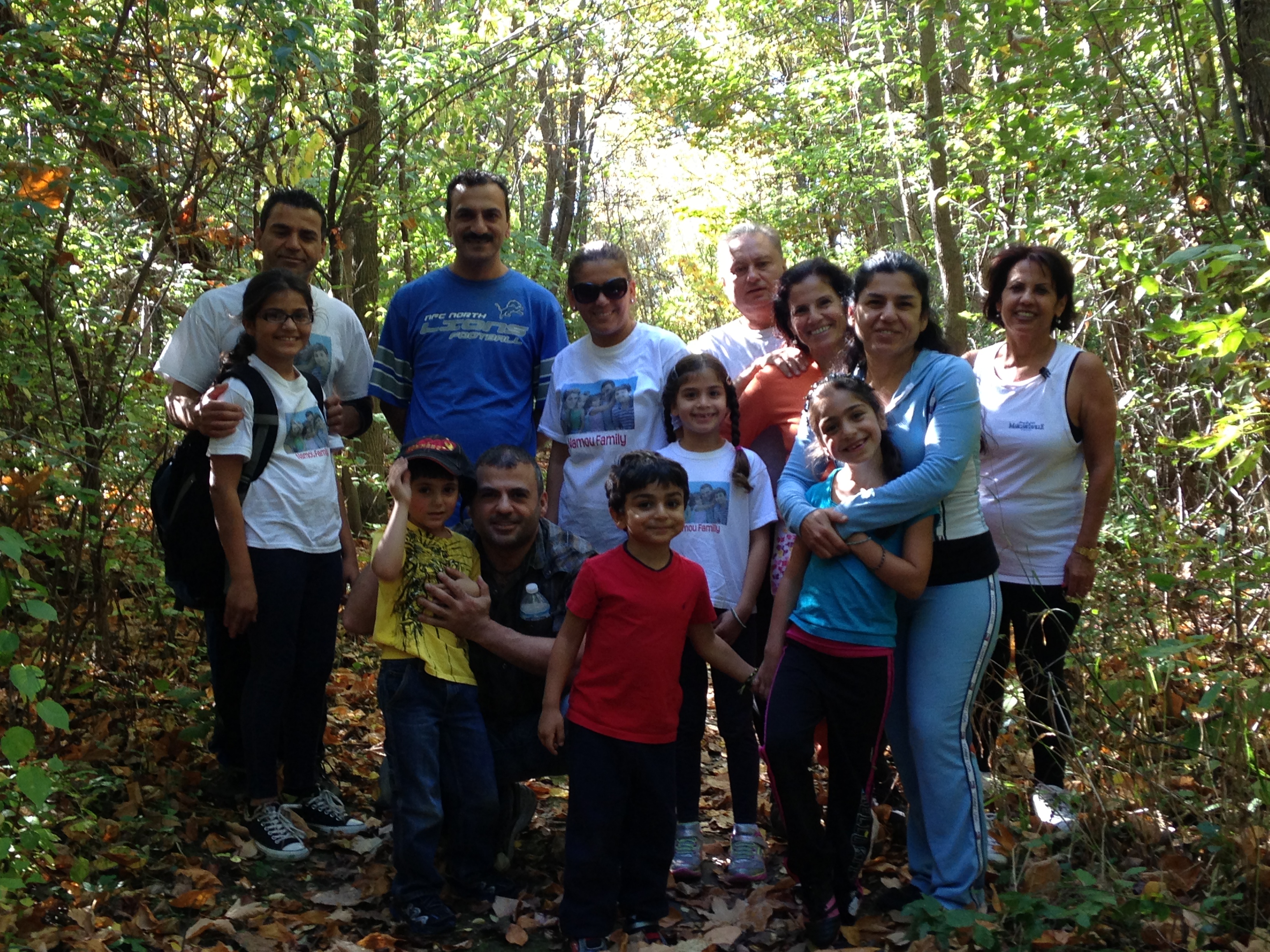
Last year my cousin raved about this one park that she said we “must go to.” So we did. It was Bloomer Park in Rochester. They have a number of playgrounds and picnic areas and countless gorgeous trees to stare at. But our favorite discovery was the hiking trail we accidentally came across. We went up and down peaks, walked over fresh fallen leaves, amongst trees bunched together like parsley. The sun glistened over the small river beside us, bikers passed us by, and our children picked up sticks to use as canes as we moved forward.

The trail walk is around 90 minutes. Trying to find our way back to the picnic and playground area is usually not easy. Once we even ended up in a subdivision. It was a sight! Twenty people between the ages of 60 and 3 just roaming around a quiet neighborhood, looking dazed and confused. The experience was exhilarating and ever since that first time, we have gone back often for more hikes and picnic food or in today’s case, a barbecue.

Bloomer Park is named after Howard Bloomer, who was born in Baltimore, Maryland in 1871. Later in life, he received his law degree from Detroit College of Law. After law school, he helped found the Macgregor and Bloomer Law Firm. Two of his famous clients were John and Horace Dodge, the founders of Dodge Motor Car Company.

In the 1920’s, Bloomer persuaded the Dodge Brothers to donate 11 parcels of land to the State of Michigan to form state parks and recreation areas. Bloomer and his wife donated 47 acres along the Clinton River to the state in order to create Bloomer State Park #2.

Our family is grateful to Mr. Bloomer’s philanthropy.