Cultural Glimpse

Enjoying diversity

Category: Culture

Iraqi Americans (Not) Acclimating

Photo by: Suman Bhattachary

             Photo by: Suman Bhattachary

Today I attended a school meeting with the educators and parents where we discussed, once again, how to encourage Iraqi American parents to get involved in their students’ work and in the school itself. My community has the largest growing Iraqi immigrants. It has even been nicknamed “Little Baghdad” because on each corner there is an Iraqi produce market, butchery, bakery, restaurants, etc. This is great on one hand. The culture resonates very strongly here. However, when the newcomers stay within these boundaries, adding Satellite TVs in order to watch Arab channels all day long, they don’t give themselves the chance to acclimate.

One of the teachers said that she really embraces this ethnic community, especially given that she resides amongst them. “However,” she added, “it feels like this community is like a volleyball game. This team is on this side, and that team is on that side, and often they split apart. They don’t really come together.”

I remembered something my elderly neighbor once said as we chatted over our back fence. Her parents were first generation immigrants from Italy. She said that all immigrants had difficulty acclimating but that she noticed this was more prominent with Iraqis. They really resisted change.

I thought about that and wondered whether this was due to them having immigrated from a country of a different religion. They also had endured much oppression and persecution and for over 30 years war. Their wounds are so deep, it’s not easy to tap into them. They will take decades, maybe even generations, to heal. But isolation is not the answer. And it’s their children who will suffer for it.

As the principal said, “If people don’t know the truth, don’t worry. They will make it up.”

His point was to spread the good news about the school. My point is let’s spread the good news about our culture, our history, our pains and joys. Let’s share ourselves. Because if people don’t know the truth about us, they will make it up.


Winter Wonderland at the Ford House

Playhouse - A gift from her grandmother Clara, it was built in 1930 for Josephine's seventh birthday. The house contains miniature furnishings in the kitchen, bedroom, bathroom and sitting room.

Playhouse – A gift from her grandmother Clara, it was built in 1930 for Josephine’s seventh birthday. The house contains miniature furnishings in the kitchen, bedroom, bathroom and sitting room.

Last night we went with friends and family on a Winter Wonderland tour and stroll of the Edsel & Eleanor Ford House grounds. It was a lovely night, filled with the magical feeling I always experience when I enter this beautiful 87 acre estate that was built in 1929.

Edsel was the son of Henry Ford and an executive at Henry Ford Company. He was married to Eleanor and they had four children – three sons and one daughter, all of whom are now deceased. His grandchildren are still alive, and every so often they come to visit the estate, during which time it becomes closed to the public.

Edsel Ford died in this house in 1943 and his wife Eleanor lived there until her death in 1976. It was her wish that the property be used for “the benefit of the public.” So today this house is not only open to the public for guided tours, but also has wonderful programs that the whole family could enjoy, such as the Winter Wonderland, where we strolled under a canopy of twinkling lights, listened to carolers and folktale storytelling while sipping hot chocolate around a fire, and visited with Mr. and Mrs. Santa Clause who are still working although Christmas Day has passed.

Inside, we saw how the house got decorated during the holiday season. Original ornaments that the Fords used from the 1930s were hung on trees. One tree had elongated purple ornaments which Eleanor wanted but could not find anywhere, so she had the Ford Company make them for her. We wandered from room to room, listening to the sound of live musicians play soft Christmas music while tour guides filled us in with stories of the family.

One story I particularly enjoyed was the one about the painting hung on the dining room wall.

“Who is this painting of?” I asked the tour guide.

“This was Edsel’s favorite painting, because it reminded him so much of Eleanor,” the woman said. “Sometimes, when the two of them were dining alone, they would sit right here – ” she pointed to two 18th Century Queen Anne-style chairs. “So he could see that painting every time he looked up.”

My friend and I were in awe, my friend complaining under her breath that they don’t make men like this anymore.

Seeing our expressions, the woman smiled and added, “They had a very good relationship. A very good one.”

This would explain why Eleanor, after Edsel’s death, remained single for the next 33 years, until she joined her husband once again, and why this house today is still full of life.

photo 3 (1)

Working Towards Your Passions

Nina

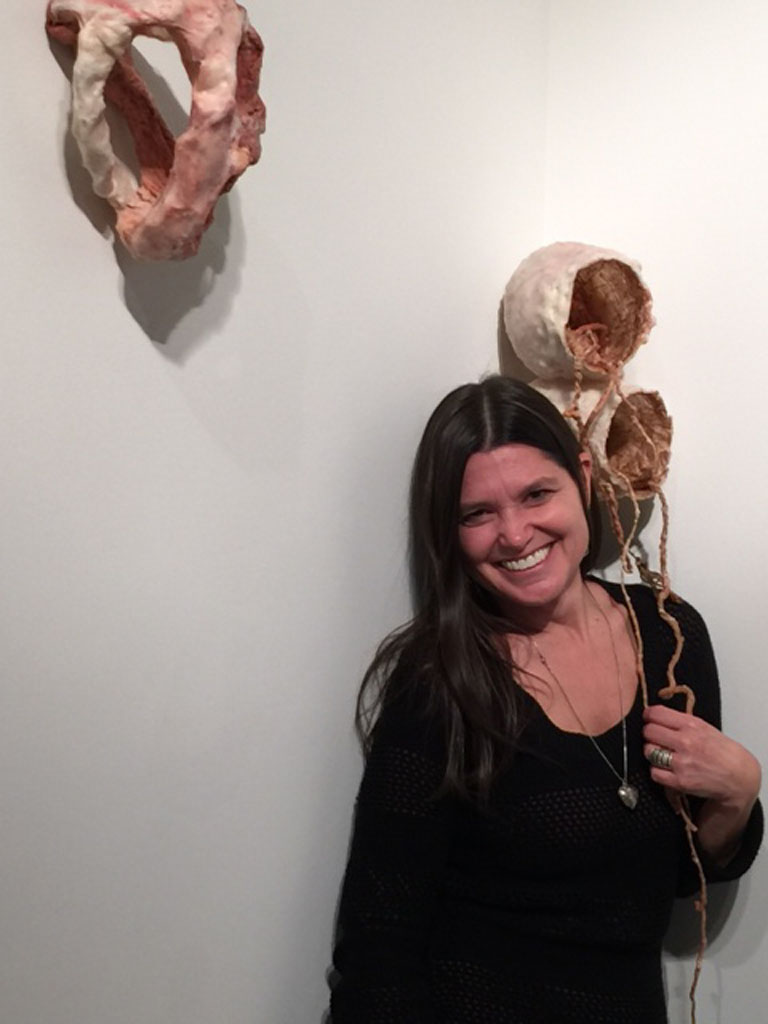
“As a teacher I employ art, not as a mere subject but rather a holistic experience to cultivate knowledge.  Entering into a sensory experience that is informative, thought provoking, and idea inducing provides one an opportunity to be inquisitive, contemplative, and theoretical. This is the territory into true learning that I wish to navigate my students through.”

These are words that Nina Caruso, a mother of three children, wrote in her thesis paper. She is finishing her bachelor’s for Studio Arts Education at Oakland University, which would qualify her to teach K-12 for art. Next year she and her daughter will be graduating college.

I met Nina years ago at a poetry group and as mothers trying to pursue our passions, we immediately connected. I remember at the time Nina was working full-time as a pre-K teacher with the Waldorf Education.

“The economy went bad, and it was not picking up again,” she said. “The school lost many families and they let some of the teachers go.”

Nina was one of the teachers they let go and that was a blessing in disguise. Otherwise, she would not have pursued her dreams.

“As mothers, we don’t get rewarded for our hard work,” she said. “By going back to school, I was rewarding myself. It was very cathartic. You have to feed yourself or you’ll burn out.”

Last week Nina’s work was part of an exhibition at Oakland University, where seniors show their work. I was sent an invite, and reading her name on the exhibitor list, I was impressed and inspired by her accomplishments. I called her and asked, “How did you do it?”

“I feel it’s important for people not to brood about the bad and to do what’s good,” she said. “It’s all work anyways. Whether you go against the current or fight for the good – it’s all work.”

While Nina is a little sad to be finishing the coursework she really enjoyed, she’s ready to enter her major as a teacher.

“I look at an artist and an educator as the same,” she said. “Educators are very creative in how they teach students to learn and artists find ways to enter into people’s sensory experience for them to learn. It can meet us where we need to be met. There are no rules. The artist might have had an intent but the receiver or viewer will get what they needed out of it.”


Wild, a Meaningful Adventure

Wild

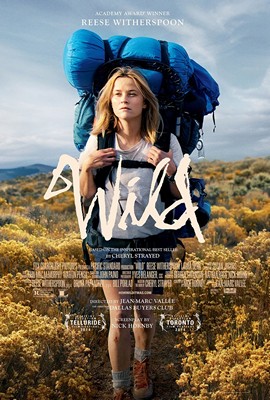
A few days ago I was invited by AMC Theater to a complimentary screening of Wild. The film was described as one woman’s 1,100-mile journey to self-discovery, and it was based on the bestselling book by Cheryl Strayed. I decided to go because the story seemed unique and meaningful, and such stories are not easy to come by. I invited my friend to come along. She is not as enthusiastic about meaningful films, and asked, impishly, “Can we watch Dumb and Dumber instead?”

“No,” I said, knowing that she’s trying to say I watch boring films.

Within ten minutes of Wild, my friend and I were captured – captured by what the main character, Cheryl Strayed (played by Reese Witherspoon) is trying to do by leaving everything behind to hike more than a thousand miles on the Pacific Crest Trail all on her own. She is washing away past hurts of her own reckless behavior, a heroin addiction, a divorce, and her mother’s untimely death. She is healing and ultimately empowering herself.

The film had no car or rape chases, no one being shot at or shooting at someone, no child abuse, or physical fights. It had humor and real people. The suspense was in caring about this one woman’s journey, because we relate to this journey that most of us want to take – though not necessarily through a 1,100-mile hike.

When we left the theater, my friend admitted that she really liked this film, to which I thought, “Halleluiah.” I have finally converted her. I noticed a man standing with a pen and paper asking for our views to submit to the studio. People told him they liked the film, that it was touching and interesting. I said to him, “The film reminds me of the foreign films I used to watch (especially the French), where stories were saturated with feelings and meanings.”

At home, I did a little research on Wild and discovered that it was directed by Jean-Marc Vallee, a Canadian film director from Quebec. Still, it was made by an American studio, and will have a theatrical release on December 5th, and not just in independent theaters.

Years ago, a successful screenwriter said in a lecture that Hollywood executives told him, “Don’t have a message. People don’t like to think.”

Either these executives were totally wrong, or times are changing – thank God.

A Magic Trick for Dolma Lovers

dolma

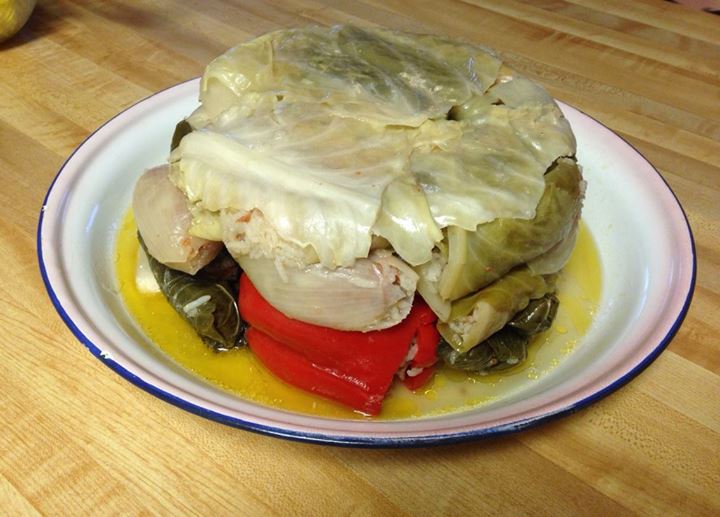
Dolma is in the air this week – literally. Three days ago, I stuffed two pots – actually three (the third pot is only red peppers), and I cooked one for dinner yesterday, as did my sister. One of the pots I’m keeping in the freezer for the near future. With dolma, it’s always good to have a backup.

At night, my husband read me an Iraqi joke someone posted on Facebook: “Americans teach that the normal time it takes to chew a bite is 30 seconds. For Iraqis, in the time it takes to close and open their eyes, you wonder where the pot of dolma has gone.” So here’s a magic trick, if you want to learn one. Just blink your eyes and poof! The pot of dolma will disappear.

That is probably why when my friend saw the picture of my pot of dolma on Facebook, she commented, “That’s the smallest pot of dolma I’ve seen!”

Here’s a little history about one of Iraq’s favorite cuisine, dolma, which by the way, its name is Turkish.
“The Arab world was under Ottoman rule for five hundred years, and the Turkish influence is seen in many preparations, such as stuffed grape leaves. But the stuffing of vegetables has its roots in the Arab cookery of the early Islamic empire of the Abbasids in Baghdad, possibly learned from the Persians. Ottoman chefs perfected the stuffing of vegetables, and today nearly everything that can be stuffed is stuffed.” —A Mediterranean Feast, Clifford A. Wright [William Morrow:New York] 1999 (p. 322)

Is Woman a Bar of Soap or a Piece of Dough?

Women

I received a chain email that read in Arabic:
A woman is like a bar of soap. Her touch is soft. Her smell is pretty. But if you press on her, she bolts out of your hands. And if you step on her, you’ll slip and break your bones. My advice? Treat your bar of soap nicely. Long live my country’s bars of soap!

The brother of the sender responded, also in Arabic:
A woman is like dough. The more you knead her, the tastier she comes out. So my advice is to knead your wife, put the dough in a warm place, and trust in God!

I always found it interesting that men, the gender that for thousands of years has been the cause of most of society’s pitfalls are the ones who try to define women, the gender who gave birth to them and raised them. And don’t give me the story of Eve and the apple she ate. Let’s look at the atrocious wars, holocaust, massacres!

Many societies have thrived as a result of powerful women. Enheduanna of ancient Iraq was the daughter of Sargon of Akkad. She is the world’s first recorded writer. She was a high priestess in Ur of the Chaldees until after her father’s death, the new ruler of Ur removed her from power. Kubaba, a Sumerian Queen in ancient Iraq, is the world’s first recorded woman ruler in history. She was said to have reigned peacefully for one hundred years.

Matriarchal communities existed in the past, and there are a number of them surviving today. The biggest difference between them and patriarchal communities is that where women rule, there was and is no need for violence. When men are able to master how to run the show without killing each other, then they can begin to describe what a woman is really about.

Coming to this Country 33 Years Ago

Coming to America

Today marks 33 years that I’ve been living in the United States. I remember on our drive home from Metro Airport February 2, 1981, I was in awe at the sight of all the snow that covered the streets. Having come from a land of sand and rivers, I was not accustomed to so much whiteness.

For years, I’ve wondered why I ended up in this country. It was not I who chose to flee Iraq and come to America. My parents made that decision, of course, since I was a child. I’ve oven thought, did they foresee the terrible condition that Iraq and the rest of the Middle East was going to be in in the upcoming decades?

“You are a creative person, and that’s why you came to this country,” one of my mentors once said to me. “You came here to be able to do your writing and to be able to help women of that region which you came from.”

Thank God, my parents were able to foresee the future and bring us to a place where creativity, and not oppression, is what’s encouraged.

A Romantic Way of Breaking a Wishbone

Ayad and Ahlam

I paid my cousin a visit yesterday to discuss a family drama that we’re trying to resolve. Because the drama is Arab style – you know, where people can get louder and louder and louder and then hardly anyone is hearing anyone else – it needed one’s full presence and concentration, along with tea and food to make it all the more spicy, not that it needed any spices.

I brought a pizza for the kids’ lunch and told my cousin, “I can’t stay more than an hour!” Three hours later, my daughter came up to me and said, “Mom, when are we going home?”

“Not before we eat!” I said, smelling the aroma of turkey, roasted almonds and raisins, saffron rice, and having gotten a peek at the pumpkin pie in the kitchen.

Although I’d already enjoyed two thanksgiving dinners earlier in the week, I couldn’t resist yet another one. Plus my cousin insisted which made it easier to pull my sleeves up and dig in.

The most amusing part of the evening (aside from the drama, which has now really become routine) was when my cousin and her husband tried to break the turkey wishbone. Although her husband cheated, using his teeth to break the bone, she won. She was proud of herself, and rightfully so. We all had a good laugh and during dinner, I noticed the couple was on more romantic terms. Well, more specifically, my cousin paid him an unexpected compliment and he was flattered!

The tradition of breaking the wishbone comes from Europe, and is thousands of years older. As far as historians and archaeologists can tell, this custom can be traced as far back as the Etruscans, an ancient Italian civilization. It was brought to North America by the English who got it from the Romans. But it was spread to other parts of the world as my family and I engaged in the breaking of the wishbone even in Iraq.

The Etruscans were really into their chicken, and believed that the bird could predict the future. I predict my cousin and her husband will be together for life, as long as they continue to be playful at heart.

Detroit Unleaded – Red Carpet Premiere

Detroit Unleaded

When I received an invitation to view Detroit Unleaded at the Detroit Institute of Film, for its red carpet premiere, I had to smile. “You did it, Roula!” I thought.

Roula Nashef, the writer, director and producer of the film went to the same film school I went to, Motion Picture Institute of Michigan. I had met her on several occasions and I have been following her hard and long journey towards completing her first feature film. As a filmmaker myself, it is inspiring to see a woman like Roula not only get her film onto the big screen, in an industry where the percentage of women filmmakers is less than 9 percent, but for the film to also win awards.

The Director of the Detroit Institute of Films was at the Toronto Film Festival when he decided to watch Detroit Unleaded. He was impressed.

“When I find something that is extraordinary I try to present it to as many people as humanly possible,” he said tonight. “I fell in love with this movie. The whole country will ultimately fall in love with this movie because it is a wonderful movie.”

That it is. Aside from the fact that it is 100% cast and filmed in Detroit and that it portrays a more realistic image of Arab-Americans, Detroit Unleaded is nicely done, with genuine humor.

Roula will surely one day make Hollywood films. I look forward to watching her career move in that direction.

For more information about the film, visit http://www.detroitunleaded.com/
To watch the trailer, click here http://www.detroitunleaded.com/trailer.html

Iraqi-American Stories, Shown by French Filmmakers

I’m sitting at my computer, having my usual morning coffee and writing my next post about the web documentary My Beloved Enemy: Iraqi-American Stories, since their trailer was just released online. Suddenly the phone rings and I see a strange out-of-the-country number. I answer and lo and behold it’s Claire, one of the French directors of the web documentary.

My Beloved Enemy, which includes my mother’s story of how she attained her US citizenship, will be released December 10th. In early September, there were three crowded screenings of this web documentary at Visa pour l’Image, the premiere International Festival held in Perpignan, France.

“Claire, this project is great, but so is its artistic quality,” I said, after having viewed the trailer.

She told me how in France they recently had this debate of whether a journalist can combine artistic work into their story or if they must remain objective. In my opinion, journalists with a lot of courage and strong feelings cannot keep their feelings to themselves or hide it from their work. That is why in recent years so many artists have dove into independent projects, so they can unleash their own heartfelt truths. Plus, no reporting is truly objective. Look at CNN and Fox News!

Also, given what Claire told me previously, that the audience at the festival was touched and impressed by the Iraqi-American stories they watched on the big screen, I say, use the artistic and journalistic and whatever other talents God gave to inspire, educate, and shed light on the world.

My Beloved Enemy