
Ibsen, Iraqi Style: The Latest from Heather Raffo
I originally wrote this article for, and it was published by, The Chaldean News http://www.chaldeannews.com/ibsen-iraqi-style-the-latest-from-heather-raffo/
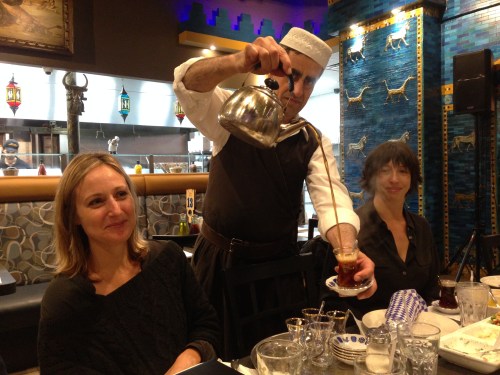
The story of a Chaldean refugee family living in New York is examined in Noura, award-winning Iraqi American playwright and performer Heather Raffo’s latest work.
The play, directed by Joanna Settle, was presented as a staged reading on October 7 as part of the Arab American National Museum’s Global Fridays program.
“You are part of our development process,” Settle told the audience of about 100 people. She had also directed Raffo’s well-received one-woman play 9 Parts of Desire. “It’s somewhere between a reading and a staging. This version is tonight-only. It’s critical that you’re here and that you share what resonated with you.”
The play was a re-imagining of A Doll’s House, written by Norwegian playwright Henrik Ibsen in 1879. That famous work is about everyday, ordinary people, with an emphasis on women’s rights.
Raffo’s Noura incorporates the stories and experiences of Iraqi Americans who must tackle such issues as assimilation, nostalgia, shame, exile and love. The play’s contemporary characters include Noura, played by Raffo; her husband Tariq, who adopted the American name Tim (Peter Ganim); their 9-year-old son Yazen, who takes the name Alex (Logan Settle Rishard, the director’s son); a Sunni doctor and family friend named Rafa’a (Piter Marek) and Maryam (Dahlia Azama), a 26-year-old Chaldean who’s an orphan and was raised at a convent in Iraq.
Noura and Maryam stayed in contact through Facebook, and Noura even helped her financially until Maryam arrived to America. These multifaceted characters come together for Christmas at Noura’s house where unknown truths and past shame and hurts are revealed.
Noura is an educated woman, an architect, who now tutors math. Tariq was a surgeon in Iraq, but when he arrived in America he had to work in a restaurant kitchen. Now he’s working in the ER. After right years in the U.S. the couple still struggles to assimilate. Tariq wants Noura to let go of her attachment to Iraq and the sorrow she feels for what the Islamic State has done to Mosul.
“You should be grateful we are in a place where we can reinvent ourselves,” he tells her.
But Noura is afraid of letting go of that connection, afraid she will lose her identity if she does so. She also feels guilty. She says, “I don’t want to reinvent myself … They never asked what part I played in f_ _ _ing up my own country.”
Through unique and realistic monologues, and plenty of humor, the characters beautifully brought the Iraqi American experience to life and they made the audience consider the question of “Who am I?”
The play came out of a three-year grant workshopping with Middle Eastern women, both Muslim and Christian, on Ibsen’s A Doll’s House in New York City.
“I was inspired to do a story off of their stories,” Raffo said.
Born to a Chaldean father and an American mother, Raffo grew up in East Lansing and went to school in Ann Arbor. She holds a BA from the University of Michigan, an MFA from the University of San Diego and she also studied at the Royal Academy of Dramatic Art in London.
“I was connected in spirit to my Chaldean heritage, but my identity was an American,” she said.
Raffo visited Iraq as a child in 1974 and then later in 1993. At age 20, she experienced her first war on television, a war between the two countries that she loved. She’d never seen her dad so distraught watching television.
“Out of that came a big need for me to bridge the two cultures,” she said. “As an artist, I was the perfect bridge for Americans because I look like them.”
Raffo has produced numerous works that portray Middle Easterners’ perspective, women in particular. She has taught and performed at dozens of universities and arts centers both in the United States and internationally, engaging students about the politics and arts of Iraq and about her own experience as an Iraqi-American playwright and actress.
“I realized as an artist, especially an actor, your job is to be a conduit of a story, that I had a role to play – saying what wasn’t being said.”
At the same time, she wondered if she would be viewed as a fraud for writing an Iraqi story.
“Who am I to write an Iraqi story?” she asked herself. “I’m a blonde woman.”
But as her Iraqi self emerged to the forefront, she realized, “My inner workings always knew I’m Iraqi.”
She has since used her talents to help Middle Eastern women reveal their own feelings and stories, and she has mentored many young Middle Eastern women.
The audience who viewed Noura was made up of various Middle Eastern backgrounds and they were particularly touched to watch a play that did not stereotype their community but gave it an honest, unique and original perspective.
One audience member expressed his desire for the communities here in America to unite the way that the characters of Noura do on the stage.
“I don’t want our communities to be divided,” he said. “I want good relations between all religions. In America, we’re seeing all the democracy that we didn’t have in the Middle East, and we can teach our kids that.”


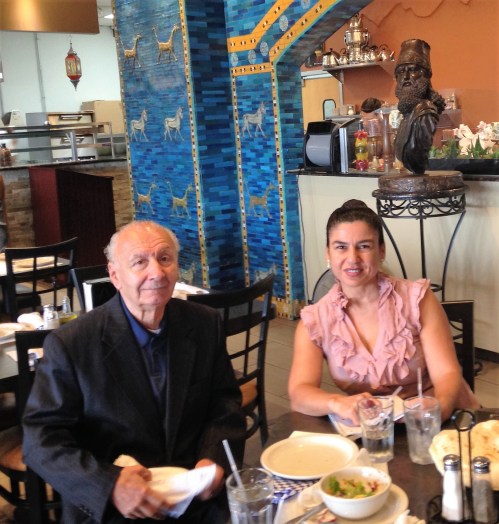 I’ve been freelancing for the Chaldean News for about ten years. Oftentimes when I interview people, they’ll ask me, “Is the publisher of this magazine the son of Fouad Manna, otherwise known as Abu Jibran?” I’d say yes and they would then list Abu Jibran’s wonderful qualities and mention his accomplishments and contributions as a writer and publisher. Their descriptions made me want to one day meet him in person.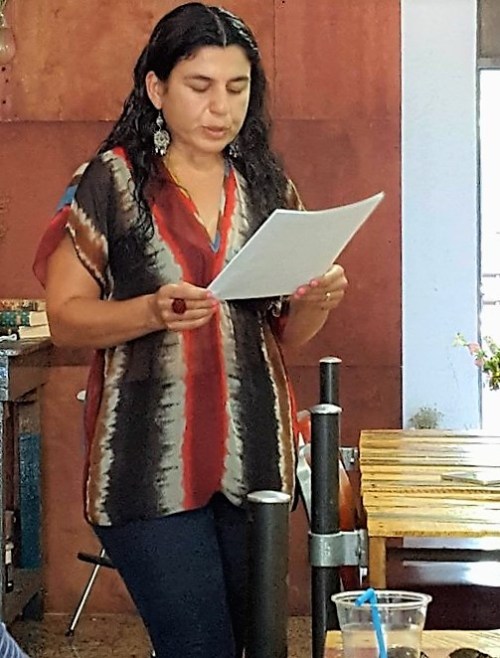
 “The school helps you to be heard not just by others listening to you, but by you listening to yourself,” said Lynn Andrews during the second year of her four-year shamanic school. “You have to do that in order to create a mirror for yourself, for your act of power. We’re peeling away the clouds of ignorance that cloud your vision. Then you begin to see that you really do have something important and wonderful to say, and more and more you’re appreciating yourself. Patience and diligence are important in this.”
 I was scheduled for a 20 minute interview at 2:30 pm by award winning talk show host Ed Tyll on Starcom Radio Network. Within a minute of our interview, I realized this was not the typical interview. It was a political rumble (one of my listeners called it egotistical bullying). I held my ground, threw my own political punches and 80 minutes later, he said, “You’re the most provocative person I’ve interviewed. You’re intelligent and brilliant and you never lost your femininity. I haven’t gone this much over an interview in 3 or 4 years.” He has been in this business for over 40 years. Oh, and he also invited me out to dinner.

 Cultural Glimpse