Cultural Glimpse

Enjoying diversity

Working Towards Your Passions
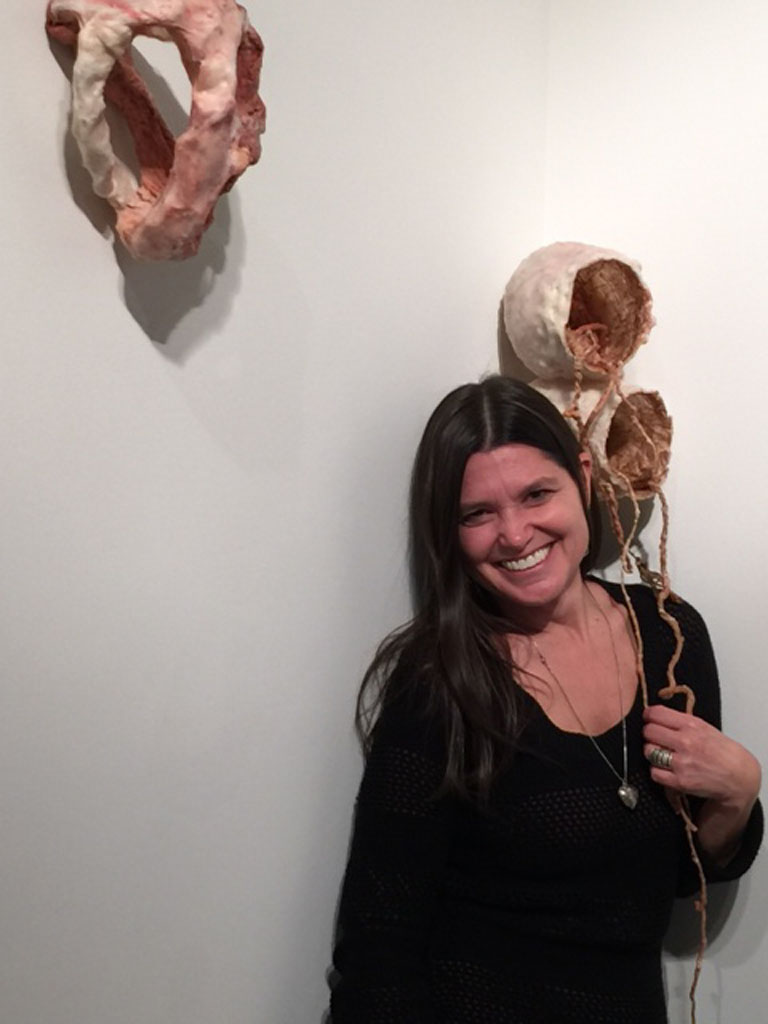
Nina

“As a teacher I employ art, not as a mere subject but rather a holistic experience to cultivate knowledge.  Entering into a sensory experience that is informative, thought provoking, and idea inducing provides one an opportunity to be inquisitive, contemplative, and theoretical. This is the territory into true learning that I wish to navigate my students through.”

These are words that Nina Caruso, a mother of three children, wrote in her thesis paper. She is finishing her bachelor’s for Studio Arts Education at Oakland University, which would qualify her to teach K-12 for art. Next year she and her daughter will be graduating college.

I met Nina years ago at a poetry group and as mothers trying to pursue our passions, we immediately connected. I remember at the time Nina was working full-time as a pre-K teacher with the Waldorf Education.

“The economy went bad, and it was not picking up again,” she said. “The school lost many families and they let some of the teachers go.”

Nina was one of the teachers they let go and that was a blessing in disguise. Otherwise, she would not have pursued her dreams.

“As mothers, we don’t get rewarded for our hard work,” she said. “By going back to school, I was rewarding myself. It was very cathartic. You have to feed yourself or you’ll burn out.”

Last week Nina’s work was part of an exhibition at Oakland University, where seniors show their work. I was sent an invite, and reading her name on the exhibitor list, I was impressed and inspired by her accomplishments. I called her and asked, “How did you do it?”

“I feel it’s important for people not to brood about the bad and to do what’s good,” she said. “It’s all work anyways. Whether you go against the current or fight for the good – it’s all work.”

While Nina is a little sad to be finishing the coursework she really enjoyed, she’s ready to enter her major as a teacher.

“I look at an artist and an educator as the same,” she said. “Educators are very creative in how they teach students to learn and artists find ways to enter into people’s sensory experience for them to learn. It can meet us where we need to be met. There are no rules. The artist might have had an intent but the receiver or viewer will get what they needed out of it.”




Wise Words from a Republican

George Brikho

“We created ISIS, and we need to destroy ISIS,” said George Brikho. “ISIS is funded by Turkey and Saudi Arabia, our supposed allies.”

These words by a Republican running for Congress in 2014 caught my interest in an event I recently covered. Unlike most Republicans, what Brikho said was honest, bold and heartfelt, not staged. He is obviously not afraid to look at the root of ISIS’ formation, which he blames on our foreign policy as well as the current and past administrations.

“Today’s Republicans are not behaving like Republicans,” he said. “Today it’s all about the money changers. Wars are being made for profit. Corporations are directing politicians. It’s no longer about liberation for the people.”

His solution is simple – stop getting involved with other countries and going to war, because the more war we get into, the more debt we have.

“Saddam and Kaddafi wanted to sell their oil their way through OPEC,” he said. “It’s like you have a store or any another business. You have the right to set the prices and do business the way you want.”

Saudi Arabia is the leader of OPEC. It is also the only member of the OPEC cartel that does not have an allotted production quota. Oil can be bought from OPEC only if you have dollars. In November 2000, Iraq began selling its oil in euros. When OPEC oil could be sold in other currencies, like the euro, that’s not too good for the U.S. economic dominance.

“Leaders of other countries were not happy about what Saddam and Kaddafi were doing and wanted things to be done the way they wanted them to be done,” said Brikho. “So they went in and polarized that nation into submission. Then the federal banking comes in, and the new leaders are given money to rebuild, and in order to be able to give this money back, those countries, who never taxed their citizens before, start taxing their people the way we do.”

I wondered why this Republican was not talking like most Republicans. What was so different about him?

“I’m a statesman, not a politician,” he said. “I’m a concerned American, and I work for the people. I am willing to expose anyone whose allegiance is to money and not the people.”

On his website, it says:

The Constitution of the United States of America is the most intelligently crafted governing document in the history of mankind. The US Constitution protects personal liberty by limiting the power of our government. Unfortunately, our government violates its boundaries on a daily basis. Our federal government must be restrained.

One wonders why the people have given their powers away.

“We have become too comfortable, to where unconsciously we’re allowing for things that don’t benefit us to happen,” he said. “For instance, a third of our paycheck goes to our government. This is modern day enslavement. You don’t need a cage to be a slave.”

I researched the difference between a statesman and a politician and found an interesting quote by James Freeman Clarke, who said, “The difference between a politician and a statesman is that a politician thinks about the next election while the statesman thinks about the next generation.”

I also found an interesting article by Mike North who wrote that the founders of this nation were not politicians, but were statesmen, adding, “We are suffering from a drought of statesmen and a flood of politicians. It’s like a diet full of calories with almost no nutrition. Statesmen are like vegetables. Many people don’t like them, but they’re good for you. Politicians are like too much ice cream. Yummy, I’ll worry about the stomach ache later.”

I feel we should be grateful that George Brikho is helping our country fill this drought, and do, what I think is so crucial for our nation to do, which is to become politically fit.

You can read Mike North’s full article here: http://mike_north.tripod.com/id20.htm

Having Great Powers

Nahren

I covered a story a few weeks ago about the genocide in Iraq. The event was organized by Assyrian activist Nahren Anweya and other influential group of people who are of Christian Iraqi decent. I later followed up with Nahren with questions for the article I had to write, and in the process, met with her briefly.

During this time, she mentioned, “Oh, I forgot to share my experience of helping to save 400 Yazedis from a sinking ship last week.”

What? I thought.

She told me the incredible story.

“A Yazedi man called me on Facebook thinking I have great powers not knowing I’m an ordinary individual, and he claimed that there were four ships filled with Yazedis. One of them had 400 passengers and it was stranded in the open water between Greece and Italy. He was hysterical and pleaded for help. I called my brother-in-law who is in the navy and informed Fox News and we were able to save all of them and bring them to Greece. They were very thankful and they were crying.”

The man knew that she was a woman with great powers, not an ordinary individual. And yet the beauty of people with great powers is that they are usually humble, and consider themselves ordinary individuals because they know that within everyone lie those same great powers – if only they were to tap into them.

Nahren2

Wild, a Meaningful Adventure

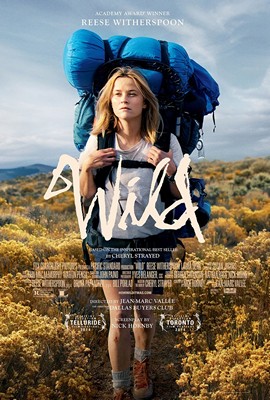
Wild

A few days ago I was invited by AMC Theater to a complimentary screening of Wild. The film was described as one woman’s 1,100-mile journey to self-discovery, and it was based on the bestselling book by Cheryl Strayed. I decided to go because the story seemed unique and meaningful, and such stories are not easy to come by. I invited my friend to come along. She is not as enthusiastic about meaningful films, and asked, impishly, “Can we watch Dumb and Dumber instead?”

“No,” I said, knowing that she’s trying to say I watch boring films.

Within ten minutes of Wild, my friend and I were captured – captured by what the main character, Cheryl Strayed (played by Reese Witherspoon) is trying to do by leaving everything behind to hike more than a thousand miles on the Pacific Crest Trail all on her own. She is washing away past hurts of her own reckless behavior, a heroin addiction, a divorce, and her mother’s untimely death. She is healing and ultimately empowering herself.

The film had no car or rape chases, no one being shot at or shooting at someone, no child abuse, or physical fights. It had humor and real people. The suspense was in caring about this one woman’s journey, because we relate to this journey that most of us want to take – though not necessarily through a 1,100-mile hike.

When we left the theater, my friend admitted that she really liked this film, to which I thought, “Halleluiah.” I have finally converted her. I noticed a man standing with a pen and paper asking for our views to submit to the studio. People told him they liked the film, that it was touching and interesting. I said to him, “The film reminds me of the foreign films I used to watch (especially the French), where stories were saturated with feelings and meanings.”

At home, I did a little research on Wild and discovered that it was directed by Jean-Marc Vallee, a Canadian film director from Quebec. Still, it was made by an American studio, and will have a theatrical release on December 5th, and not just in independent theaters.

Years ago, a successful screenwriter said in a lecture that Hollywood executives told him, “Don’t have a message. People don’t like to think.”

Either these executives were totally wrong, or times are changing – thank God.

A Heart to Serve

Silicon Valley

“God designed us for something greater than just the people in our home and in our employment,” said Pastor Aaron during Sunday’s sermon. “When God looks at us he sees a beautiful thing that He wants to shine in its beauty.”

Listening to these words, I could not help but think of Ron, the man whom I bought a computer from the night before. He told me his story. About ten years ago, Ron was the general manager of a wholesale business. He was living a “normal” life when one day he read in the Detroit News an article that explained Southeast Michigan alone sends over two billion pounds of electronic waste into our landfills, every year.

“Those last two words – every year – really grabbed my heart,” he said, demonstrating by grabbing his shirt. “I thought, oh my God, something has to be done.”

The idea that two billion pounds of electronic waste was sent into our landfills every year kept bugging him to the point where he gave into “The Calling.” In less than two years, he quit his job and began Silicon Alley Recyclers, a non-profit charity computer and electronics thrift store in Warren, Michigan, where you can find super bargain priced electronics like computers, printers, and TVs. Most of the equipment at Silicon Alley is commercial grade, with very few consumer products.

“What most people do not know is that there are two grades of electronics – commercial and consumer, which is like Mercedes and a Chevy,” said Ron.

Ron credits Focus Hope for being his mentor, helping him turn Silicon Alley into a non-profit. He also has a hard-working and loyal volunteer staff that helps him dissemble the equipment for recycling, and then package it. These products are then reintroduced into needed and useful hands through various charity and marketing methods. Hundreds of computer systems have been donated to schools and churches.

Ron has loved the process. But his biggest challenge is funding.

“I’ve loaned everything I have in the world to keep it alive,” he said. “It owes me a salary for 8 years but I’ll never see it,” he added laughing. Then he asked, “Do you have a good heart?”

I was confused.

“You know, like Sanford and Son – when Fred was always having those heart attacks?”

“That was my dad’s favorite show,” I reminisced, and told him that yes, I had a good heart. He led me to a door that opened to a huge room with gigantic aisles of equipment.

“You have your work cut out for you,” I said.

But it was easy to see that this man, who has four children and four grandchildren, was shining in his work. While I was in the store, two of his “board members” walked in, one a minister and the other, Professor Wesley Arnold, a historian who made DVDs and wrote books about Macomb and distributed both for free. The warmth, laughter, and character in that place was as rare as finding a genius heart-felt show like Sanford and Son and no doubt, their service to this earth will be as timeless.

For more information, visit http://www.siliconalleyrecyclers.us

An Arabian Wedding in America

While I love weddings, anyone who knows me (or who has invited me to their wedding) will vouch that over the years, I’ve grown too tired to last the entire night of fun, dancing and eating – especially since Chaldean weddings tend to occur on a monthly basis, often during the middle of the week.

One thing I never tire from, however, is the main entrance, when the bride and groom appear hand in hand as a married couple for the first time.  My husband’s niece had a most beautiful and vibrant entrance. She looked so elegant that she reminded me very much of a Princess Diana (with a Middle Eastern touch). The welcoming heartbeats of the Arab drums, the colorful dancers, the light surrounding the guests and the exotic and passionate dancing on stage will cause me to not tire of watching this video  – in the comfort of my own home.

Sally's Wedding

Writing To Change The World

       IMG_2734Writing Spirit called for me to pick it up like a child off the store’s bookshelves. It was an odd-looking book about writing. On the cover large palms came halfway out of the water, and in the table of contents, the chapter headings had words like power animals, shamanism, alchemy and baptism. None of it made sense to me, and the last thing I wanted was a book on writing. I had been writing for over twenty years, and the journey had proven so futile, I wanted to bury the pits of this desire into someone else’s backyard and start a new garden, one that resembled those in One Thousand and One Nights stories, where the hero ends up with breathtaking trees bearing pears, apples, figs, pomegranates, and apricots made of real gold, diamonds and rubies.

Yet the book stuck to my hands like glue.  I bought it, even though I barely had any time to eat a meal sitting down let alone read a book. I was raising two young children and doing a lot of freelance work, as well as trying to write a book. The moment I read Writing Spirit, however, the fragrance of that Arabian treasure garden raced out of the pages, and I remembered all the reasons I’d become a writer in the first place – the calling, the sacredness of storytelling, the freedom this profession provides, in my case allowing me to raise my children without having to abandon my career. Shortly afterwards, I enrolled in Lynn’s school, The Mystery School.

The Mystery School is a spiritual school that has, for over 25 years, passed down Native American shamanic teachings of 44 women known as the Sisterhood of the Shields. These women are healers from various cultures such as Panama, Guatemala, Australia, Nepal, North American and the Yucatan. Their teachings have been passed from one generation to the next for over 5,000 years. They initiated Lynn as a member of The Sisterhood and appointed her as their public messenger. Lynn’s study began with Agnes Whistling Elk and Ruby Plenty Chiefs, Native American healers in northern Canada. Lynn wrote about her own experience in Medicine Woman, and later, as she met with more of the women of the Sisterhood, wrote over a dozen more books. Her website describes her “as a major link between the ancient world of shamanism and modern societies’ thirst for profound personal healing and a deeper understanding of the pathway to enlightenment.”

I recently met Lynn in person and I discovered that the majority of her apprentices and graduates, who are from all over the world, were first introduced to the Sisterhood teachings by reading one of her books. Something in her books resonates within people the ancient healing and magic of long ago, thus bringing to life, through experiential learning, a connection to spirit and the earth.

  “You write in order to change the world, knowing perfectly well that you probably can’t, but also knowing that literature is indispensable to the world… The world changes according to the way people see it, and if you alter, even by a millimeter, the way people look at reality, then you can change it.”   —  James Baldwin

Falling in Love with Political Matters

IMG_8869

During Saddam’s era, if you were interested in politics you had to either join the Baath Party, be neutral or, if you wanted to start a new party or movement, risk imprisonment or death. Today, the situation is ten times worse. You risk losing your life (in a most brutal manner) no matter what you do or believe in.

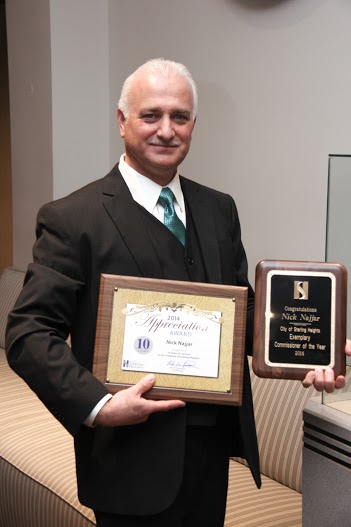
In America, it’s quite the opposite. You get city officials who actually have an interest in establishing a relationship with your diverse community – something the City of Sterling Heights has been known to do over the years. You can even get rewarded for your efforts. That was the case with my colleague Nick Najjar last week when he received an award as Commissioner of the Year for the City of Sterling Heights. Over the years Nick has fostered civic virtue and political awareness, promoted active participation in political changes, and helped citizens identify policies that would benefit them. He is an example of someone who truly understands and honors the privileges this country has to offer.

Americans frequently expect the government to do something about their problems. But, how does the government know what these problems are unless members of the community address them? Some think that getting politically involved would not make a difference. Others, like Nick, have the attitude that it’s easier to act and create than it is to complain and be pessimistic.

It’s easy to complain. It’s rewarding to act – with love. We fall in love with tourist destinations, religious institutions, restaurants or foods, fashion trends, television shows, celebrities, or a new hobby.  But we rarely fall in love with politics and government matters, even though they impact our everyday life and will affect our future.

If we expect the government to do something about our problems, we have to look at how we can help them do just that, even if it simply means becoming better informed and passing that knowledge on to our neighbors. Even if it simply means treating our community with love and appreciation.


Unique Relationships Serving Communities

As I watched Laila and Georgia, the 6th episode of the Intersection of Faith and Culture short documentary video series, I thought, “I know these people!” Laila has been quite supportive of my work and Georgia is the wife of Stephen Coats, a filmmaker I met at a journalism conference. We sat on the same panel and since we have followed each other’s work. But, I had no idea Laila and Stephen’s wife are such close friends.

Laila is a Syrian-American journalist who works incredibly hard, acting as an powerful and influential mouthpiece for her Arab Muslim community within the broader American culture. Laila’s friend, Georgia, is Greek-American, and has been a longtime companion of Laila.

“When I came to this country I had no one,” said Laila with teary eyes. “Georgia and her husband Stephen took me in like I was family.”

Over time, the two women have become like sisters to each other.

“I believe that life is deeper and richer and more spiritual when I know and love people who are different than me,” said Georgia, who moved to Dearborn just before the 9/11 attacks. The next day, on September 12th, she was teaching a class, English as a second language, to primarily Arabic-speaking women.

Before moving here, people warned Georgia not to go to Dearborn, which has a large Muslim population, because it’s considered dangerous. But she put her trust in God and figured, she just came from Colorado where in the 1999 the Columbine High School shooting occurred.

“How is this place safe to be, and Dearborn isn’t?” she said. “We don’t know where the dangerous people are.”

When the controversial Pastor Terry Jones wanted to have a protest in front of the Islamic Center of America, the community of Dearborn came together in opposition to his agenda.

“There’s a verse in the Bible that says in the end, there will be people worshiping God from every town, every tribe, every nation and every language,” said Georgia. “That’s what I believe.”

Laila and Georgia are of completely different backgrounds, but they have more similarities than differences – they are both mothers, both spiritual, and they serve their communities in wonderful ways.

Having survived cancer, Georgia shares her journey as a cancer survivor, a wife and mother through her blog http://thecrazyedamommy.wordpress.com/ Laila Al-Husseini is one of the most famous Arab anchors in the United States and is known for her popular show US Arab Radio. The program broadcasts Tuesday mornings, live on WNZK 690 AM to audiences in Michigan, Toledo, Ohio, and Windsor and for audiences in Washington, Virginia, and Maryland, the program broadcasts on WDMV 700 AM.

It makes you wonder why Pastor Terry Jones’ desire to burn Korans and not Laila and Georgia’s example of peaceful relationships get the media’s attention. And what role, do we the audience, play in that?

IMG_1332

The Clearing, a Magical School

Jens Jensen

A week ago I went with my sister to the Henry Ford Estate, to watch the documentary screening of Jens Jensen: The Living Green. We parked our car and to reach the house by foot, walked through a dense woodland area which was created by Jens Jenson, a Danish American landscape architect, known for his “prairie style” design work. He designed the gardens at the Henry Ford Estate and the Edsel and Eleanor Ford House.

I loved the character of this man, who considered himself an artist, not an architect. Jenson saw a connection between the performing arts and nature. He was called a Native Nature Poet. He summed up his philosophy by saying, “Every plant has fitness and must be placed in its proper surroundings so as to bring out tis full beauty. Therein lies the art of landscaping.” He believed that only when we leave the beauty of nature alone, as God created it, would we really have democracy.

At 75 years of age, Jensen, who wanted to create harmony between the hand of man and the hand of nature, established a school in 1935 called The Clearing in Ellison Bay, Wisconsin. It taught environmental citizenship and sought students Jenson thought would “study profoundly… do things worthwhile… not for oneself but for others.”

Jensen died in 1951, at the age of 91. But the school he founded is pretty alive. The Clearing offers year-long educational opportunities in three programs: the Summer program, the Workshop Program and the Winter Program. All programs offer a wide range of classes (which are taught in a relaxed and informal style), including painting, writing, quilting, birding, wood carving, poetry, rustic furniture making, photography, poetry, fine wood-working, music, weaving, philosophy, stained glass, metal work, nature study and paper arts.

Sounds like we have in our country more magical programs than Harry Potter ever did. The only thing is we need to discover them.