Cultural Glimpse

Enjoying diversity

How to Advertise War

How to Advertise War

From The Magic of Believing by Claude Bristol (published 1948), pages 51-52

For forty-four years, ever since the Russ-Japanese war, the Japs immortalized Naval Warrant Officer Magoschichi Sugino, fabled as one of Japan’s early suicide fighters and greatest heroes. Thousands of statues were erected to his memory and in repeated song and story young Nipponese were taught to believe that by following his example, they could die in no more heroic manner than as a suicide fighter. Millions of them believed it and during the war thousands of them did die as suicide fighters… This terrible and persistent deeply founded belief, though based entirely on a fable, caused thousands of Japanese to throw away their lives during the war.

We, too, as Americans, were subjected to the power of suggestion long before and during World War I; we got it again in a big way under the direction of General Hugh Johnson with his N.R.A. plan, and in World War II it inspired us to increase our effort, to buy bonds, and so forth. We were constantly told that Germany and Japan had to be defeated unconditionally. Under the constant repetition of the same thought all individual thinking was paralyzed and the mass mind became grooved to a certain pattern – win the war unconditionally. As one writer said: “In war the voice of dissension becomes the voice of treason.” So again we see the terrific force of thought repetition – it is our master and we do as we are told.

This subtle force of the repeated suggestion overcomes our reason, acting directly on our emotions and our feelings, and finally penetrating to the very depths of our subconscious minds. It is the basic principle of all successful advertising – the continued and repeated suggestion that first makes you believe after which you are eager to buy.

Choosing Faithfulness

Pastor Aaron (2)

Pastor Aaron read from 1 Samuel 2:12

“Now it was the practice of the priests that, whenever any of the people offered a sacrifice, the priest’s servant would come with a three-pronged fork in his hand while the meat was being boiled and would plunge the fork into the pan or kettle or cauldron or pot.”

He stopped and said, as if to himself, “It’s always dangerous to talk about food, especially when it’s barbecue, especially during second service.”

The congregation laughed.

Being light-hearted and down-to-earth makes it so much easier to feel God’s message. This is what happens every Sunday at Freedom Christian, where the pastor incorporates the bible’s teachings into his everyday family life. He turns the act of helping a man shovel his snow into a thoughtful and humorous story. The man whom he helped thanked him and asked, “Where do you work?”

“I’m a pastor.”

“Oh, you’re a man of God.”

“A title does not make me a man of God,” said the pastor. “You should know me for a few years and decide whether or not I am a man of God.”

He added that some Christian colleges are worse than regular colleges. They have the same ungodliness but they are wrapped up with religious terms.

The sermon’s topic was not religious terms, but it was about Samuel proving that we can be faithful in an unfaithful environment.

“You choose faithfulness and you choose unfaithfulness and then faithfulness and unfaithfulness chooses you,” he said. “I will take a faithful person in my life more than someone who is talented or someone who is flashy. Faithfulness means being faithful again and again and again. It’s being faithful in your life from the east of your life to the west of your life, from the north of your life to the south of your life.”

The pastor’s last words during today’s sermon were “Examine one area in your life where you can be faithful and work all week to make it a strength.”


The Power of Western Women

Photo by: Pedro J Perez

Photo by: Pedro J Perez

Last night, I wrapped myself in a red blanket as I listened to my teacher Lynn Andrews talk during a conference call with her apprentices. She said something which I never heard her say before. She said, “I really believe that the world is going to be saved by the women of the west.”

Many societies have thrived as a result of powerful women. Enheduanna of ancient Iraq was the daughter of Sargon of Akkad. She is the world’s first recorded writer. She was a high priestess in Ur of the Chaldees until her father’s death, the new ruler of Ur removed her from power. Kubaba, a Sumerian Queen in ancient Iraq, is the world’s first recorded woman ruler in history. She was said to have reigned peacefully for one hundred years.

Matriarchal communities existed in the past, and there a number of them surviving today. One society in the high mountains of China is known as the Kingdom of Women. Their reputation for “free Love”, along with the breathtaking landscape of their homelands draws increasing numbers of tourists.

Jennifer Morse writes in her book Apprentice to Power the following conversation she had with Lynn:

“The nature of the earth is feminine, so we women naturally understand the nature of things,” Lynn said. “Deep down, each woman knows that she knows. But we are taught that we don’t know. For men, the energy of this plant is not familiar. So they don’t know. But they are taught that they do.”

“So it’s all set up backwards,” said Jennifer.

Lynn smiled. “Yes, it is. We have to teach them.”

Perhaps this explains the thousands of years of unnecessary wars and violence. The biggest difference between matriarch and patriarchal communities is that where women rule, there was and is no need for violence. Maybe that’s the core problem in the Middle East. It is overly male dominated, which has created an incredible imbalance in that region.

For me, I am incredibly grateful for the dozens of powerful western women who have supported my work throughout the years, and I would not be a bit surprised if it is, like Lynn says, western women who end up saving the world.

Can Romance Turn into a Disease?

file8741293813237

The pest control guy came over this morning, ready to spray away the carpenter ants. These ants had built a colony in the heating vent, he explained, and survived in what felt to them like summer. When they were hungry, they came out to my kitchen to pick up crumbs.

As he sprayed the edges of the house, he stroke a conversation about the importance of family. He said he had been married for thirty years and had three adult children who were healthy and well educated. He said that other people in his family were not as fortunate, that they had divorced, which had a negative impact on their children when they grew up.

The Americans for Divorce Reform estimates that “Probably, 40 or possibly 50 percent of marriages will end in divorce if current trends continue.” This once did not apply to the Chaldean (Christian Iraqi) community in America. But nowadays, divorce has become a trend to a people that once were determined to make it work, especially when children were involved.

“People spend a year or two preparing for the wedding,” said the pest control guy. “They pay tens or hundreds of thousands of dollars going all out. They have the wedding reception, and then the marriage lasts as little as a year.”

In his case, it took thirty days to prepare for his wedding. It was just a matter of calling the priest, calling a local restaurant to make a reservation, inviting the closest people and reserving most of the focus on the marriage, not the wedding.

I remembered something my yoga instructor said last week. She’s a beautiful Asian woman that looks as though she’s 24 years old. But when she said she’d been married for 34 years and has two children, I figured she’s much older than that. As we groaned while holding a position for what felt like forever, she said, “The challenge is learning how to become comfortable in what sometimes feels uncomfortable. That’s how my marriage with my husband has lasted this long.”

Most of the divorces that he and I witnessed were for petty issues that could have been worked out. I thought about something that Stuart Wilde once said, “What makes anything sacred is the fact that we concentrate on it and say, ‘This is sacred.’ You make it important. In fact love is actually concentration. Romance is actually a disease that comes from over concentrating on another person.”

The best article that talks about this is by Axinia, a Russian born blogger and photographer who works and lives in Austria.

Romantic Love vs. True Love and Why Happy Marriages are so Rare in the West

By: Axinia

Romantic love is the single greatest energy system in the Western psyche. In our culture it has supplanted religion as the arena in which men and women seek meaning, transcendence, wholeness, and ecstasy…We are so accustomed to living with the beliefs and assumptions of romantic love that we think it is the only form of “love” on which marriage or love relationships can be based. We think it is the only “true love”. But there is much that we can learn from the East about this. In Eastern countries, like those of India and Japan, we find that married couples love each other with great warmth, often with a stability and devotion that puts us to shame. But their love is not “romantic love” as we know it. They don’t impose the same ideals on their relationships, nor do they impose such impossible demands and expectations on each other as we do.

Romantic love has existed throughout history in many cultures. We find it in the literature of ancient Greece, the Roman empire, ancient Persia, and feudal Japan. But our modern Western society is the only culture in history that has experienced romantic love as a mass phenomenon. We are the only society that makes romance the basis of our marriages and love relationships and the cultural ideal of “true love”.

One of the greatest paradoxes in romantic love is that it never produces human relationships as long as it stays romantic. It produces drama, daring adventures, wondrous, intense love scenes, jealousies, and betrayal; but people never seem to settle into relationship with each other as flesh-and-blood human beings until they are out of the romantic love stage, until they love each other instead of “being in love”.

Romance, in its purest form, seeks only one thing – passion. It is willing to sacrifice everything else – every duty, obligation, relationship, or commitment  – in order to have passion.

http://1000petals.wordpress.com/2010/02/04/romantic-love-vs-true-love-and-why-happy-marriages-are-so-rare-in-the-west/

Is Yoga Dangerous for Christians?

Yoga

I was picking up food from McDonald’s when I heard a conservative evangelical Christian radio host say, “I would not touch yoga with a ten foot pole.” He and his guest host then went in depth about the the spiritual dangers of yoga for Christians. I thought, “Oh my! I’ve been in involved in a dangerous practice for over ten years.”

I remembered an article I wrote about yoga and Christianity. It was originally published by The Chaldean News. http://www.chaldeannews.com/staying-centered/

Here’s a reprint of the article:

Staying Centered

An unfounded belief that yoga is against the Catholic faith persists, though experts say it’s not true.

“Since the term yoga is used in Hindu, it conjures up images in people’s mind,” said Fr. Peter Fennessy, one of six Jesuit priests at Manresa Jesuit Retreat Center in West Bloomfield. “But there are different ways of approaching yoga, one of which focuses on the physical. On that level, it is not religious. It’s a way to relax and become centered. It is then a nice way to pray, because praying without words is a much deeper form of prayer than praying with words.”

For the past eight years, Manresa has offered Christian yoga classes that today are held every Monday from 5:30-6:45 p.m. at a fee of $12 per class. Instructor Grace Seroka, who has been practicing yoga for 40 years, helped start the class when she found she couldn’t relate to other classes’ Indian, vocal music or new-age reflections that were played during the relaxation periods.

“That type of music was not where my heart and spirit were at,” she said. “It was not of my culture.”

Instead, Seroka uses spiritual and sacred Christian music, scripture readings, and weekly Christian themes.

“Yoga is a prelude to meditation,” she said. “On a personal level, over the years it has helped me to slow down, focus, deeply stretch my muscles, and gradually bring me to a stillness.”

Janice Bahura, whose father is Chaldean and mother is American, has been doing yoga since she was 13. She has been teaching classes at Lifetime Fitness in Troy for more than 11 years and also runs classes at the Wellness Training Institute in Sterling Heights. There she works therapeutically by integrating yoga and meditation with elderly, post-surgery patients or those with injuries, to get them to live a healthy lifestyle.

Bahura is impressed by Seroka’s classes. “During meditation, Grace played a tape of Assyrian chanting, the type you hear when you go into church.”

“In my class, I’m paralleling breathing and posture with Christianity,” said Seroka. “That has helped me see the gospel for today, not 2,000 years ago.”

The yoga instructors and the priests at Manresa agree that yoga is healthy to the mind, body and spirit and is not in conflict with Christianity or its belief system.

Where then does the conflict come in?

“Long ago higher-ups in the church would meditate, but politically they tried to keep the regular people from meditating for fear that they would lose respect and power and would no longer be needed,” Bahura said.

Those who are against yoga are an isolated group, but nonetheless, that group does exist.

“I’ve heard some Christians say they don’t believe it is right for a person to connect to God through meditation rather than through Jesus,” said Bahura.

To that, Fr. Fennessy responded, “We say ‘Our Father’ three times a day without mentioning Jesus. We go directly to God.”

Some fear each posture in yoga is specific to some Hindu god, such as when one is standing with arms over their head or sleeping with arms by their side.

“Well, right now, I’m sitting with my legs crossed,” said Fr. Fennessy, “and my arms are on the desk. Does that mean I’m invoking a certain god?”

“I’ve spoken to women who say their church does not allow it and so they’re going to follow orders,” said Bahura. “But they won’t know what’s dangerous about it because they’ll never ever try it.”

Her mother was not such a woman. A Catholic, Bahura’s mother was a practitioner of transcendental meditation. One day the priest at her church questioned whether that contradicted with Christianity, to which she replied, “It has actually strengthened my Christian faith.”

“People are afraid that yoga will lead them into a different religion or away from Christianity,” said Seroka. “But what they fail to realize is that as Christians we meditate too.”

“Christians can profit, can learn from, various Eastern disciplines,” said Fr. Fennessy, but added that one should be careful not to practice syncretism – the combining of different beliefs. “Yoga is a spiritual practice. If it works, use it. If it doesn’t work, don’t use it.”

Fr. Fennessy also noted an interesting contradiction. Hindus don’t believe that the body is real, that it is in fact an illusion, and one must transcend it to the spiritual to get enlightened. Yet though they think the world is an illusion, they put enormous time into the body through yoga, bodily cleansing, eating and breathing.

“We Christians say God created the material world and we focus on the body, yet the only thing we do about it is kneel and stand,” Fr. Fennessy said. “We neglect the body so much and yet theologically we say it’s important. For Christians, the body, the incarnation of Christ, should be very important.”

The official documents of the Catholic Church contain just two references to yoga. They allow that methods of prayer deriving from non-Christian religions can help Christians in their prayer, but warn that discretion needs to be exercised to avoid syncretism and to see that elements do not creep in that are contrary to the fundamental nature of Christian prayer and practice.

“Spirituality is universal and that’s what I bring to my classes,” said Bahura. “It’s where all speak the same language, just using different words. This is the key to getting along and understanding people.”


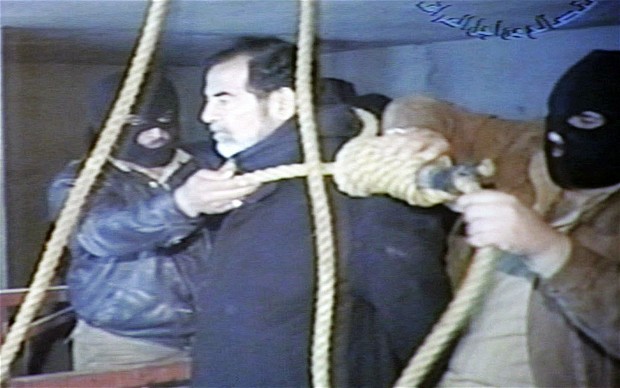
How Saddam, the So-Called Butcher, Dealt With Prisoners

Who's the Real Butchers in this Picture?

Who are the Real Butchers in this Picture?

Iraq was bombed for 43 consecutive days during the 1991 Gulf War.  The coalition flew over 100,000 sorties, dropping 88,500 tons of bombs, and widely destroying military and civilian infrastructure. So when Iraq captured Americans and journalists a few months later, what did they do to them? They released them.

Missing American, French Journalists Released by Iraq

April 16, 1991 | From Reuters

An American and a French journalist, missing and feared dead in Iraq for almost three weeks, are alive and on their way to Amman, Jordan, from Baghdad, CBS News reported Monday. CBS News broadcast a brief interview with Frank Smyth, 29, and Alain Buu, 30, who were released from an Iraqi prison. Both men said they were fine, but they did not give full details of what happened to them after their capture by Iraqi troops while covering the Kurdish uprising in northern Iraq.

Ex-POWs Return to Hero’s Welcome at Camp Pendleton

March 19, 1991 | JOHN M. GLIONNA, TIMES STAFF WRITER

Two Marine Corps fliers who spent 48 days as Iraqi prisoners of war, most of the time handcuffed and blindfolded in prisons in and around Baghdad, returned to their home base to a hero’s welcome Monday. Shortly before dusk, the Air Force Lear jet that had carried Lt. Col. Clifford Acree and Chief Warrant Officer Guy L. Hunter Jr. from Washington touched down on a wind-swept Pendleton runway as hundreds of family members, friends, well-wishers and fellow Marines shouted their names and waved American flags and yellow balloons.

The two men were forced to eject from their damaged OV-10 Bronco reconnaissance plane on Jan. 18 and parachuted to the Kuwaiti desert, where they were seized by patrolling Iraqi soldiers.

In Honor of the Jordanian Pilot Killed by ISIS

Cradle of Humankind

Cradle of Humankind

Lynn Andrew’s Walk in Balance has daily readings filled with ancient wisdom. For February 3, the following is the teaching:

Respect the Unknown

Great evil has been done on earth by people who think they have all the answers. They have no respect for the unknown. If you do not see all sides of truth and you think that only what you understand is valid, then you dishonor power. You ignore much of the body of the Great Spirit. The body of the Great Spirit is all creation.

We are limited as human beings. Most humans live in a tiny little world where only their own perceptions are accepted as real. They will kill for those perceptions. I am asking you to respect what you don’t see. Give humble respect to what is unknown and unknowable in the universe.

Ruby Plenty Chiefs

Crystal Woman

*   *   *   *  *  

Given the cruel manner in which the Jordanian pilot was burned to death by ISIS today, the February 3rd teaching is most appropriate to describe what is happening in our world.

Run Warren Run

Elizabeth Warren

It’s time for the United States to have a woman president. Actually, the time is way overdue. Dozens of countries around the world have had female political leaders for decades now. Eight Muslim countries have already chosen female leaders.

Obviously, not any woman leader will do. She has to be strong, honest, and intelligent. She also must really care about the majority of American people and not only the elite. When I received an invitation from MoveOn.org to attend a “Run Warren Run” house party in Rochester, which is intended to convince Senator Elizabeth Warren to run for presidency, I decided to go and learn whether or not Warren had the qualities to be a great leader.

I watched videos of Warren talk about the fact that average Americans are being left behind because Washington has failed them. How? She gave her story as an example.

When she was twelve, her father, a janitor, had a heart attack – which led to many medical bills, as well as a pay cut because he could not do his previous work. Eventually, this led to the loss of their car because they couldn’t make the loan payments. To support their home of four children, her mother found work in the catalog-order department at Sears.

“That minimum-wage job saved our home,” said Warren.

Imagine that! In the early sixties, a minimum-wage job saved a home of six family members. I remembered a recent interview I did at the Chaldean Community Foundation, where the director of this nonprofit organization told me how some of the difficulties that Iraqi refugees face is the inability to provide for their families despite their hard-working efforts.

Their complaints are similar to this: “Back home, a father worked and was able to feed all seven of us. Here, all seven of us are working and we’re barely making it.”

“A lot of people feel discouraged and it’s because the government is not working for them,” said Warren. “It’s time that Washington starts working for them.”

I recalled a report I read in 2014 in the Huffington Post, entitled “The Top 25 Best Countries to be a Woman.” The United States scored number 23, with areas in Africa scoring higher than us. How is it that our rating was so low? Well, countries that fared much better in living conditions, for less money, shared their wealth and opportunities more equally between the genders.

Those numbers say a great deal about our need to balance the give and take between the people and the government. Given her passionate advocacy for working families, it looks like Elizabeth Warren could help bump the U.S.’s position on that poll quite a few notches.

Saddam vs. King of Saudi Arabia

My trip to Iraq in 2000 where I celebrated Easter with my relatives

My trip to Iraq in 2000 where I celebrated Easter with my relatives. Here we are having a nice picnic in Mosul

A week ago an Iranian student emailed me. He was angry that I had written something negative about Saddam. He called Saddam a hero. I was surprised, not because he likes Saddam (there are many people who do). I was surprised because he’s Iranian. His country was at war with Iraq for nearly ten years.

I thought about the trip I took to Iraq in 2000, how safe Iraq was during that time. I thought about the honor that the Saudi King’s death is receiving, and the discrepancies and double standards in politics. I thought about the following facts:

Saddam

  • Protected Christians and encouraged women to wear western clothing (women were not veiled in Baghdad and those few who were only covered their hair)
  • Received the keys to the city of Detroit in 1980 after donating substantial amounts of money to a church in the city.helping build Chaldean churches
  • Credited with creating one of the strongest school systems in the Middle East.
  • Iraq won a UNESCO prize for eradicating illiteracy in 1982. Literacy rates for women were among the highest of all Islamic nations, and unlike most Middle East school systems, Iraqi education was largely secular.
  • Hated Osama Bin Laden
  • There were no terrorist groups inside Iraq while he was in power
  • He did not gas his own people (CIA officer Stephen C. Pelletiere, the agency’s senior political analyst on Iraq during the Iran-Iraq war, wrote in a New York Times article that Saddam Hussein has much to answer for in the area of human rights abuses. ”But accusing him of gassing his own people at Halabja as an act of genocide is not correct, because as far as the information we have goes, all of the cases where gas was used involved battles. These were tragedies of war.” He also wrote that these facts have “long been in the public domain but, extraordinarily, as often as the Halabja affair is cited, they are rarely mentioned.”

Saudi King

  • Permitted over 400 terrorist groups to exist in his country
  • Locked up four of his daughters into dark and suffocating rooms since 2002
  • Allowed beheading of citizens for crimes like apostasy and adultery
  • Prohibited movie theaters, social mixing, music schools, gyms for girls and Valentine’s Day
  • Prohibits women from traveling without permission or driving a car
  • Bans other religions: twelve Filipino Christians and a priest were arrested while attending a service in a private home, in October 2010. They were verbally charged with ‘blaspheming against Islam” and cordially banned for life from Saudi Arabia (quiet deportations are a new tactic of the religious police – it avoids the media scrutiny that heavy-handed arrests generate).
  • Allows anti-American hate speeches in their mosques

John of God

John of God

I had an interesting and wise visitor come over for lunch. As we sat over a meal of zucchini stew and red rice, Reverend Barbara told me stories of her several trips to Brazil where she went to see John of God at work.

John of God, a Catholic, is an unconscious medium and healer who sees over 1000 people a day, free of charge. It is estimated that he has treated, either directly or indirectly, up to 15 million people during the past 40 years. He has cured malignant tumors, made a blind person see, and the lame suddenly walk. Yet he always says, “I do not cure anybody. God heals, and in his infinite goodness permits the Entities to heal and console my brothers.”

Reverend Barbara recounted the story of John of God’s childhood and young adulthood. In the past, he was persecuted by the church and government authorities as a result of this gift. That did not stop him from his mission and he continued to help anyone who asked him for help. In the end, he gained the respect and acceptance of high-profile politicians such as the president of Peru and the mayors of assorted Brazilian towns who protected him and allowed him to continue to use his gifts to heal people.

I asked why she thought the church saw him as a threat.

“They think it goes against the Bible’s teachings,” she said. “But the Bible had books that talked about incarnation and women having leadership roles. Those books were ultimately not included in the Bible.”

Not included. You see, there was an editing process to the bible that today continues – with mainstream media and publishing outlets. Gary J. McDonald describes it best in his article Why Christianity Rejected Reincarnation:

Who created the New Testament? Was it Jesus? Was it His apostles? Was it God? The answer is none of the above. The first Christian emperor of Rome, Constantine the Great (285-337 AD), in the year 325 AD called together the First Ecumenical Council (a religious council) which consisted of the five main churches at the time to determine which opposing viewpoints concerning Jesus’ teachings would constitute religious doctrine. Hundreds of writings by a wide range of authors were considered and voted on. Yes, voted on! A number of writings received a majority vote while many other books, some with opposing viewpoints, were subsequently excluded. A few of the more noteworthy texts that did not make the cut include The Gospel of Mary, The Gospel of Thomas, and The Acts of Paul.

As additional ecumenical councils met over the centuries, certain words or sentences contained within the Bible were altered or deleted; in some instances, whole sections were removed. Many of the translations from Aramaic, Hebrew, and Greek (the original languages of the Bible) to other languages were incorrectly translated and as a consequence, the wrong meanings were applied to them. Those that believed in ideas or texts that contradicted the decisions made by the councils were called heretics and faced excommunication from the church. Ecumenical Councils over time determined what was to be considered religious doctrine and what wasn’t. Many scholars believe that the Fifth Ecumenical Council (553 AD) deleted most verses addressing reincarnation from the Bible. But why? The reasons are simple. The church elders wanted the general populace to believe that it was only through the church and its elders could anyone communicate with God or ever hope to reach heaven. This kept all power within the church versus within the people themselves. And since the elders were men, this kept women at a subordinate level as well.

As we finished our lunch and were enjoying tea with clotted cream and date syrup, Reverend Barbara casually brought up a powerful point. “Jesus said whatever I do you can do the same and better, which means we’re capable of healing as well. If Jesus is telling the truth, if he was not lying, then why aren’t we doing what he says?”