Cultural Glimpse

Enjoying diversity

Category: Spirituality

God is the Recipe

God

“God is not an ingredient in your life,” said Pastor Aaron. “He is the recipe.”

Pastor Aaron talked about how people love God and get spiritual when life is rough and they’re having problems. But during good times, they forget about God. God gets put on the wayside.

“If you want to add God into your life, you have to subtract something from it,” he said. “In order to bring God into my life I have to remove what’s offensive to him.”

He took a glass of water and poured it into a full pitcher of water.

“We overflow the boundaries of life, and everything spills over and becomes saturated by what we add,” he said. “We end up making a mess.”

The pastor implored us not to waste time on this earth by waiting for something to happen. He also talked about the importance of prayer without ceasing, which means a continuous attitude and communication with God without being unproductive.

“Oftentimes we look at the enemy and say [confrontationally] let’s go,” he said. “We should focus on God rather than the enemy.”

To do that, he prays, “God, you got a problem here (whether in the church, the community, the neighborhood). How do You want me to help?”

“That prayer keeps your eyes on God and not on yourself,” He said.

I thought, it will also help us clean the mess we’ve made on this earth and replace it with a beautiful and delicious Recipe.

How to Advertise War

How to Advertise War

From The Magic of Believing by Claude Bristol (published 1948), pages 51-52

For forty-four years, ever since the Russ-Japanese war, the Japs immortalized Naval Warrant Officer Magoschichi Sugino, fabled as one of Japan’s early suicide fighters and greatest heroes. Thousands of statues were erected to his memory and in repeated song and story young Nipponese were taught to believe that by following his example, they could die in no more heroic manner than as a suicide fighter. Millions of them believed it and during the war thousands of them did die as suicide fighters… This terrible and persistent deeply founded belief, though based entirely on a fable, caused thousands of Japanese to throw away their lives during the war.

We, too, as Americans, were subjected to the power of suggestion long before and during World War I; we got it again in a big way under the direction of General Hugh Johnson with his N.R.A. plan, and in World War II it inspired us to increase our effort, to buy bonds, and so forth. We were constantly told that Germany and Japan had to be defeated unconditionally. Under the constant repetition of the same thought all individual thinking was paralyzed and the mass mind became grooved to a certain pattern – win the war unconditionally. As one writer said: “In war the voice of dissension becomes the voice of treason.” So again we see the terrific force of thought repetition – it is our master and we do as we are told.

This subtle force of the repeated suggestion overcomes our reason, acting directly on our emotions and our feelings, and finally penetrating to the very depths of our subconscious minds. It is the basic principle of all successful advertising – the continued and repeated suggestion that first makes you believe after which you are eager to buy.

Choosing Faithfulness

Pastor Aaron (2)

Pastor Aaron read from 1 Samuel 2:12

“Now it was the practice of the priests that, whenever any of the people offered a sacrifice, the priest’s servant would come with a three-pronged fork in his hand while the meat was being boiled and would plunge the fork into the pan or kettle or cauldron or pot.”

He stopped and said, as if to himself, “It’s always dangerous to talk about food, especially when it’s barbecue, especially during second service.”

The congregation laughed.

Being light-hearted and down-to-earth makes it so much easier to feel God’s message. This is what happens every Sunday at Freedom Christian, where the pastor incorporates the bible’s teachings into his everyday family life. He turns the act of helping a man shovel his snow into a thoughtful and humorous story. The man whom he helped thanked him and asked, “Where do you work?”

“I’m a pastor.”

“Oh, you’re a man of God.”

“A title does not make me a man of God,” said the pastor. “You should know me for a few years and decide whether or not I am a man of God.”

He added that some Christian colleges are worse than regular colleges. They have the same ungodliness but they are wrapped up with religious terms.

The sermon’s topic was not religious terms, but it was about Samuel proving that we can be faithful in an unfaithful environment.

“You choose faithfulness and you choose unfaithfulness and then faithfulness and unfaithfulness chooses you,” he said. “I will take a faithful person in my life more than someone who is talented or someone who is flashy. Faithfulness means being faithful again and again and again. It’s being faithful in your life from the east of your life to the west of your life, from the north of your life to the south of your life.”

The pastor’s last words during today’s sermon were “Examine one area in your life where you can be faithful and work all week to make it a strength.”


The Power of Western Women

Photo by: Pedro J Perez

Photo by: Pedro J Perez

Last night, I wrapped myself in a red blanket as I listened to my teacher Lynn Andrews talk during a conference call with her apprentices. She said something which I never heard her say before. She said, “I really believe that the world is going to be saved by the women of the west.”

Many societies have thrived as a result of powerful women. Enheduanna of ancient Iraq was the daughter of Sargon of Akkad. She is the world’s first recorded writer. She was a high priestess in Ur of the Chaldees until her father’s death, the new ruler of Ur removed her from power. Kubaba, a Sumerian Queen in ancient Iraq, is the world’s first recorded woman ruler in history. She was said to have reigned peacefully for one hundred years.

Matriarchal communities existed in the past, and there a number of them surviving today. One society in the high mountains of China is known as the Kingdom of Women. Their reputation for “free Love”, along with the breathtaking landscape of their homelands draws increasing numbers of tourists.

Jennifer Morse writes in her book Apprentice to Power the following conversation she had with Lynn:

“The nature of the earth is feminine, so we women naturally understand the nature of things,” Lynn said. “Deep down, each woman knows that she knows. But we are taught that we don’t know. For men, the energy of this plant is not familiar. So they don’t know. But they are taught that they do.”

“So it’s all set up backwards,” said Jennifer.

Lynn smiled. “Yes, it is. We have to teach them.”

Perhaps this explains the thousands of years of unnecessary wars and violence. The biggest difference between matriarch and patriarchal communities is that where women rule, there was and is no need for violence. Maybe that’s the core problem in the Middle East. It is overly male dominated, which has created an incredible imbalance in that region.

For me, I am incredibly grateful for the dozens of powerful western women who have supported my work throughout the years, and I would not be a bit surprised if it is, like Lynn says, western women who end up saving the world.

In Honor of the Jordanian Pilot Killed by ISIS

Cradle of Humankind

Cradle of Humankind

Lynn Andrew’s Walk in Balance has daily readings filled with ancient wisdom. For February 3, the following is the teaching:

Respect the Unknown

Great evil has been done on earth by people who think they have all the answers. They have no respect for the unknown. If you do not see all sides of truth and you think that only what you understand is valid, then you dishonor power. You ignore much of the body of the Great Spirit. The body of the Great Spirit is all creation.

We are limited as human beings. Most humans live in a tiny little world where only their own perceptions are accepted as real. They will kill for those perceptions. I am asking you to respect what you don’t see. Give humble respect to what is unknown and unknowable in the universe.

Ruby Plenty Chiefs

Crystal Woman

*   *   *   *  *  

Given the cruel manner in which the Jordanian pilot was burned to death by ISIS today, the February 3rd teaching is most appropriate to describe what is happening in our world.

John of God

John of God

I had an interesting and wise visitor come over for lunch. As we sat over a meal of zucchini stew and red rice, Reverend Barbara told me stories of her several trips to Brazil where she went to see John of God at work.

John of God, a Catholic, is an unconscious medium and healer who sees over 1000 people a day, free of charge. It is estimated that he has treated, either directly or indirectly, up to 15 million people during the past 40 years. He has cured malignant tumors, made a blind person see, and the lame suddenly walk. Yet he always says, “I do not cure anybody. God heals, and in his infinite goodness permits the Entities to heal and console my brothers.”

Reverend Barbara recounted the story of John of God’s childhood and young adulthood. In the past, he was persecuted by the church and government authorities as a result of this gift. That did not stop him from his mission and he continued to help anyone who asked him for help. In the end, he gained the respect and acceptance of high-profile politicians such as the president of Peru and the mayors of assorted Brazilian towns who protected him and allowed him to continue to use his gifts to heal people.

I asked why she thought the church saw him as a threat.

“They think it goes against the Bible’s teachings,” she said. “But the Bible had books that talked about incarnation and women having leadership roles. Those books were ultimately not included in the Bible.”

Not included. You see, there was an editing process to the bible that today continues – with mainstream media and publishing outlets. Gary J. McDonald describes it best in his article Why Christianity Rejected Reincarnation:

Who created the New Testament? Was it Jesus? Was it His apostles? Was it God? The answer is none of the above. The first Christian emperor of Rome, Constantine the Great (285-337 AD), in the year 325 AD called together the First Ecumenical Council (a religious council) which consisted of the five main churches at the time to determine which opposing viewpoints concerning Jesus’ teachings would constitute religious doctrine. Hundreds of writings by a wide range of authors were considered and voted on. Yes, voted on! A number of writings received a majority vote while many other books, some with opposing viewpoints, were subsequently excluded. A few of the more noteworthy texts that did not make the cut include The Gospel of Mary, The Gospel of Thomas, and The Acts of Paul.

As additional ecumenical councils met over the centuries, certain words or sentences contained within the Bible were altered or deleted; in some instances, whole sections were removed. Many of the translations from Aramaic, Hebrew, and Greek (the original languages of the Bible) to other languages were incorrectly translated and as a consequence, the wrong meanings were applied to them. Those that believed in ideas or texts that contradicted the decisions made by the councils were called heretics and faced excommunication from the church. Ecumenical Councils over time determined what was to be considered religious doctrine and what wasn’t. Many scholars believe that the Fifth Ecumenical Council (553 AD) deleted most verses addressing reincarnation from the Bible. But why? The reasons are simple. The church elders wanted the general populace to believe that it was only through the church and its elders could anyone communicate with God or ever hope to reach heaven. This kept all power within the church versus within the people themselves. And since the elders were men, this kept women at a subordinate level as well.

As we finished our lunch and were enjoying tea with clotted cream and date syrup, Reverend Barbara casually brought up a powerful point. “Jesus said whatever I do you can do the same and better, which means we’re capable of healing as well. If Jesus is telling the truth, if he was not lying, then why aren’t we doing what he says?”

Family Constellations

Family Constellations

A friend invited me to join her to a lecture series by the Metropolitan Detroit A.R.E. (Association of Research and Enlightenment) Community, a non-profit organization which was founded in 1931 by Edgar Cayce. The subject was Family Constellations and the presenters were Vince Anthony Pitre and Robert Auerbach.

These men described how unconscious limits to success often stem initially from the unresolved and many times unspoken traumas, tragedies and transgressions that weave themselves into the energy, “fabric” and conversations of our family.

“We hold many of our histories in our bodies, in our flesh,” said Auerbach. “Family Constellations is a different way to heal resistant, stubborn patterns that might not be ours, or it might be an issue that goes back into past family generation trauma or transgressions that was never healed or resolved. This energy sticks from generation to generation because it’s an unconscious process.”

So they offer workshops to help detox from family pain and/or drama.

“It’s done without making anyone wrong, or putting blame on anyone,” said Pitre. “It’s about seeing where issues came from so we can find a resolution. You don’t heal by chasing light all day. You have to face the dark side as well.”

Through movement and unspoken words, people in the room get psychologically reconfigured. Not only is the person with the problem being healed but so are their family members, even if they are not in the room.

“In this process, new images come up that counters what the person thought of themselves growing up,” said Pitre. “The person leaves behind their old story. This allows their brain to rewire to this new image which they step into and move on with their life.”

Bert Hellinger founded this therapeutic method, which draws on elements of family systems therapy, existential phenomenology and Zulu attitudes to family. Hellinger was a priest whose travels to Africa led him to gain fascination of how the natives honored their ancestors, and the way in which they helped each other heal.

Although I am familiar with similar teachings, being myself an apprentice of Lynn Andrew’s shamanic school, I loved that this type of healing was evidently growing to where you can find them in local cities. For years, I have believed that holistic health is going to be as popular as yoga classes and I see it happening now. Such workshops, teachings and healings are especially beneficial for those who grew up in very old tribal mentalities that limit them from their full potential.

For more information, contact the Center for Healing Arts and Massage http://www.center4thehealingarts.com/index.html

Iraqi Children Receive Christmas Gifts

This morning I received an email from Shlama Foundation telling me what my and others’ contributions were spent on. With a combined $680 donation, the foundation was able to deliver 550 Christmas gifts to displaced children on December 29th.

On one hand, that brought a smile to my face. On the other hand, I thought, “I should have donated more than a hundred dollars.” My children received a number of unnecessary gifts for Christmas, many of which they used for only a day or two.  We should have used that money to give to the Iraqi children. Such an act would have been more rewarding and my children would have learned a valuable lesson about the job of giving.

Shlama Foundation was founded in August 2014, after tens of thousands of Christian Iraqis fled ISIS and were forced to live in refugee camps in the Kurdistan region. One of the founders, Noor Matti, lives in Iraq. He had come to Michigan when he was six years old. As an adult, he applied to pharmacy school and was accepted, but decided instead to return to Iraq.

Shlama means “peace” and the foundation has established a secure system that not only shows where the money went, but creates a relationship between donor and recipient. On their website, a spreadsheet shows the name of the donor, the amount given, and a link to a YouTube video that portrays how and for whom the money was used, with photos of the receipts. In each video, the recipients express their situation, thank the donor by name and address how the money has touched them.

I interviewed the members of this organization last year, during which time Matti told me his feelings about the situation in Iraq. “Better days are ahead,” he said. “As a nation, we hit rock bottom. So, there’s nowhere to go but up.”

Learn more at Shlama.org

Shlama Foundation

Dealing with Christmas Crazies

Pastor Aaron2

I am grateful to have a large loving tribe that consists of 11 siblings, at least 33 nieces and nephews, and at least 10 great nieces and nephews (sorry, I’ve lost count). That’s not counting in-laws, aunts, uncles, and first cousins that all live in our vicinity. Being surrounded by this many family members is great, but it also means dealing with so many difficult people that at times, you feel entitled to an honorary doctorate degree in psychology.

Then during Sunday’s Morning Worship, Pastor Aaron talked about how to handle, in a biblical way, the Christmas Crazies who drive us insane. His sermon helped put things into perspective.

“My father used to always say ‘Hurt people hurt people,’” said Pastor Aaron. “Most people who are difficult are either wounded, fearful, are in physical or emotional pain, self-protecting, worried, or spiritually dying or dead.”

These difficult people usually fall into the following categories:

  1. Dishonest People – they devalue people for their own gain
  2. Demanding People (parents excluded, but please avoid dictatorship style parenting at home)
  3. Deadly People – they love to kill through emotional and spiritual complaints, argument, creating as much conflict as possible, causing pain to others. These are people who love to throw emotional damage to others, even through social media.
  4. Defensive People – They struggle when confronted about themselves. They don’t listen. They just get angry.

So how do you handle people who are either dishonest, demanding, deadly, or defensive? Using biblical verses, Pastor Aaron explained:

1.Realize you can’t get along with everyone.

“You live in a mental prison when you work very hard to please people,” he said. “I realized long ago that I can’t make everyone like me. Once I stopped trying to be everyone’s best friend, I started making better decisions for myself. You are responsible for your life.”

If it is possible, as far as it depends on you, live at peace with everyone.    Romans 12:8

 Fear of man will prove to be a snare, but whoever trusts in the Lord is kept safe.    Proverbs 29:25

2. Refuse to give into payback mentality

Do not repay evil with evil or insult on insult. On the contrary, repay evil with blessings, because to this you were called so that you may inherit a blessing. 1 Peter 3:9

3. Respond with Love and Concern

Even if we decide to never be in contact with someone again, because of how hurtful they once were or can continue to be, we must realize two things: 1) God loves these people; 2) God does not love you more than he loves them. He might not love their behavior, but He loves them.

“God does not intend for us to be a doormat or to be a wimp, but when you focus on something long enough – angry prayers or retaliation, for instance – you become it,” said the Pastor.

For the Spirit God gave us does not make us timid, but gives us power, love and self-discipline.   – 2 Timothy 1:7

“My mother always said, ‘When you live your life in the right way, in the end even your enemies will want to make peace with you,” he said.

When the Lord takes pleasure in anyone’s way, he causes their enemies to make peace with them. Proverbs 16:7

“So let’s live up to the calling God gave us and respond to difficult people the way Jesus would have,” said the Pastor at the end of the sermon, preparing us for a lovely holiday season with our families – we pray.


Working Towards Your Passions

Nina

“As a teacher I employ art, not as a mere subject but rather a holistic experience to cultivate knowledge.  Entering into a sensory experience that is informative, thought provoking, and idea inducing provides one an opportunity to be inquisitive, contemplative, and theoretical. This is the territory into true learning that I wish to navigate my students through.”

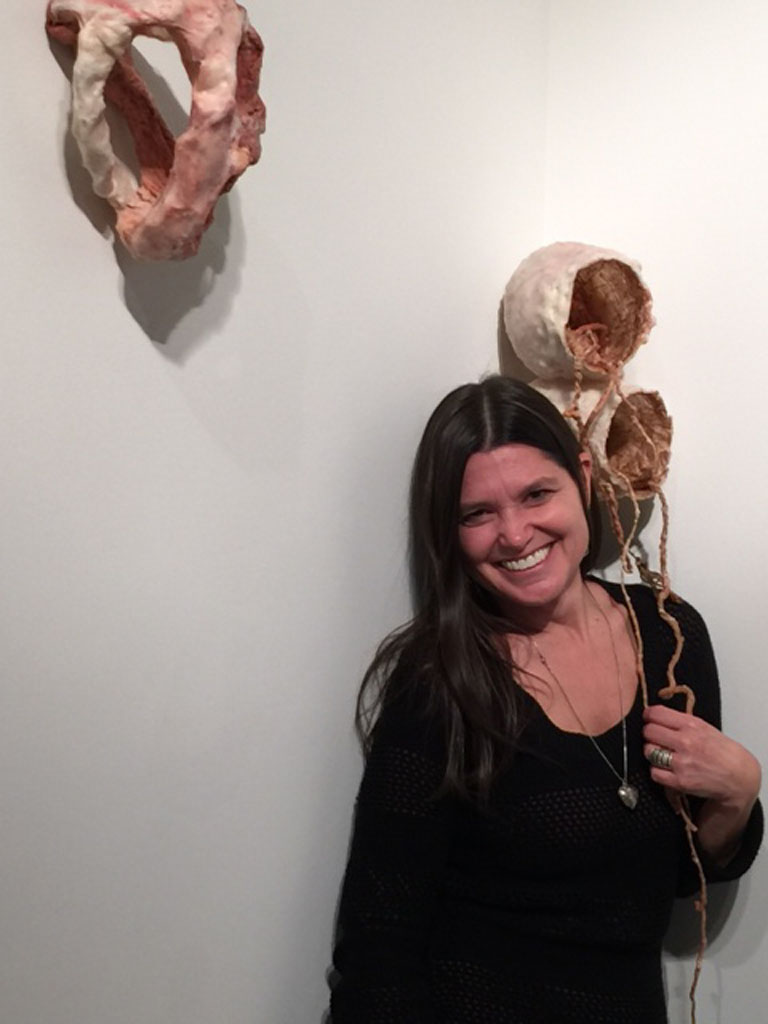
These are words that Nina Caruso, a mother of three children, wrote in her thesis paper. She is finishing her bachelor’s for Studio Arts Education at Oakland University, which would qualify her to teach K-12 for art. Next year she and her daughter will be graduating college.

I met Nina years ago at a poetry group and as mothers trying to pursue our passions, we immediately connected. I remember at the time Nina was working full-time as a pre-K teacher with the Waldorf Education.

“The economy went bad, and it was not picking up again,” she said. “The school lost many families and they let some of the teachers go.”

Nina was one of the teachers they let go and that was a blessing in disguise. Otherwise, she would not have pursued her dreams.

“As mothers, we don’t get rewarded for our hard work,” she said. “By going back to school, I was rewarding myself. It was very cathartic. You have to feed yourself or you’ll burn out.”

Last week Nina’s work was part of an exhibition at Oakland University, where seniors show their work. I was sent an invite, and reading her name on the exhibitor list, I was impressed and inspired by her accomplishments. I called her and asked, “How did you do it?”

“I feel it’s important for people not to brood about the bad and to do what’s good,” she said. “It’s all work anyways. Whether you go against the current or fight for the good – it’s all work.”

While Nina is a little sad to be finishing the coursework she really enjoyed, she’s ready to enter her major as a teacher.

“I look at an artist and an educator as the same,” she said. “Educators are very creative in how they teach students to learn and artists find ways to enter into people’s sensory experience for them to learn. It can meet us where we need to be met. There are no rules. The artist might have had an intent but the receiver or viewer will get what they needed out of it.”